














The Ultimate Guide to Affiliate Marketing [2026]
Published By John Desyllas
September 11, 2020

11/09/20
Who hasn’t dreamt of making a living from passive income? Sounds hard to believe, but there’s a (totally legal) way to make the dream come true: affiliate marketing.
If you’re looking for the catch, there isn’t one. Affiliate marketing allows you to generate a steady income online. But to make it happen, you have to take it one step at a time and leave nothing to chance.
In this guide, you can find everything you need to streamline it. After that, you’ll be on the fast track to becoming a full-fledged affiliate marketer.
Steady income, your way
From signup to sales, manage every step with Moosend’s versatile tools.
Start for freeWhat is Affiliate Marketing?
Affiliate marketing is a business scheme where businesses partner with individuals or other brands called affiliates. These third-party marketers become company representatives who promote the brand’s products or services online while businesses reward them with commissions.
The whole concept is based on revenue sharing.
A company offers incentives to its promoters to gain visibility, drive traffic, and boost sales for its products. If affiliates succeed in their digital marketing efforts, the company gives them a share of the profits. So everybody wins.
For example, a travel blogger could collaborate with a travel agency to recommend tour packages. Through the blogger’s content, the agency reaches readers who may be looking to plan a trip to increase its booking rates.
How Does Affiliate Marketing Work?
The “mechanics” of affiliate marketing are easy to grasp.
Here’s how it works:
- The retailer creates an affiliate program and specifies the commission rates and types. They provide a unique link to each affiliate so the brand can later track the sale back to the right person.
- The affiliate promotes the company’s products or services through their content, which includes the link mentioned. The action required might be purchasing a product/service, signing up for a free trial, or subscribing to a newsletter.
- A visitor clicks the link and a cookie is stored on their device. This cookie allows brands to link the activity to the affiliate so they’ll get paid even if the customer doesn’t convert at the time (depending on the cookie duration).
- The business tracks the conversion through the affiliate link and pays the affiliate partner the commission they’ve agreed.
Let us give you an example.
You’ve watched a video of PewDiePie and clicked on his affiliate link bringing you to NordVPN’s website:
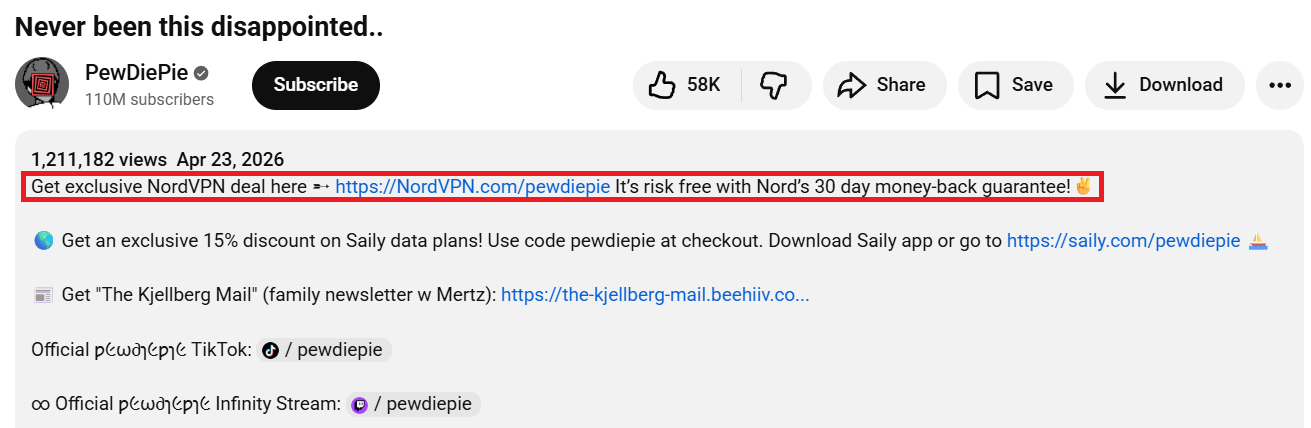
You checked the product out but didn’t purchase it. A cookie is stored on your computer. A few days later you go back to NordVPN’s site and buy the product.
PewDiePie will still get his commission because of the 30-day cookie duration policy of NordVPN.
Affiliate Marketing Payment Models
There are different payment models in affiliate marketing, depending on the company’s priorities.
Here are the main commission structures that businesses use:
- Pay per Sale (PPS): This is the most popular type, rewarding affiliate marketers for each sale generated through the referral link. Here, the business priority is none other than driving sales.
- Pay per Lead (PPL): In this model, affiliates earn a commission after visitors click on a link and complete an action, such as downloading a resource or signing up for a free trial. From the company’s perspective, the goal is to acquire qualified leads.
- Pay per Click (PPC): Affiliates get paid for every click on the link that directs users to the business website, regardless of whether they’ll take further action. Brands use this model less because increasing traffic isn’t usually as effective as generating leads and sales.
Why Become an Affiliate Marketer?
Affiliate marketing is a business model with significant benefits, especially for content creators, influencers, and anyone who wants to target audiences online without working 9-to-5.
Let’s see why this marketing channel is worth your while:
Convenience & flexibility
Affiliate marketing offers a ton of flexibility to creators who want to make money online. As an affiliate, your role is to educate customers and sell products without stressing over R&D, keeping stock, or providing customer support.
Once you link the seller with the customer, you’ve done your part, and in time, you can enjoy the fruits of your labor. Since you’re practically a freelancer, you are free from restrictions like fixed schedules.
This means you can:
- Set and adjust your own goals
- Determine your working hours
- Collaborate with multiple partners
- Diversify your portfolio according to your preferences
But the most important thing is you can work from anywhere. No need to go to the office every day and lose hours commuting. It might be the comfort of your home or you can be a digital nomad in search of your next destination.
The only thing you need is a stable internet connection and a solid content marketing strategy.
Low cost and risk
Most affiliate marketing programs are free to join, so you don’t need to worry about pouring your savings into this venture.
Practically, this means you can start earning money by promoting an established affiliate product with little or even zero upfront investment. Moreover, by choosing appropriate marketing methods (e.g., blogging, SEO) you can keep costs to a minimum down the line.
As you build and engage your audience, you’ll use your content to recommend the affiliate partner’s program without the risk of losing anything but your time. This certainly won’t be an issue if you do things the right way.
Passive income
For most affiliates, the simplicity of generating passive income is the greatest benefit of this model.
They just need to invest a set amount of time and effort in an affiliate campaign. In return, they’ll have a steady, recurring income, as customers will continue buying the product long after the campaign launch.
Also, you can strategically choose to join high-ticket affiliate marketing programs or work with many businesses for better earning potential.
Multiple revenue and expansion opportunities
One of the main reasons why affiliate marketing is a lucrative revenue stream is that affiliates can sign up for various programs and earn commissions from all of them.
This offers you the freedom to promote products from different companies and industries, which is a privilege a typical salesperson doesn’t have.
As your target audience and authority grows, so does your reach. For example, if your focus is food blogging, you can start by promoting restaurants. As you scale, you might expand into meal subscription services or delivery apps.
Performance-based rewards
In most regular jobs, you receive the same paycheck at the end of each month, at least until you get a raise. But in affiliate marketing, your earnings depend purely on your performance.
By writing engaging content, improving your skill set, and building trust with your audience, you’ll gradually see your revenue go up.
So the more you put into affiliate marketing, the more you’re going to earn. Your hard work is the only variable that matters, which isn’t affected by how the company or your coworkers perform.
How To Become an Affiliate Marketer?
Now that the theory is clear, we’ll share a step-by-step guide on how to actually become a successful affiliate marketer.
1. Decide on your affiliate niche
With 70 million blogs created on WordPress alone each month, finding your niche plays an integral role in affiliate marketing success.
The most popular advice is to niche down. Surprisingly, the first thing to consider isn’t just your expertise level but also what you’re passionate about.
For example, if you’re into gardening, a blog sharing planting tips and reviewing tools is a good fit.
This genuine interest helps you connect with like-minded people whose needs you understand firsthand. As a result, you’re more likely to produce content and promote products/services that solve their pain points. Talking about something you care about also allows you to push through bumps in the road.
But is passion really enough? No, since you’ll need to be somewhat familiar with the topics you’ll cover. Even if you don’t know everything at the start, you should stay up to date with the latest developments and keep learning to become an authority in your field.
Another important factor is choosing a niche with solid earning potential. You’ll want a sufficient audience, but not an oversaturated space since fierce competition can make it harder for your content to stand out.
2. Select your marketing channels
You may be new to marketing and not know which channels to use for your affiliate partnerships. Or you may already have a successful blog or YouTube channel, but want to expand your reach.
Whatever the case, here are some key marketing channels to get traffic for your affiliate promotions:
- Blogging is a relatively easy and cost-effective way to attract and build a loyal audience. Due to its popularity, you can find many guides to help you get started. Now, the typical cost of running a blog is fairly low, depending on the hosting provider. Once set, focus on creating high-quality content, such as how-to guides or product reviews. You should also optimize your content for SEO by doing keyword research and analyzing top-performing pages in SERPs.
- A YouTube channel allows you to create and upload video content for free. Videos have the power to convey ideas quickly and simply. For example, a video tutorial is an excellent way to show how products work and persuade visitors to click on the affiliate link in the video description. Also, keep in mind that YouTube is the second largest search engine (below Google), so following SEO best practices is key to reaching a wider audience.
- Social media marketing platforms help you connect with a large following and promote your partnerships through various content types like stories or posts. Depending on your niche and audience, create an account on Facebook, Instagram, or TikTok, or just monetize your existing channel. Facebook might be better for community building, while TikTok works better for short, lighthearted videos. Always check each platform’s guidelines for sponsored content to avoid penalties.
Of course, it’s not an either-or matter, since you can combine a blog with a YouTube channel like Anastasia Blogger does, or use any other mix that fits you.
Email marketing gives you extra opportunities to promote your content and build long-term bonds with subscribers.
Want to learn more on what affiliates can do with newsletters and email marketing software? You can watch Anastasia’s case study explaining how she leverages Moosend’s features to connect with her audience.
3. Find and join an affiliate program
There are various programs to select, depending on the niche and types of products you want to promote. Each program comes with its own commission rates, structure, and target audience, all of which can affect your earning potential.
For example, low-paying programs with mass appeal usually focus on lower-priced consumer goods, such as games or everyday items. An example is Amazon’s affiliate program, known as Amazon Associates.
On the other hand, high-paying programs with a smaller pool of potential customers often relate to niche products. These tend to be more competitive and are common among SaaS businesses, such as Moosend’s Affiliate Program:
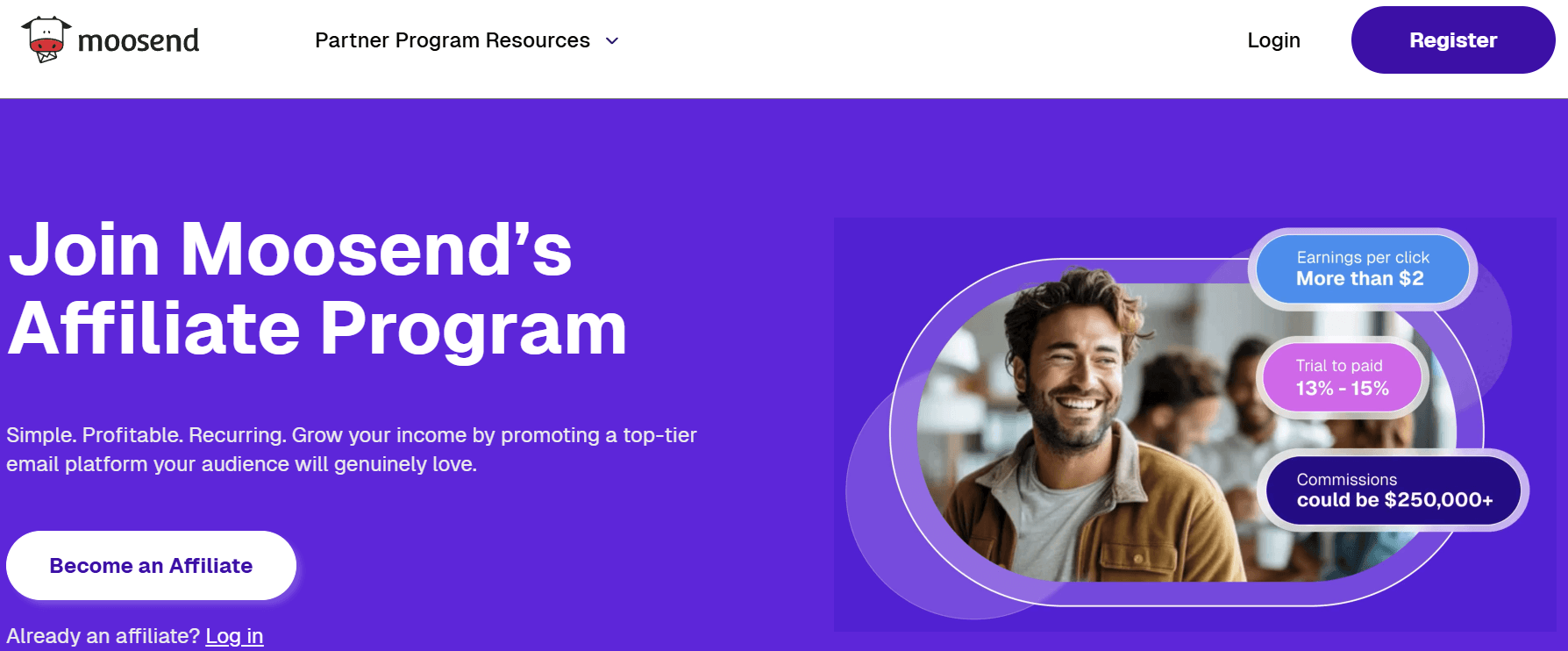
There are also programs that combine high payouts with mass appeal. These are typically more suitable for experienced affiliates. TripAdvisor’s Affiliate Program, for example, is considered high-paying while offering a broader reach.
Now, where can you find these programs? The easiest way is to join an affiliate network or platform that acts as an intermediary between merchants and affiliate marketers.
Here’s a list of the most popular ones:
- ShareASale
- Amazon Associates
- RevenueWire
- CJ Affiliate
- Rakuten Advertising
- PartnerStack
- Clickbank
- FlexOffers
These networks provide useful insights into product performance, making it easier to decide what to promote. If you’re new to affiliate marketing, stick with two or three platforms so you don’t feel overwhelmed. As you scale, you can expand and manage more partnerships.
If you prefer the direct approach, start with companies whose products you already use and love and check whether they have an affiliate program. You can do a Google or LLM search with the brand name and “affiliate program.” Alternatively, visit their website and look for partner or affiliate pages.
Even if they don’t seem to have an affiliate program, you can always approach companies whose products you wish to promote. They might be willing to partner with you if you have a clever idea, a strong presence, or a relevant audience.
4. Create quality content
Next comes a difficult stage in the affiliate marketing journey, which is to cut through the noise among hundreds of blogs, videos, podcasts, or any other content type you’ll use.
What should guide your content decisions? The answer is simple: your audience. To provide high-quality content, you should know their needs and pain points. Then, create content that addresses them and goes beyond what they can already find on the merchant’s website.
Here’s how you can do that:
- Keep in mind that quality beats quantity every time. One or two in-depth pieces that match user intent are more likely to result in traffic and loyalty compared to four or five that feel generic and poorly crafted.
- Give them unique insights they can’t find elsewhere. Any promotion is as good as the data backing it up. Consider conducting your own research and showcase results with reports or case studies. You can also turn this material into a lead magnet to grow your email list while providing value from the early stages of your relationship.
- Use simple and conversational language. Being an industry expert is always a plus. This doesn’t mean you should use business jargon and complicated terms to list benefits and features. A conversational tone and easy-to-grasp language ensures that your message gets across and your audience can tell what’s in it for them.
- Offer a flawless user experience from start to finish. This includes double-checking for grammar errors, broken links, slow-loading assets, or poor-quality visuals. When using text, improve readability with short sentences and paragraphs, white space, bullet points, and information hierarchy.
- If you’re creating content like product reviews or comparison listicles and your budget allows it, buy the product yourself. Consumers will appreciate the authenticity and hands-on knowledge in your content.
- Place your affiliate links early in your content. People rarely read an entire blog post or sit through an entire video or podcast, so you’ll want to grab their attention when it’s at its peak. For blogs, that would be within the first quarter of the post, while for videos within the first minute. Also, ensure your content “hosts” your links in a natural way so your content doesn’t look spammy.
Pro tip: It may be wise to utilize an affiliate tracking plugin, such as PrettyLinks, allowing you to organize, track, and shorten your links.
5. Include an affiliate disclosure
Whichever platform you may choose for your efforts, always disclose the fact that you’re using affiliate links. This is crucial since the Federal Trade Commission (FTC) dictates that endorsements resulting in affiliate income must be transparent and in no way misleading.
If you have a blog, include this information at the bottom of your homepage or, better yet, include it in a standalone Privacy Policy page. Just like Adam Enfroy does:
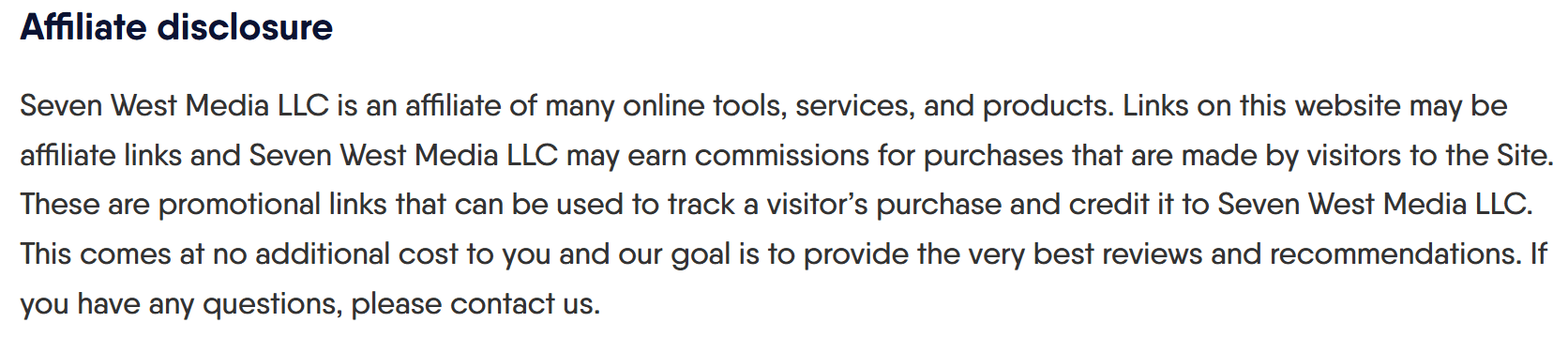
On YouTube, you can display it within the video content so no viewer misses it or disclose it in the description. But we definitely recommend the first option since the information could get lost for visitors who don’t check video descriptions.
On social media platforms, you can add the disclaimer in the description and include #ad or #sponsored to be extra clear. However, the best course of action is to place the disclaimer in your bio or within the content for the same reason discussed above.
6. Generate traffic
Now that you’ve nailed content creation, it’s time to get the word out to both existing and prospective audiences. Thankfully, you have several tactics at your disposal to attract more traffic to your affiliate promotions.
The first powerful tool in your arsenal is search engines. You can drive traffic to your blog, site, or YouTube channel organically. Simply put, without paying anything.
Since people naturally look for information online, you can start by identifying and targeting specific keywords that people are searching for. Then, creating high-quality content that matches their intent will get you consistent traffic.
Always invest time in link building, for example in the form of blog posting, to increase your search engine rankings. Also, make sure to stay up to date with algorithm changes and updates that may affect your place in SERPs so you can adjust in time.
Once your affiliate marketing business gets going, you can leverage Pay-per-Click (PPC) ads depending on your budget. Paid advertising has the advantage that you only have to pay if somebody clicks on your ad.
This makes paid ads a great strategy, especially if you use high-paying affiliate programs. But for new affiliates or those with budget constraints, it might not be the best option.
As opposed to paid ads, email marketing is a great fit for every budget and expertise level. It starts with picking an affordable email service that will help you build and grow your email list.
But most people want something valuable in return to provide brands with their email address. Target visitors with subscription forms triggered when they scroll through a page or try to exit it. In your form, make sure to highlight the benefits of becoming a subscriber, such as exclusive access to resources.
You can also use a lead magnet, just like SmartBlogger does in this exit-intent form that promises visitors a free writing cheat sheet in exchange for their email address:

It doesn’t end there, though. To keep your audience engaged, send them regular news and updates through an informative and entertaining weekly or monthly newsletter.
To make this happen, you don’t need many tools. You can sign up for a Moosend account and start using its segmentation and lead generation functionality, built-in newsletter templates, automation workflows, and reporting tools to get the most out of your campaigns.
7. Monitor progress and study trends
Without tracking your affiliate marketing performance, you’re moving blindly. You should monitor analytics on a regular basis, using metrics provided by your affiliate network, Google Analytics, and affiliate tracking plugins.
This way, you’ll know:
- The links getting the most clicks
- The content types performing better
- The sources bringing in more traffic
- The products/services converting
With this information, you can identify which tactics you need to invest more in, and which ones don’t bear fruit.
On top of that, it’s important to study new affiliate marketing strategies and trends, like the growing role of AI in marketing. You can do so by subscribing to reputable industry newsletters, visiting niche blogs and social media channels, and participating in conferences.
Also, make sure to stay ahead of algorithm changes in search engines and social media platforms so you can pivot accordingly.
How to Choose the Best Affiliate Program
One of the reasons why affiliate marketers fail is because they choose the wrong niche or the wrong products to promote. So, whether affiliate sales are an alternative revenue stream or your main source of income, it’s crucial to select quality affiliate programs.
Worry not, though. Here, we’ll share the key factors that help you identify the best affiliate programs for you and your audience.
Commission rates
This is probably the most important factor in every affiliate marketer’s mind. And with good reason, since the more a program pays, the more income you earn.
Typically, commission rates in eCommerce affiliate marketing programs go up to 20%, while digital products, such as SaaS or courses, may offer up to 40%.
Although high commission rates are tempting, they don’t ensure long-term profit on their own. You should also consider the effort required, as selling a high-priced product is more difficult than selling a cheap one.
Also, you may have more chances with low-commission products or services that convert well and have a strong market reputation.
Commission type
Besides the payment models discussed above like PPL or PPC, affiliate commissions can be flat or recurring.
In the flat commission model, the company pays you one time for the sale. This is more common for physical products.
In recurring commissions, things differ a little. You earn a commission every time a customer uses the product or renews their subscription. These recurring payments are popular among SaaS companies and subscription businesses.
Cookie lifetime
This metric represents how long the cookie is stored on the visitor’s device. Is it a day, a week, or a month?
Cookie duration plays a significant role in maximizing your affiliate efforts. That’s because not all consumers are ready to convert the moment they click on your link. A longer period ensures you’ll get paid for those who postpone their buying decisions.
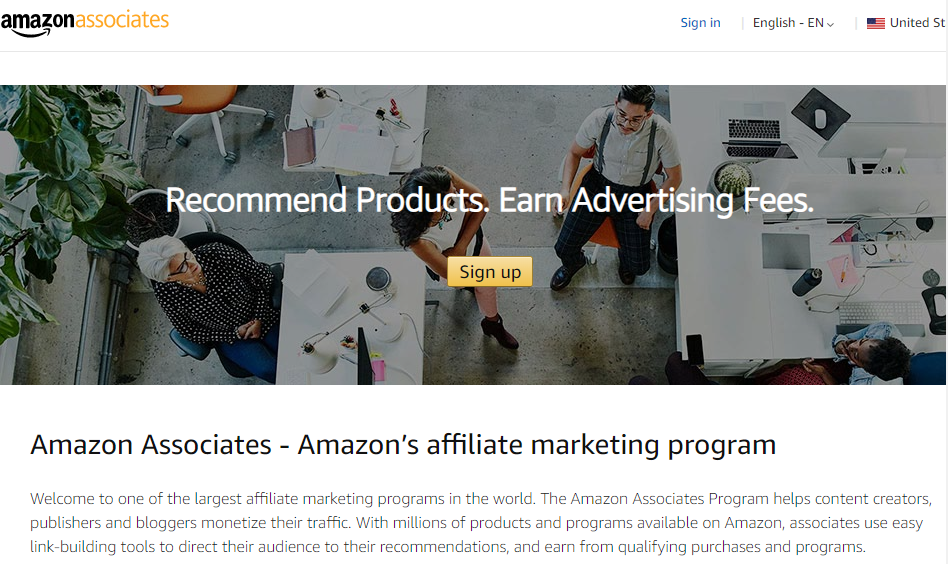
Amazon Associates program, for example, offers a 24-hour cookie window. If the customer buys from your link within that window, you get your commission. The same goes if they add products to their cart and complete the purchase within 90 days.
While relatively short, the broad range of products offered is a decisive factor for affiliates choosing this program.
Niche relevancy
Your audience always comes first. Without them, you have no sales, hence no affiliate commissions.
So, before anything, you should pick products or services that align both with your audience’s needs and content topics. Answer questions like: “Which of their pain points do the products solve?” upfront, and start thinking of ways to showcase this in your content.
If your promotions feel irrelevant to your audience or you create different content just to sell high-commission products, it could easily break trust and damage your authority.
Payment specifics
There’s more to how you’ll get paid than commission rates. For example, do you need to provide a bank account or can you receive commissions through PayPal or checks?
Max Benz, Founder at BankingGeek, also highlights the currency issue: “When you make the decision of how to receive your well-earned affiliate money, you should also make sure that your bank account accepts the currency used by the affiliate program. Most of the time, you’ll have programs paying in USD but there are also exceptions.”
Now, if it’s a recurring model, make sure to check how often you’ll receive payments.
Lastly, it’s good to know if the program you aim for has a minimum payout. For example, a program with a minimum payout of $1000 and a typical commission of $10 requires time and a solid audience to reach the threshold.
Marketing resources
Affiliate marketers usually have to handle communication, content creation, monitoring, and more by themselves.
But if the brand provides resources that help you promote their products with ease, you save time and effort while maintaining consistency and authenticity.
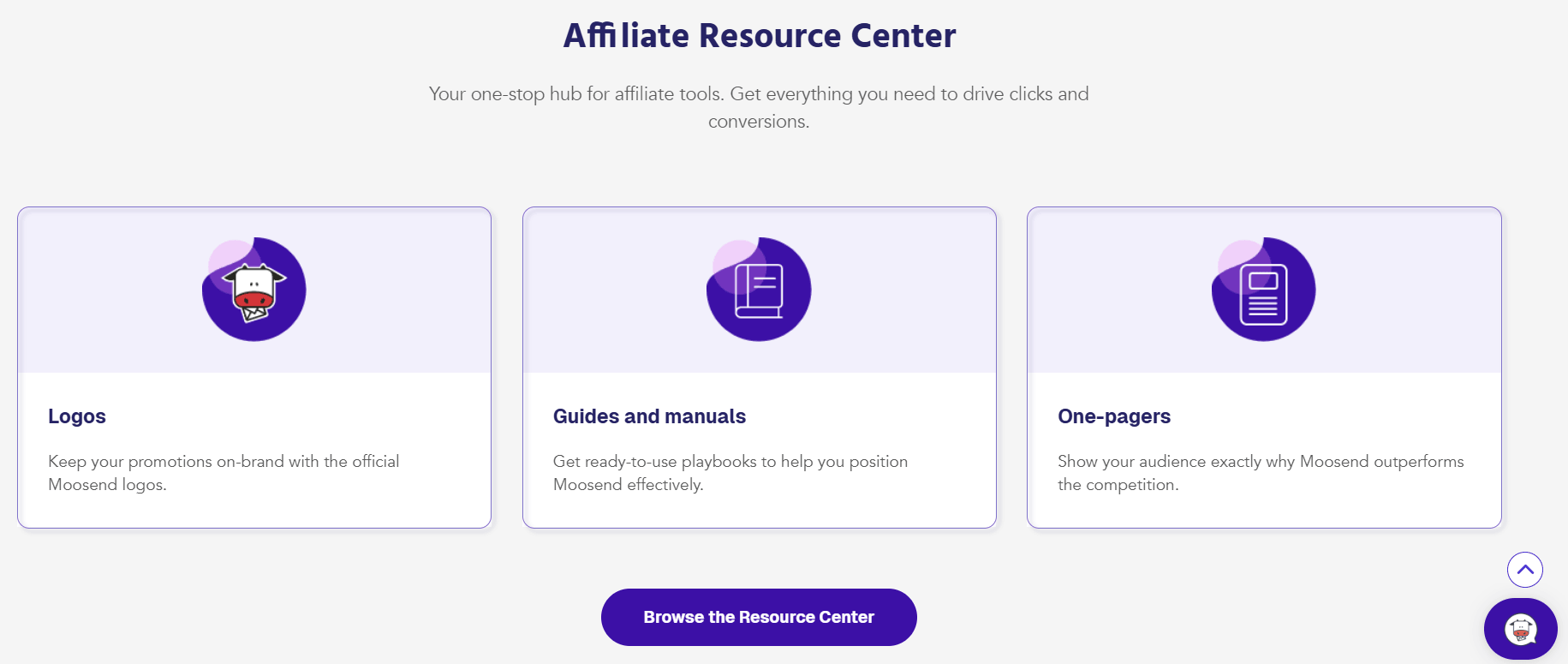
Look for programs that offer material like logos, product images, and email templates to help you achieve conversions. Your job will also get easier with training resources, such as product demos, and dedicated affiliate support, so even beginners can familiarize themselves quickly.
For example, Moosend gives access to affiliate program resources like company logos, banners, manuals, and one-pagers:
Restrictions
Some brands set certain restrictions to ensure the most suitable affiliates enter their programs.
One restriction has to do with the marketing tactics you can use. For example, some businesses may not allow paid ads as a promotion channel. Geographic restrictions are also common, since some companies limit their scope to marketers from specific regions.
Other companies also require a well-established presence, for example in social media if you’re an influencer.
Such restrictions can narrow down your options between programs with similar characteristics but stricter eligibility criteria.
Promotion and conversion rates
While you can influence clicks, the final conversion depends on the merchant. It comes down to the strategy used by the company to encourage sales. Do they capture attention with an engaging video or just use a mundane landing page?
If there’s no real effort to “secure” the sale, then the product will have poor conversion rates. This is why you should prefer to market products that convert well even if their commission amount is low.
If information about affiliate programs is scarce, you can also inquire and learn specifics to decide whether their program is worth your time.
Competition
Last but not least comes the competition you’ll face, meaning how many people are actively promoting the product. If you’re new and the program you like seems saturated, maybe you should choose another one.
Established brands are definitely a go-to, but don’t ignore new, promising programs looking for affiliate partners to enlist.
On a final note, don’t ignore your “gut” feeling. If a product or program feels sketchy, or you wouldn’t refer it to a friend or family member, then you’re better off not promoting it.
Best Affiliate Programs Per Industry
There’s a plethora of competing products or services in every industry, so finding the affiliate program that stands out can get tricky.
To help you identify the most effective ones, we hand-picked the best affiliate programs for various industries.
| Affiliate Program | Commission Rate | Commission Type | Sign Up | |
| Email Marketing | Moosend | Up to 40% | Recurring | Click here |
| eCommerce | Amazon Associates | 10% | Flat | Click here |
| Web hosting | Bluehost | Starting at $65/sale | Flat | Click here |
| Social media marketing | SocialPilot | 20% | Recurring (for 1 year) | Click here |
| Online courses | Teachable | 30% | Recurring (for 1 year) | Click here |
| Website builder | Brizy | 30% | Flat | Click here |
| VPN | NordVPN | Up to 100% | Recurring | Click here |
Best Affiliate Networks
Affiliate networks help you analyze performance and make accurate decisions about which program to promote based on real metrics instead of guesswork.
Therefore, finding the network that best suits your needs is of the utmost importance.
Below you can see a table that sums up some of the most popular and established affiliate networks.
| Network | Niches | Fees | Registration |
| Clickbank | Digital products, Self-Help, Health & Fitness, Lifestyle | No fee | Click here |
| CJ Affiliate | Automotive, Electronics, Software, Home | No fee | Click here |
| Awin | Retail, Finance, Telecommunications, Travel | No fee | Click here |
| Rakuten Affiliate Network | Beauty, Fashion, Finance, Software | No fee | Click here |
| FlexOffers | Electronics, Travel, Automotive, Family & Education | No fee | Click here |
Build Connections
We’ve demonstrated that the possibility of passive income is real. But don’t rush to quit your 9-to-5 job and expect results as soon as you build a blog or Instagram account.
Instead, do thorough research, join affiliate communities, reach out to companies, and make connections. It’s equally important to learn what your audience wants and choose products or services that help them reach their goals.
Above all, successful affiliate marketers aim for authenticity. So, the best business decision is to become an advocate of brands and offerings you feel strongly about. Buy them and use them yourself so you can give your audience the exclusive, inside information they need to trust you and click on your links.
FAQs
Now let’s look at some answers to common questions about affiliate marketing.
1. How much does it cost to become an affiliate marketer?
The short answer is nothing. Most affiliate programs and networks are free to join, requiring no upfront investment from the partner. But some companies set eligibility criteria for affiliates, such as having a blog, mobile app, or social media channel. So, you might need a small budget for web hosting, video creation, and other essential tools. Alternatively, look for free options to get started.
2. Is affiliate marketing illegal or risky?
First things first, it’s a completely legal marketing model. To ensure transparency and compliance, you have to disclose the affiliate relationship within your content or social media profile. The risky part is that your income may not be as stable as that of a regular job. But if you partner with multiple brands and pick niches relevant to your audience’s needs, chances are you can earn more as you grow and improve.
3. How much money can affiliate marketers make?
There are many factors that affect the income you make as an affiliate, such as the niche, products or services promoted, the brand’s commission rates, and your audience size. Some partners use affiliate marketing as an extra revenue stream that brings in a few hundred dollars occasionally, depending on the effort. However, those who take it seriously and join high-ticket affiliate programs or collaborate with many brands can achieve significant earning potential.
Similar Posts

 Published by

 Published by


Create, send and optimize your email marketing campaigns