













How to Use UGC in Emails: Examples & Templates [2026]
Published By Alexandra Marinaki
July 15, 2026

15/07/26
You spend hours crafting the perfect email. You polish the visuals and fine-tune every word until the message feels just right. But even with a “perfect” design, something is often missing.
In many cases, that missing piece is simpler than it seems: trust.
Before making purchase decisions, most consumers look for social proof. Whether it’s a real customer testimonial or a 10-second unboxing video from TikTok, user-generated content (UGC) often builds credibility faster than a studio-shot campaign. Instead of telling your audience you’re the best, you let their peers prove it.
In this post, we’ll show you how to use UGC in your emails successfully. From high-converting use cases to valuable marketing tips, here’s how to make social proof the most organic and profitable part of your campaigns.
Enrich your emails with UGC
Use Moosend’s pre-made templates and drag-and-drop builder to design memorable campaigns.
Start for freeWhy UGC Can Make Your Emails Stand Out
If you’re skeptical about adding user-generated content, these benefits will clear the air:
- Stops the “scroll-past” effect: Considering how many emails land in an inbox, and how similar most promotions look, scrolling past them is inevitable. But an authentic photo or video from a customer stands out. It feels like something a friend would send, which naturally makes people stop and look.
- Proves you’re authentic: Since many brands rely on polished studio images and AI-generated copy, using raw imagery and real customer quotes makes your brand feel more relatable. It’s proof that your products work in the real world, not just under perfect lighting.
- Increases trust: No one wants to be the first to try a new product or service. User-generated content reassures prospective customers that they’re making a great choice, giving them the confidence to move faster to checkout.
- Adds a human touch: It’s hard to resonate with a logo. Sharing stories from real people who use and trust your products is like a friendly recommendation. It builds a connection that a standard sales pitch simply can’t match.
The bottom line? UGC shifts the focus from what you say about your brand to what the world says about it. Being real is your biggest competitive advantage.
Common User-Generated Content Types
To use UGC effectively, you first need to identify the different types of content available and what will resonate most with your audience. Here are the most common options:
- Photos & short videos: This includes raw smartphone captures, such as lifestyle images, unboxing reels, or vertical clips showing the product in action.
- Written reviews & ratings: Testimonials and star ratings from popular review sites can work wonders, especially when paired with “Verified Buyer” badges or indicators like date and location to prove authenticity.
- Social media mentions: Snapshots of your brand being mentioned on platforms like Instagram or TikTok can capture real-time hype around your products.
- Customer stories: Longer narratives, such as case studies, can demonstrate the real impact your products or services have on a customer’s life.
- Gamified user content: Interactive elements, like community polls or “voted by you” product designs, help build trust through the power of real-time data.
- Micro-influencer endorsements: When not part of a paid partnership, content from niche creators can offer more authority than a casual customer post while remaining more relatable than a professional ad.
The good news is that adding UGC to your emails doesn’t necessarily require coding or design skills. With the right email marketing platform, you can easily combine automation and design tools to bring these ideas to life.
For example, tools like Moosend offer ready-made workflows and a drag-and-drop editor to get you started quickly. Feel free to sign up for a 30-day free trial and see how it suits your needs.
Top UGC Email Campaigns & Use Cases
Which email types benefit most from UGC? The short answer is any campaign where you want to see higher conversion rates. Here are the most effective use cases, along with examples from notable brands to inspire your next send.
1. Welcome emails
First impressions matter, and that’s why adding UGC to your welcome emails can make a significant difference. Since new subscribers are often at their most engaged the moment they join your list, reinforcing that interest with social proof can be the final nudge they need to make their first purchase.
Triple Nikel, a veteran-owned apparel business, welcomes new subscribers with a time-sensitive discount paired with a “What they say about us” section. In it, new subscribers can read a genuine customer review alongside an image of real people wearing the brand’s T-shirts.
This not only showcases the quality, but also highlights the brand’s legacy. There’s no better way to kick off a relationship than by showing off happy customers from day one.
Subject line: Welcome to Triple Nikel!

2. Product recommendations
Instead of just listing a product to convince people to buy it, show it in action or feature the customers who already trust it. Enhance your “Recommended for you” section with best-selling items or customer ratings and reviews to sharpen your marketing message.
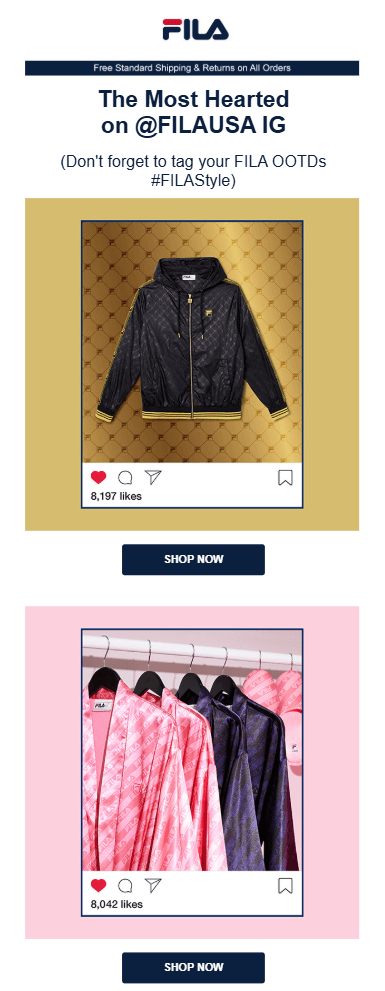
For example, instead of simply recommending its top products, FILA shared a campaign featuring the items that received the most likes on Instagram. They let recipients know exactly what the email was about right from the subject line. Plus, the clear “Shop Now” call-to-action buttons help turn that social proof into immediate conversions.
Subject line: Most ❤️’ed Instagram
3. Upsell/Cross-sell campaigns
If a customer has recently made a purchase, you can enhance their experience and boost your ROI with upsell or cross-sell emails. Instead of simply suggesting products they might like, invite them to join a successful community already using those solutions.
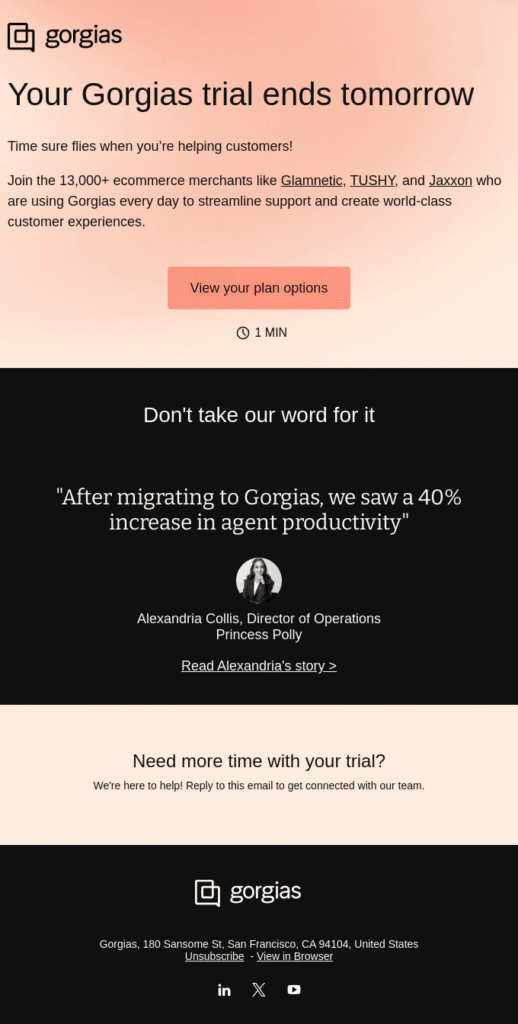
In this example from Gorgias, they invite trial members whose access is about to expire to upgrade by including a powerful quote from a current customer who saw a rapid increase in productivity. By adding the customer’s headshot and a link to the full case study, Gorgias provides the proof needed for those still on the fence.
Subject line: ⌛️ Your Gorgias trial ends tomorrow
4. Abandoned cart emails
Did you know that approximately 69% of abandoned cart emails are opened? Because these triggered messages receive such high traction, they’re the perfect place for social proof. Instead of a standard “You forgot this,” try a more compelling angle like: “See why [Customer Name] loves this.” Often, that’s exactly the motivation a shopper needs to head back to the checkout.
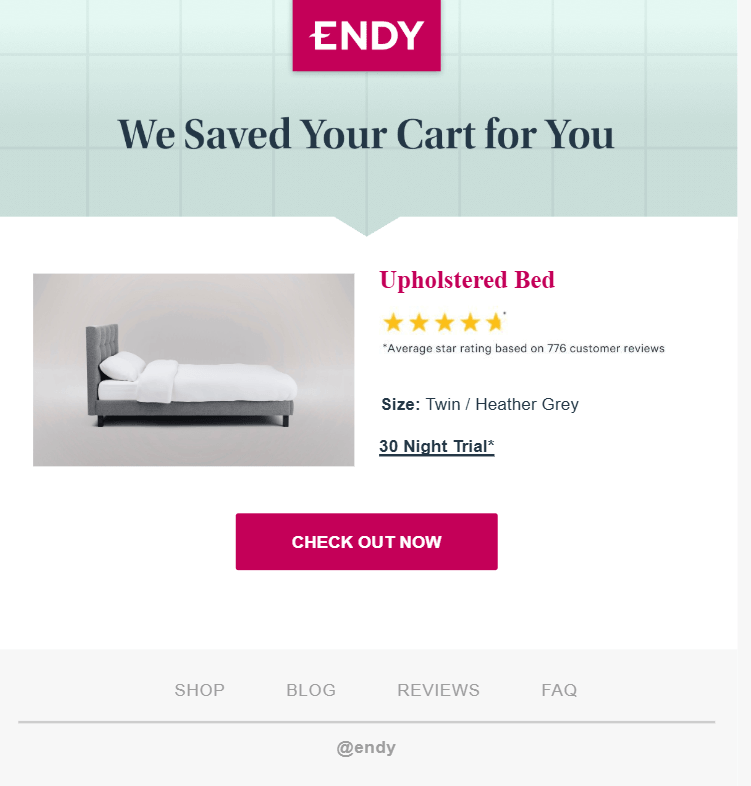
In their abandoned cart email, Endy embeds a high star rating directly next to the product image, including the total number of customer reviews. By showing that the product’s popularity is backed by thousands of real users, they instantly build the credibility needed to overcome prospects’ hesitance.
Subject line: It looks like you left something behind…
5. Seasonal newsletters
Given how hectic inboxes get during peak seasons like Christmas or summer, adding authentic voices to your emails can help you stand out. By using reviews or content from your community that truly resonates with your audience, you give your seasonal ROI a better chance to spike.
For instance, Oodie created a high-energy GIF featuring customer images and ratings to boost their Valentine’s Day sale. It’s the kind of content that’s hard to scroll past. This addition helps prospects visualize themselves using the product, making it much easier for them to hit “purchase.”
Subject line: 🌹 Valentine’s Day sale ends soon

6. Post-purchase emails
Reassuring your recent buyers that they made the right choice by sending a post-purchase email filled with pro tips or product insights is a great tactic. When this advice comes directly from the community, the perceived value is much higher. It transforms a simple transaction into the feeling of joining an active, supportive circle.
After a CTA button that links to educational content, Sundays shared reviews from real customers, each with a happy pet’s headshot to engage pet owners.
Subject line: Get ready for the good stuff!

7. Lead nurturing campaigns
Most SaaS businesses invest in moving leads down the funnel, and nurturing emails are an important part of that process. To remove any hesitation regarding your service, provide user-generated content at key decision points to turn prospects into users. For instance, triggering these emails for people who have recently browsed your pricing or product pages can effectively move the needle.
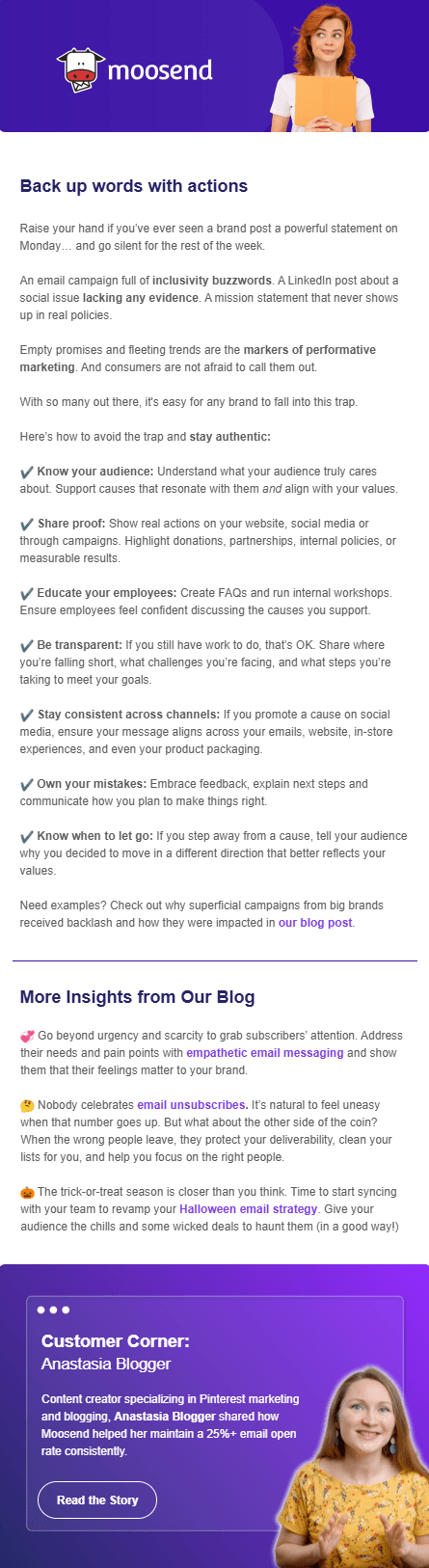
In Moosend’s monthly newsletter, for instance, we feature top-performing posts from our blog. We often include compelling customer stories to subtly encourage those who haven’t signed up yet to give us a try, while showing existing users how to get the most out of our platform.
Subject line: Don’t Be That Brand 🤦
8. Re-engagement emails
When a subscriber hasn’t opened your emails for months, a simple “We miss you” is usually not enough. To truly win them back, follow that sentiment with evidence from authentic voices on why your brand is still worth their attention. Including testimonials from real customers can remind them of the value they’re missing and spark a new reaction.
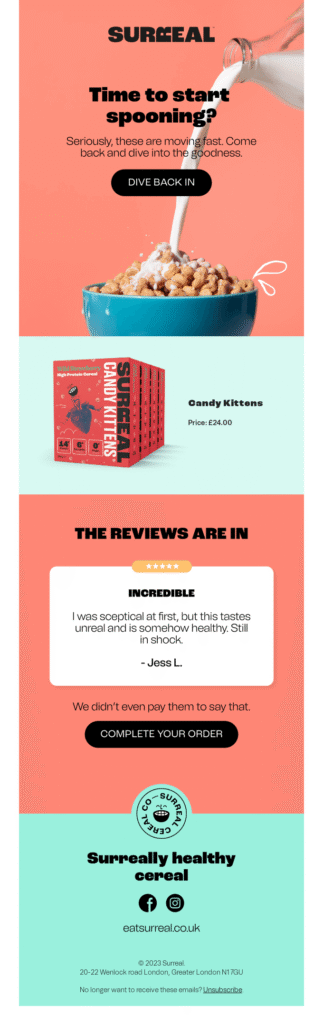
Surreal, the cereal brand known for its uniquely witty tone, shared an honest review in a recent re-engagement campaign. It perfectly reflects the recipient’s mindset, from initial skepticism to eventually liking the product.
Subject line: You’ve got Surreally good taste 👌
How to Collect High-Quality UGC
Ready-to-use reviews, especially high-quality visual content, are unlikely to reach you unless you’re actively looking for them. To start collecting valuable user-generated content, you need a streamlined strategy.
Check out these simple tactics to get started:
Track social media hashtags and mentions
Create unique branded hashtags and monitor what’s being said about your brand and products. Don’t just track direct mentions; look for the lifestyle being built around your brand. Also, choose content that doesn’t just show how good your products are, but how they actually feel and fit into your customers’ lives.
Beyond hashtags, use social listening tools like Brand24 or Sprout Social to monitor brand mentions and broader niche hashtags. When you find a great post, save it to build a mood board for future email campaigns.
Don’t forget to keep an eye on niche platforms like Reddit or Slack communities, too. A detailed recommendation in a private channel is often more “high-intent” than a public Instagram post, providing a deeper level of trust.
Set up post-purchase triggers
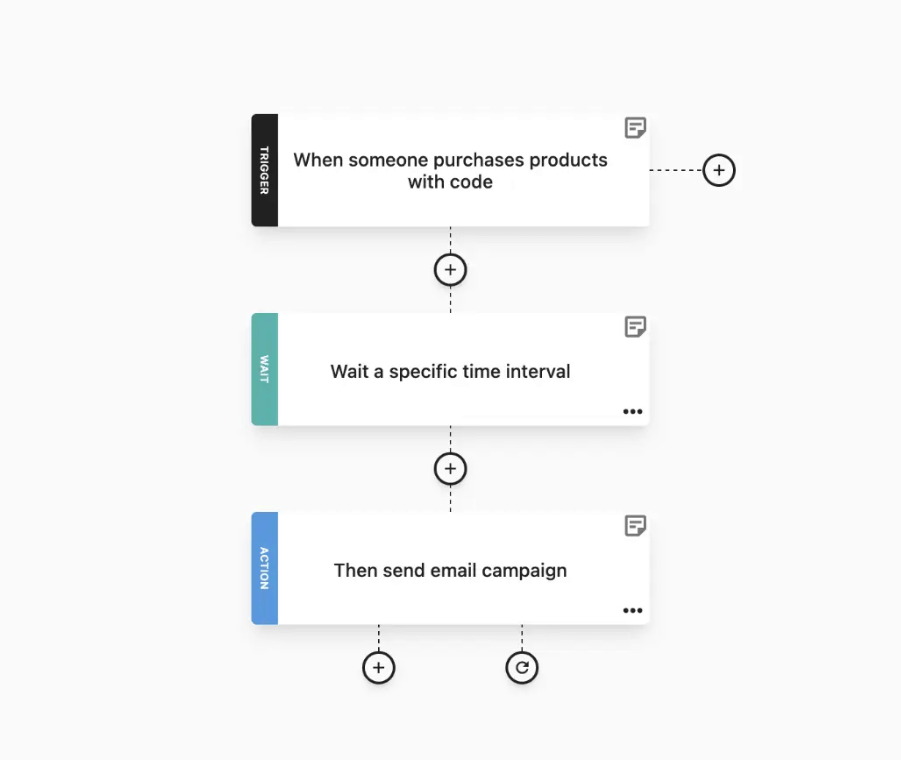
With email automation, you can trigger the right requests at the perfect moment. To collect UGC, you can schedule post-purchase triggers 24-48 hours after delivery to ask for unboxing content, or follow up 1-2 weeks later for more in-depth performance reviews.
Choose the content type that your audience is most likely to share, and then make the process frictionless. For example, you can embed a star-rating system directly in your email or provide a quick checklist on how to film a brief TikTok reel and successfully upload it.
To bring this UGC strategy to life, an email marketing platform with robust automation and design capabilities is essential. You can choose from pre-made workflow recipes and easily adjust the send criteria using if/then branching logic. This allows you to automatically follow up with customers based on their specific actions, or lack of them.
Share compelling incentives
If you’re looking for UGC that requires more effort, like high-definition video or a recorded podcast quote, it’s best to offer something in return to the customers who “join the mission.”
A tiered reward program is an excellent way to scale these incentives based on the level of effort required. For example:
- Written reviews: Offer free shipping on their next order.
- Video tutorials: Provide a 10% discount or a gift card.
- High-quality creators: Run a giveaway where anyone submitting top-tier UGC can win a high-value grand prize.
Keep in mind that in certain industries, especially SaaS, where your customers are often other businesses, status often outweighs discounts. Instead of a coupon, give them the opportunity to be featured in your next newsletter or dedicate a full case study to their success and share it across your social channels.
Check popular review platforms
Your best reviews don’t always live on your own assets, like your website or social media. External platforms, such as Yelp and Google, or G2 and Capterra for SaaS, often contain gem reviews you can proudly share with your audience.
Seek out 5-star ratings and generous testimonials and re-package them into brand-aligned graphics for your email campaigns. This is especially effective for written reviews that highlight your product’s unique features in a way your own marketing copy might miss.
Moreover, if your brand has gained enough traction, search YouTube and TikTok for “Best [Product Category] of 2026” videos to see if you’ve been featured. If you find a shoutout you love, reach out to the creator and ask for permission to share a snippet of their content in your next email.
Reach out to loyal customers
There’s no better advocate than a customer who has stood by your brand for years. These loyal members know your products inside and out. To tap into their trust, invite your top 1% into an ‘Insiders Circle.’
Give them early access to product drops in exchange for their honest, first-look reviews. By giving them a seat at the table, you aren’t just collecting content; you’re turning customers into co-creators who are eager to share their experiences with the world.
To save them time, share a dedicated landing page where they can easily drag and drop their videos and photos directly from their phones. This keeps the quality high and the process simple.
Best Practices for Adding UGC to Your Email Campaigns
Is simply adding UGC enough to make your emails more appealing and high-converting? How you apply that content matters just as much as the content itself. Follow these best practices to ensure your UGC-based email campaigns perform their best.
1. Secure explicit consent and rights
Authenticity requires integrity, so before displaying any type of UGC, you must obtain the customer’s consent. When you find a great post, reach out via email or DM to ask for permission to feature it.
To be as transparent as possible, provide context on where the content will appear. Try something like: “We love how you showcased our service! We’d be honored to feature your post in our next weekly newsletter.” Always keep a screenshot of their reply or use a rights management tool (DRM) tool to maintain digital proof of consent.
Keep in mind that under recent privacy regulations, users have the right to request the removal of their content at any time. While this is rare for email, it can be tricky when it happens. Since you can’t “unsend” an email, your best move is to replace the file at the source URL. By doing this, the photo will be updated (or disappear) the next time someone opens the email.
Want to learn more? Download our email privacy guide to dive into the most essential compliance rules.
2. Match UCG with the email context
Not every piece of user-generated content fits every email. If you sell bedding, for example, there’s no need to include a review about your linen sheets in a product recommendation email specifically for mattresses.
Make sure the UGC you choose aligns with the overall “vibe” of the email, including its design and core messaging. Audience segmentation plays a huge role here: if you’re sending different campaigns to Gen Z and Gen X, you might lead with a high-energy short-form video for the former and a detailed, authoritative written review for the latter.
Finally, when a specific product is featured in your UGC, ensure the CTA button leads directly to that product page. Making a customer navigate from your homepage to find what they just saw in a photo adds unnecessary friction and can cost you the sale.
3. Make social proof easy to spot
Why add UGC to your emails if it’s buried in the copy or hidden at the very bottom? Your subscribers should be able to identify a customer story at a glance.
Start by making your UGC stand out visually. You can replicate a social media UI frame (like an Instagram post layout) or add a “Verified Buyer” badge to differentiate from your standard assets. Additionally, when pairing social proof with a specific product, place them close together to strengthen the connection, while maintaining enough white space for a clean, scannable reading experience.
Finally, some brands use handwritten-style email fonts for quotes to give the impression they were written by real people. This small design choice makes the content feel more human and approachable.
4. Optimize for responsiveness and accessibility
Most users open their emails on mobile devices, so ensuring an optimal experience is non-negotiable. Make your UGC fully mobile-responsive by using vertical (9:16) or square (1:1) aspect ratios that naturally fit a phone screen.
Avoid using large files that slow down loading times and hurt the overall user experience. Instead, use modern formats like WebP to compress customer media without losing quality. Finally, to ensure your content is accessible to everyone, add alternative (alt) text to all images. This allows screen readers to describe your UGC to visually impaired users, making your brand more inclusive.
5. Ensure quality without over-editing
User-generated content doesn’t need to be perfect. In fact, it’s often more convincing when it feels raw and authentic. While light polishing of colors, audio, or typos is fine, the final output should feel like it was created by a friend, not a creative agency.
Make sure any modifications stay true to the original vibe. If you find yourself spending too much time trying to “fix” a specific customer photo, it’s a sign you should choose a different one. The goal is to find content that’s naturally high-quality, not to over-edit it into something that looks like a studio shot.
Pre-made UGC-based Email Templates
Most email marketing platforms provide pre-made, fully responsive templates to save you time. Here are a few standout designs from Moosend’s library that are perfect for showcasing user-generated content.
You can sign up for a free trial and use our drag-and-drop builder to customize these layouts to fit your brand in minutes.
Visual UGC email template
Enhance this eCommerce template with user-generated photos that showcase your brand in the real world. You can easily swap static images for high-energy lifestyle videos, just remember to keep your file sizes optimized so they don’t impact loading times or the mobile experience.

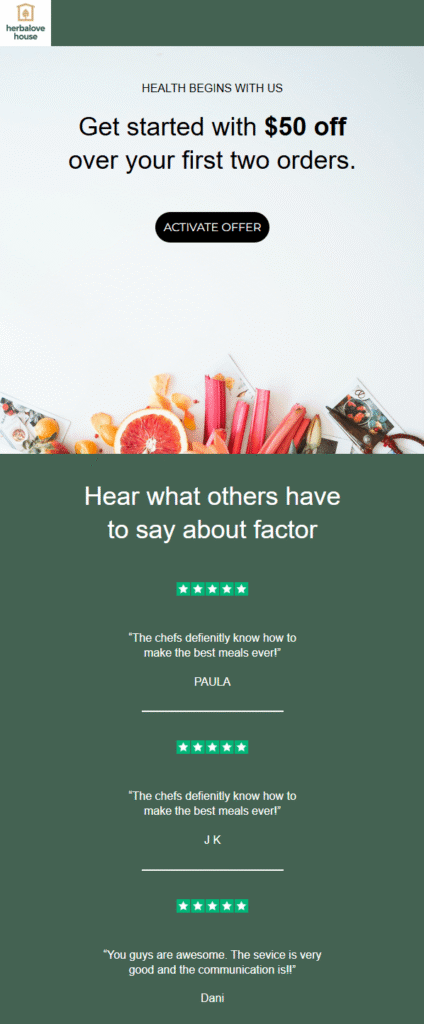
Written UGC email design
Customize this template to fit your brand’s specific goals, whether you’re in SaaS or eCommerce. You can easily include images, videos, or any other content type that resonates with your audience. With Moosend’s drag-and-drop editor, making these adjustments is simple and requires zero coding knowledge.
Real Stories, Real Results
Is now the right time to start incorporating UGC into your email campaigns? Absolutely. And if you’re already using it, there’s always room to optimize. Before you build your next campaign, remember that authentic stories are your most powerful tools for turning skeptical visitors into loyal customers.
Seek out the quotes and social media posts that complement your brand, plan your outreach, and let the world see your greatest reward: the trust and preference of your customers.
FAQs
Here’s a quick round of frequently asked questions regarding UGC in emails.
1. What is user-generated content (UGC)?
User-generated content refers to any type of social proof created directly by your customers, such as testimonials, lifestyle images, or “day-in-the-life” videos featuring your products or services. It’s the most effective form of word-of-mouth marketing because it comes from real people, whom consumers find far more trustworthy than traditional brand advertisements
2. How can I collect UCG through emails?
Use automation to schedule post-purchase triggers 24–48 hours after delivery (for unboxing content) or 1–2 weeks later (for performance reviews). Asking for a “real opinion to help other shoppers” is a powerful motivator, and offering a small incentive, like free shipping or entry into a giveaway, can significantly boost your response rates.
3. Can I use AI-generated images if I don’t have real photos?
No. If a customer detects AI-generated content being passed off as authentic UGC, it will damage your brand’s reputation and destroy consumer trust. It’s much better to feature a single, high-quality written review from a real customer than to put your credibility at risk with “fake” visuals. For UGC to work, it must remain raw, real, and authentic.
Similar Posts
 Published by


 Published by

Create, send and optimize your email marketing campaigns