












Thank You Message Ideas To Reward Small Business Customers
Published By Maria Fintanidou
September 2, 2026

02/09/26
We’ve all seen the power of a scribbled “thank you.” Think of that note on the fridge that read “Thanks for buying milk, you saved breakfast!” Or the one at the table saying “Meatloaf was amazing, thank you! ♥️”
A thank you note requires little effort, but it can have a huge impact. It’s a simple yet powerful signal that someone noticed and didn’t take that effort for granted.
That’s the relationship you want to build with your customers as a small business. Each time someone signs up for your newsletter or leaves a review, they make an effort. And when you send heartfelt small business thank you messages to customers, you honor their time.
In this post, we share thank you message ideas to help you do the same. Explore examples and tips to express gratitude and turn casual shoppers into loyal advocates.
Why Small Businesses Should Use Customer Thank You Messages
Let’s see how your small business can benefit from sending thank you messages to customers:
- Adding a human touch: A simple thank you note slipped into a shopping bag can transform a “passing-by” purchase into a memorable experience. These little details showcase the human face of a business, helping you create genuine connections.
- Building trust: Many consumers think of brand messages as promotional. But what if you send a thank-you email or text message just to share your gratitude, with no sale attached? This shows them they’ve trusted a brand that celebrates the relationship, not just the transaction.
- Standing out from competitors: People want to feel appreciated and special. Larger corporations may not go the extra mile for their customers, sticking to generic messages. But a heartfelt thank you card that sits on the kitchen table may be what sets your small business apart.
- Driving word-of-mouth: Thoughtful thank you notes can become great stories customers tell their friends, making them want to experience the same kind of treatment themselves. Like a little bag with handmade treats a hotel owner can offer their guests before they leave.
Types of Thank You Messages for Small Businesses
Every interaction with your customers offers a unique opportunity to deliver thank you business messages. Below you’ll find message ideas for different cases and you’ll learn how to engage shoppers at every step:
1. Signup or account creation thank you note
Let’s start with the digital equivalent of “Hey, nice to have you in our shop” in the real world. As such, it means the world to welcome newcomers as soon as they sign up for your newsletter or create an account on your online store.
To nail first impressions, remember that nothing says welcome better than a small discount on your new visitor’s first order or visit.
Here are some copy suggestions to get a better idea of the messaging:
- Thanks for signing up for our newsletter. Be on the lookout for exclusive deals, first dibs on new products/services, and fun tips.
- We’re glad to welcome you aboard. Sit comfortably and take a look around. Whenever you find something you love, here’s a 10% discount on your first order.
- You’re in. Get ready for subscriber-only discounts and insider news to land in your inbox. For now, grab this welcome coupon code as a token of appreciation.
- Welcome to the club. As a thank you for creating an account, here are some resources to get started and make the most of our services from day one.
How to use them:
A minimalist welcome email with a note from the founder and a few details about how they came up with the idea is a great way to get people excited about joining your community.
EADEM’s founders use this thank you email to introduce themselves and their vision. The first-time discount and beauty award badges adds credibility and encourages purchases.

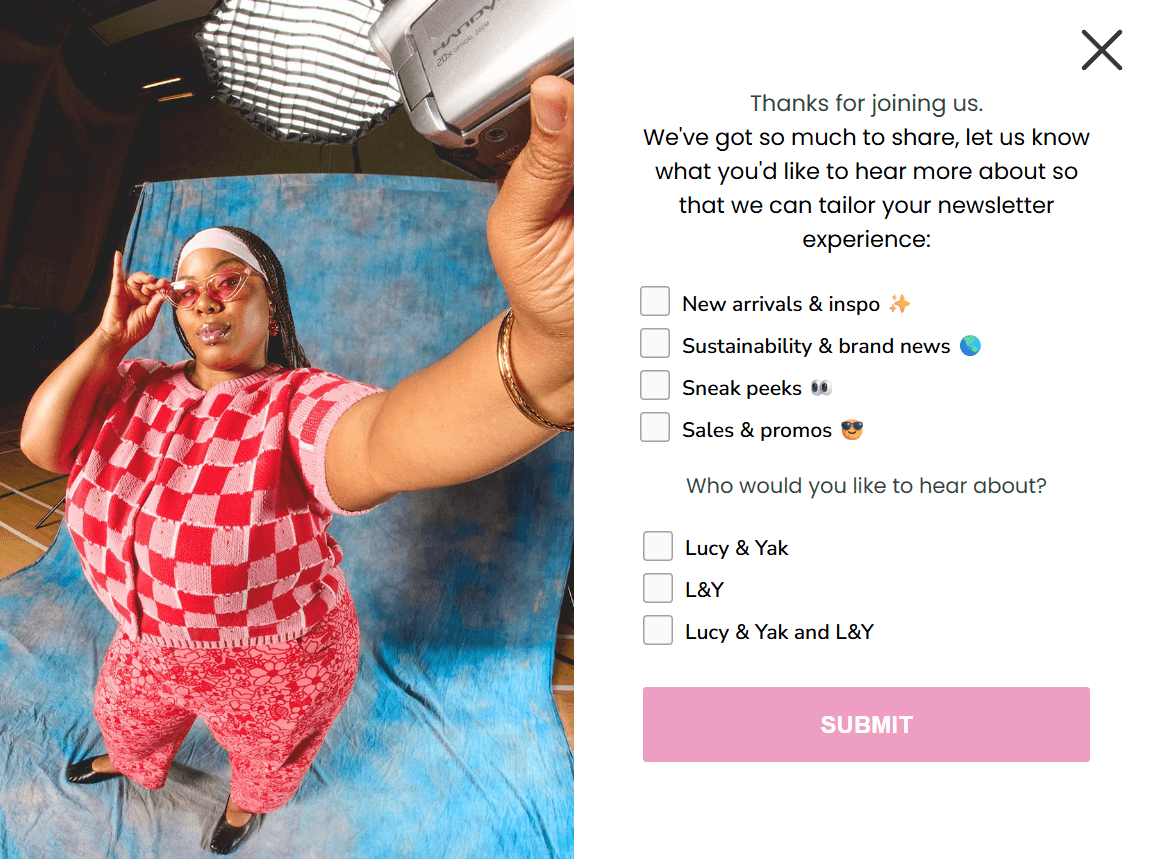
You can also welcome them while they’re warmed up, right there on your website. Just like Lucy and Yak does. They cleverly include a short preference center to provide a personalized email experience from the first messages.
2. Post-purchase messages
When someone invests in your small business, they choose your products or services over several alternatives. This creates a moment of trust.
Post-purchase thank you messages help keep this positive momentum going. Besides expressing gratitude, you can use them to share next steps or resources and send upsell or cross-sell recommendations.
Check out these thank you notes for different products or services to get an idea:
- Thank you for your order. Check your bag for your gift. If you could spare a moment, we’d love to know your thoughts, so feel free to leave us a review on our website.
- It’s an honor that you trusted us with your project. If any questions or queries come up, you can reach us at [Contact Details]. We’ll be happy to help.
- Thank you for registering for [Course Name]. Here’s what to expect: [Course Details]. Start any time by clicking here: [Link].
How to use them:
A simple and effective way to send a thank you message to small business customers is through SMS. Include a link where they can check order details, track delivery, or share feedback.
For in-person transactions, a handwritten or printed thank you note leaves a lasting impression. Some businesses choose to include a small card inside the package while others print a short thank you message directly on shopping bags.
3. Appointment or reservation “thank you”
These customer appreciation messages are sent after someone makes an appointment or reservation. At this stage, they may not be paying customers yet. So, it’s important to acknowledge their interest and nurture them.
You can use this message type to confirm booking details, share useful information, or provide rescheduling options if needed.
Like in the examples below:
- Thank you for your reservation. We hope you’re as excited as we are for your upcoming stay. If your plans change, you can adjust your reservation here: [Link]
- We’re glad you chose [Clinic Name]. Your appointment is confirmed for [Date] at [Time]. Click the link to view the details or reschedule.
- You’ve scheduled an appointment for [Date] at [Time]. We appreciate the support. You’ll receive a reminder the day before your appointment.
- Thank you for choosing our business for a consultation. We’re grateful for your time and can’t wait to discuss next steps.
How to use them:
Email is one of the most common ways to send post-booking thank you messages to customers. You can offer instructions, let them change their appointments or add them to their calendar through an email CTA.
For walk-in appointments or reservations, you can do what my dentist does. Use your business card to note down the appointment details, along with a little face or heart and a simple thank you note. She’s done it so many times, and I still smile every time I slip the card into my pocket.
With a tool like Moosend or Mailchimp, you can automate these thank you messages to get triggered immediately after those interactions without the need for manual tweaks.
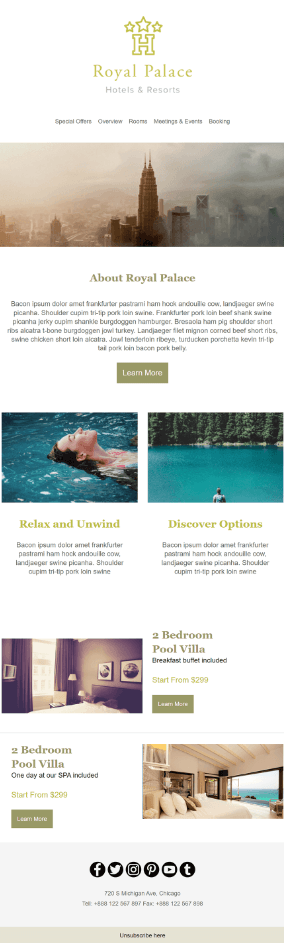
To save more time, pick and customize a professional, ready-made email template. For example, a local B&B can add reservation information and the subscriber’s name, as well as recommend nearby activities or attractions.
4. Feedback submission thank you
22% of US respondents trust online reviews when exploring business options. So, when customers spend time and effort leaving feedback on your website, social media, or Google you must show up to thank them. Reply within a few hours of the review, starting with a sincere message of appreciation.
Negative reviews deserve your attention, too. First, responding to bad reviews makes you look professional and open to change. More importantly, they help you turn a bad experience into a positive one by reassuring unhappy customers you’ll use their insights to improve.
Here are some suggestions to inspire you:
- We’re grateful for your kind words. We’ll be happy to provide you with advice anytime you need it in the future.
- Thank you for taking the time to complete our survey. Click on this link to get a free [Resource Type] as a token of our appreciation.
- We appreciate your feedback. We’re working on a solution to avoid similar incidents and would love to make it up to you on your next visit.
- Thank you for reaching out. We will look into the issue soon and inform you through a DM.
How to use them:
The most direct method here is to reply through the channel your customers used, whether it’s Google or any industry-specific review website.
If you used a survey email to collect feedback, send an email campaign to thank them and perhaps offer a small discount on their next order or customer loyalty points.
For negative feedback, consider giving unsatisfied customers a call to thank them for their insights and ask what you can do to compensate them.
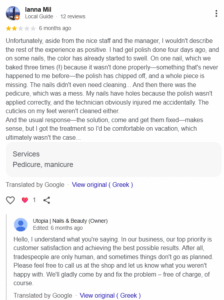
Just like Utopia Nails & Beauty does, using empathetic language and encouraging the customer to book a new appointment so they can fix the problem, free of charge.
5. Social media engagement thank you messages
On social media, true engagement comes with comments, reposts, tags, and mentions, expanding your reach to new audiences. The way you respond to these actions, though, may turn a simple repost into a lasting bond.
Use social listening tools to ensure you track every engagement signal and respond promptly.
Then, a short thank you message encourages your customers to keep interacting with you online. It might even be something as simple as “thank you @[Name]” and an emoji.
If you want more, check the following message ideas:
- So glad you’re enjoying our [Product Name]. Thanks for the mention!
- Your post put a smile on our face. Thank you for spreading the word.
- We’re so happy you shared this 🤩Your support keeps us strong and motivated.
- There’s nothing better than seeing our products in action and our customers excited.
How to use them:
When it comes to social media engagement, always tag the user and, if possible, mention the action to build rapport and add a personal touch.
You can also repost customer content on your feed or stories after asking for their permission. This actively shows you value their effort. Besides that, user-generated content is usually unbiased, authentic, and relatable, so potential buyers are more likely to trust it compared to social ads.
6. Event follow-up messages
Whether someone stops by your stand at an outdoor market, registers for a webinar, or takes a course, they choose to spend time with your business and invest in your expertise.
Thank you messages give you the chance to follow up with helpful material while your brand is still fresh in customers’ minds. They can also open the door to purchases, loyalty program sign-ups, and consultations.
Below are some examples to inspire your event follow-up messages:
- We enjoyed meeting with you at [Event Name]. We appreciate the time you took to chat and can’t wait to share our latest business news with you. Here are some resources to get to know us better: [Links].
- Thank you for stopping by our stand at [Market Name]. We hope to see you again soon in one of our stores.
- Thanks for joining [Webinar Name]. Below you’ll find a short checklist on how to use what you’ve learned.
- It was great seeing you at our workshop. Here’s a quick recap and some additional resources to put your knowledge into practice: [Links]
How to use them:
For in-person events or trade shows, you can mix and match offline and online marketing tactics. Offer a business card with your contact details, along with your website and social media.
You can also gather the email addresses and phone numbers of people who stopped by and checked out your products. A few days later, send a simple email or text message to thank them for showing interest in your brand and educate them on your products or services.
7. Customer appreciation and loyalty messages
Sending small business thank you-messages to repeat and loyal customers is a thoughtful way to let them know you appreciate their trust. As a reward, include a small gift, such as a product sample, a free or discounted service, or access to exclusive content.
Here are some ways to communicate that:
- Your support is what keeps our small business going. We can’t thank you enough for it, but hope a free [Service Type] does the trick.
- Thank you for choosing us again. To show our appreciation, here’s a little something for you: [Coupon Code] for 20% off your next purchase/ reservation.
- Dear [Customer’s Name], it’s a pleasure to have you as a loyal customer. Thank you for being a part of our journey.
- Thank you for your loyalty. We’re so excited to see your team thrive with our platform. Here’s to more great projects ahead!
How to use them:
Now that instant messaging is everywhere, you can stand out from the crowd with a good old-fashioned move that leans into nostalgia.
Send a greeting card or note via mail that says something as simple as “thank you for supporting our small business.” It feels personal, bringing to mind a long-distance friend rather than a faceless brand.
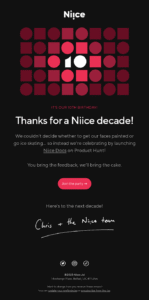
Niice’s anniversary email kills two (or more like three) birds with one stone: they say thank you for the support, announce a new product, and prompt subscribers to leave their feedback.
8. Recommendation thank you messages
What do hair stylists, real estate agents, and doctors have in common? Before choosing one, most of us take recommendations from friends and family. This is probably your most genuine advertising source, so you should give credit to those advocates.
Send a thank you message to people who support you, emphasizing that their recommendation contributes to your growth. To return the favor, offer a complementary product, an upgraded service, or a shout-out on social media.
Check out these thank you notes:
- Hey [Customer’s Name], thank you for bringing a friend in. A little gift is coming your way to show you how much this means to us.
- Our team is grateful for the referral. Your support helps us advance and improve the way we do business.
- Thank you for recommending our business to [Referral’s Name]. As a thank you, enjoy [Reward Type] on your next visit.
How to use them:
If you have an ongoing collaboration with the customer who made the referral, you can take a more direct approach and send a text message. You can always do it in person if you have a scheduled appointment or your customers are regular, like in the case of a coffee shop.
For referral program members, email marketing is the most straightforward channel. An email campaign gives you enough room to highlight the reward and share instructions on how to claim it.
Best Touchpoints to Thank Small Business Customers
We already mentioned some channels you can use for your thank-you messages. What you choose, though, depends on several factors like your customers’ preferred channels of communication.
It also comes down to the contact details at your disposal, whether that’s your customer’s email or physical address, or their phone number.
To give you an idea, let’s check the most effective channels to send thank you messages to small business customers:
Email marketing
According to Constant Contact’s report, 44% of small businesses mention that email marketing remains their number one communication channel.
Email platforms like Moosend, Brevo, and Constant Contact allow SMBs to access ready-made templates, drag-and-drop email builders, and automation recipes. These features help you create beautiful emails from scratch, even if you have zero technical skills.
Moreover, small businesses turn to email due to its cost-effectiveness and scalability. Most email solutions offer free versions or trials and flexible pricing so you can start small and adjust as your business grows.
Social media
Most online conversations happen on social media. A quick reply to comments or mentions shows followers that you’re paying attention and value their opinions. You can also repost their content to celebrate their support.
This kind of real-time engagement encourages others to join the conversation, creating opportunities to increase brand awareness.
However, time is of the essence here. Reply to comments and mentions while the action is fresh on your customers’ minds (and feeds).
A social listening tool ensures no interaction goes unnoticed. Also, remember that every comment matters, including negative ones, if you want to show that you take feedback seriously.
SMS and WhatsApp messages
Your customers’ phone numbers are a valuable asset, especially for time-sensitive communications like immediate post-purchase confirmation messages.
However, this channel comes with certain drawbacks. The main one is character limitations, which prevent you from sharing long-form content, such as follow-up material.
While you can always use a link to direct them to it, some may hesitate due to privacy concerns. Also, this communication method might feel intrusive, leading customers to opt out.
Some email marketing tools, such as Constant Contact or Klaviyo, let you combine email with SMS marketing. Still, you should review their pricing carefully to ensure the combination doesn’t break your budget.
In-person interactions
Contrary to popular belief, the offline approach remains relevant. If you run a service-based business, why wait for the next engagement opportunity? Seize the moment at checkout to thank customers face-to-face.
To go the extra mile, offer customers a printed thank you card or a free sample before they leave. Another good idea is to ask for their phone number and email address. Ask politely and mention why you need their data, emphasizing what they will gain from the communication.
Product packaging and direct mail
Picture the moment your order finally arrives at your doorstep. You open the package, get your hands on your favorite products, and there’s a small thank you card waiting for you. Or a branded mug, pen, you name it. That’s an unexpected gesture you’ll remember.
Small businesses can use direct mail to send a handwritten thank you card at a random time to show customers they matter year-round. Alternatively, leverage occasions like Thanksgiving or Christmas to make them feel special.
Although this method can help your small business stand out, it’s not the most affordable option. So, use it sparingly and combine it with online tactics to get better results with fewer resources.
Tips for Creating Memorable Thank You Messages
Follow these winning tactics to deliver thank you messages that resonate with your customers:
- Keep it genuine and short: An important part of customer appreciation is respecting their time. Get to the point from the first words and keep your thank you message focused. Avoid overly professional language and speak from the heart so your customers can tell there’s a human behind the email or SMS.
- Add a personal touch: Even something as personal as a handwritten note benefits from personalization. The simplest way is to include your customer’s name and reference the action you’re thanking them for, such as a recommendation. You could also call back to a shared memory from past interactions to make them smile.
- Avoid sounding promotional and pushy: Stuffing your thank you message with product or service recommendations distracts customers from its purpose. Focus on expressing gratitude and use promotions subtly only when it’s necessary. Otherwise, your customers may question the authenticity of your message and your motives.
- Reward their loyalty: Enhance the customer experience by offering a small perk in return for their trust. It doesn’t have to be fancy, as long as it adds value to the message. A small discount on their next purchase or a treat on their way out makes a difference. But not every thank you note needs a reward. Use them occasionally so that your customers don’t take them for granted.
- Mind the timing: Your thank you note should reach people shortly after the action or before the trigger date (e.g., birthdays). This is even more important for emails or social media posts where you plan in advance. For general “thank you for the support” messages, timing can be more flexible.
- Don’t go overboard: While showing appreciation plays an integral role in customer retention, you don’t want to overwhelm people with multiple messages across different channels. Decide on a strategy that identifies when it makes sense to send an SMS or email, engage with customers on social media, or offer a note in person.
Small Gestures for Growing Small Businesses
A heartfelt thank you message keeps your small business top of mind. You can start small with a handwritten note at checkout and incorporate other tactics when it feels appropriate.
Regardless of the channel, the key is to stay friendly and authentic. Even if your customers throw away the shopping bag or misplace the note, they’ll remember the gesture and how it made them feel.
Do you want to celebrate customer loyalty? With an email tool like Moosend, you can create, personalize, and scale your messages effortlessly. Give Moosend a go by signing up for the 30-day free trial to automate your way to customer engagement.
FAQs
Below you’ll find answers to frequently asked questions about thank you message ideas for small businesses.
1. What should effective thank you messages include?
A thank you note should express gratitude for a specific, recent interaction, such as a purchase or an event registration. Include personalization elements, for example the customer’s name, and use a warm yet professional voice. Make sure to add your contact details in case customers want to reach out.
2. How often should SMBs send thank you notes to customers?
The frequency of these messages depends on your business type, customer behavior, and communication channel. You can say thank you after email signups, purchases, or referrals. For loyal customers, leverage occasions like their anniversary with your business to acknowledge their contribution to your success.
3. How can you monitor the performance of thank you messages sent to customers?
Monitoring the performance of thank you messages is easy on certain channels. For example, in email marketing you can track metrics such as opens, clicks, and conversions. On social media, keep an eye on comments, shares, and mentions. For offline touchpoints, the impact of your messages is reflected on repeat sales, positive feedback, and recommendations.
Similar Posts
 Published by

 Published by
 Published by
Create, send and optimize your email marketing campaigns