













How to Run A Successful Email Challenge: Tips & Examples [2026]
Published By Alexandra Marinaki
December 19, 2025

19/12/25
Many creators and business owners struggle with email list growth, often resorting to generic lead generation tactics that fail to capture attention.
But what if you could offer a valuable and fun experience that not only converts new leads but also makes existing subscribers look forward to your emails every single day? Email challenges are made just for that.
This guide will show you exactly how to create a high-converting email challenge, including the best planning practices and real-world examples you need to achieve your business goals.
Inbox, we have a challenge
Get Moosend’s pre-made workflows and email templates at a low cost.
Start freeWhat is an Email Challenge?
An email challenge is a marketing strategy that involves delivering a series of action-oriented or educational emails to people who’ve subscribed to receive this content. It’s a powerful lead magnet and engagement tool where a marketer guides participants through a process over a set period to achieve a specific, tangible goal.
For instance:
- A yoga instructor can create a 30-day challenge with short programs to help participants boost their well-being goals.
- A food blogger can host a 7-Day Meal Prep Challenge during back-to-school season to grow their list.
Apart from list building and audience engagement, the hosts can also promote relevant products and services to boost their business, from books and courses to affiliate links.
Why You Should Launch Email Challenges
Here are some of the main benefits of running email marketing challenges to help you decide if it’s an appropriate strategy for your business:
- Grow your email list: Apart from gaining new subscribers, you ensure these people are highly interested in your offers and less likely to unsubscribe.
- Engage your existing audience: Email challenges bring value to your current subscribers and help revive your relationships with contacts who have started to disengage.
- Promote relevant offers: Participants are more likely to consider purchasing your products or services if they see them as a natural part of the challenge experience.
- Improve your sender reputation: Since participants have specifically chosen to receive this content, they’re highly likely to engage with it, which boosts your sender reputation and email deliverability.
- Build trust through expertise: Providing immediate, actionable value will help subscribers view you as a leading expert in your niche and show more trust in your future recommendations.
But how can you reap all those benefits? You need to build a dedicated email marketing strategy that will secure high open rates and conversions.
Best Practices for Converting Email Challenges
Follow this step-by-step guide to streamline your email challenge effectively.
1. Create an email marketing plan
A great strategy starts with clarity, especially in goal-setting. Asking yourself these questions can point you in the right direction:
- What do you want to achieve through the email challenge, apart from list growth?
- Will your email campaigns be content-based, or do you also plan to promote specific services or products?
- Are you targeting a specific audience segment?
- What tools will you need to implement this, except for an Email Service Provider (ESP)?
Once the email content and calls-to-action (CTAs) become clearer, determine how much time participants will need to execute the challenge, and add it to your email marketing calendar. Sit down with your team to create a dedicated marketing plan and allocate different tasks. Then, decide how much time you can invest and pick the optimal duration for the challenge based on your goals.
Next, consider whether personalized content will help achieve your goals faster. While a bulk email is often enough, you can use customer segmentation or dynamic content to send targeted challenge emails and create a sense of exclusivity.
Moreover, choose if you prefer an evergreen or a limited-time email challenge. In the first option, people join at their convenience, but if you want to instill urgency, the second option is more suitable.
2. Choose the right challenge for your audience
In addition to setting the best goals for your business, you should follow the same process for your target audience. To get them to sign up for your email challenge, you should focus on delivering the highest possible value.
First, research where you can find the winning topic. You can start by reviewing your own data. Check out your analytics to see which subjects have the most traction. Use data from high-performing blog posts, previous successful newsletters, social media engagement statistics, and lead magnets that performed well.
Also, leverage current trends in your niche, but ensure you offer a fresh angle to stand out from the competition. Seasonal themes, such as back-to-school organization or holiday dinner prep, often convert well if they offer a unique solution.
Interested in people’s opinions before investing in this project? Use social media (like Instagram Stories or Facebook) or send out a quick survey via email to ask followers what type of challenge they’d prefer to join.
Moreover, if you have an ongoing feedback stream with loyal customers or influential accounts, ask them what specific challenge they would follow and pay attention to their needs.
3. Craft your email challenge content
Once your plan is ready, move on to the creative part. Find the best way to deliver high-quality content to your audience without wearing them out or boring them, especially if the challenge lasts more than one week, as your contacts might get distracted along the way.
Starting with the subject line, make sure each email begins with the day of the challenge and clearly introduces the topic to boost open rates.
Here’s an example from Better Brand that sets the tone.
Subject line: Challenge #4 – A Random Act Of Kindness
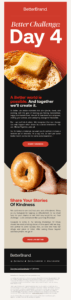
People generally don’t spend much time reading a single email, no matter how invested they feel in a challenge. Find the right balance between text and visuals in each email, as Better Brand did to boost campaign performance. You can also add interactive content, such as quizzes, short videos, or downloadable checklists, to make the process more engaging and hands-on.
Empower participants to keep up the challenge despite the potential difficulty. For instance, if you’re delivering a mindfulness challenge, start with simpler exercises and acknowledge how hard it can be to stay in the present moment.
Finally, avoid overtly salesy language when promoting relevant products or services. Participants opted in for a different reason and might get confused. Instead, share how these paid offers can help them sustain their progress beyond the challenge.
4. Prepare additional challenge resources
While some marketers use existing content for these challenges, others prefer to craft fresh resources for this cause. From exclusive videos to podcasts or tutorials, they choose to offer a rich experience that doesn’t feel familiar.
Understandably, it can be challenging to craft all that content from scratch. This is where repurposing your existing content and packaging it in a unique way becomes highly valuable.
Here are two practical content scenarios:
- The Knitting Challenge: Create a simple 7-day challenge where subscribers learn one small technique each day. You can take instructions from your blog posts, tweak them, and create short, exclusive video tutorials using that copy as a script. This adds a valuable new format without starting from zero.
- The Leadership Challenge: Train new leaders on essential skills to prepare them for their new role. You can turn existing podcasts into a newsletter series featuring key quotes, actionable summaries, and links to the full episode for those who want more.
It’s up to you to decide the perfect content format for your audience based on available tools, time, and other resources. Combine data from your analytics tools to find what works best for your audience and drives the most engagement.
5. Design your emails for consistency and conversion
Apart from a consistent subject line that secures a high open rate, it’s best to keep the same format for your email series. Using the same fonts and colors provides users with the stability they need to dive deeper into the content without getting distracted.
You can, of course, play with assets and visuals. For example, enhance certain emails with videos, infographics, or GIFs, but ensure they always add value to the challenge participants. Divide your emails into different sections with white space and use bullet points and short paragraphs to improve readability. Remember, participants are looking for instructions, not prose.
If you use CTAs in your emails, make sure they stand out from the rest of the text. Use a distinct color for your button and place it at a prominent location so it is easy to find.
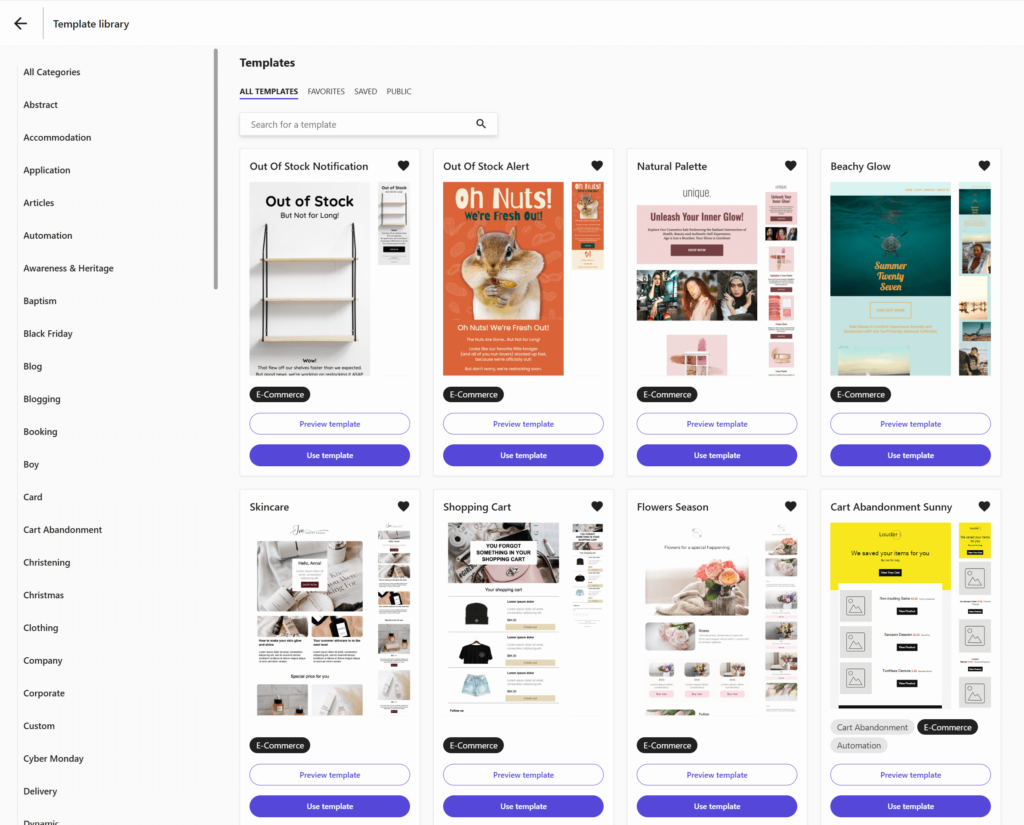
Want to save time? Many notable design or email marketing services offer pre-made templates. Choose your favorite and customize it based on your needs.
7. Create a dedicated landing page
One of the most essential assets to promote your email challenge is a landing page. This standalone web page has everything a prospect needs to sign up for your channel without getting distracted by other links or marketing actions.
Here’s an inspiring example by Simplish for their 7-Day Productivity Detox:

A great landing page consists of the following elements:
- A clear headline that includes the name and scope of the challenge.
- Supporting copy that clearly details the benefits the user will receive and the challenge Unique Selling Proposition (USP).
- A clear call-to-action button and a signup form to easily collect email addresses.
- Visual elements like clean graphics or mockups that optimize the reader’s experience and draw attention to the key information.
To gain trust faster, use social proof like testimonials from people who’ve joined the challenge or logos from brands that have trusted your business. Also, write your copy in a motivational tone to boost registrations and set expectations about the challenge agenda.
If it’s your first time designing a landing page, you can save significant time by using a dedicated landing page builder with pre-made templates. All you need to do is customize them with your brand’s elements.
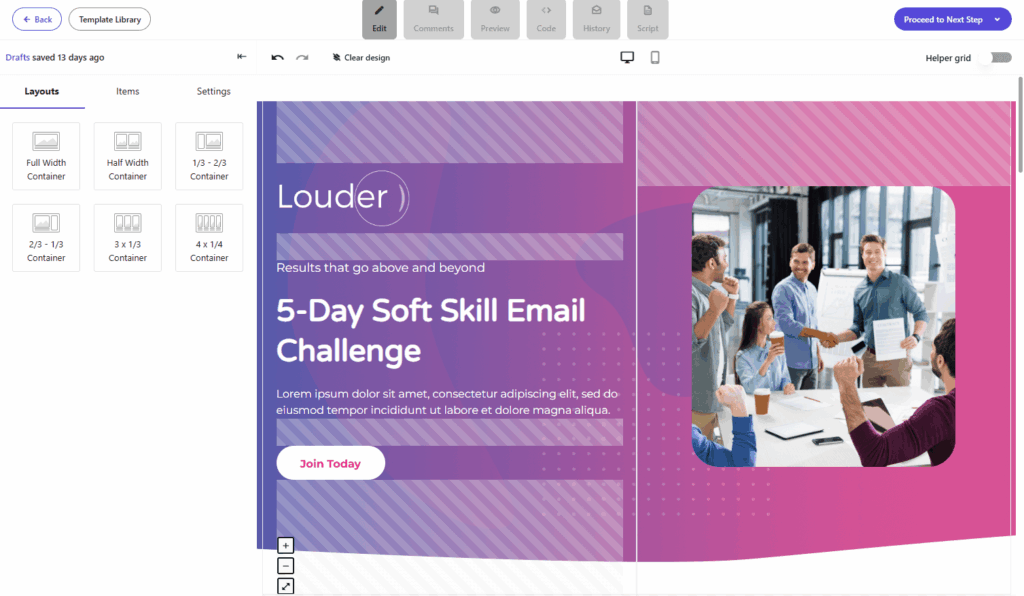
Check out these additional resources:
- Best Practices for Landing Page Copy With Examples
- Landing Page Mistakes You Should Avoid
- Landing Page Design Examples To Inspire Your Layout
7. Set up your automated email series
Sending these emails manually would waste a lot of your time. By pre-writing and scheduling your entire sequence, you ensure every participant receives the right content at the right time.
Most email marketing software, like Moosend and Constant Contact, offer pre-made email automation workflows to help you create them easily. The first step is selecting the trigger, the activity that enrolls the person in the challenge.
This is typically a sign-up for a dedicated landing page form. Then, you can choose the actions that will set the sequence in motion (e.g., send email, wait X days, add tag, remove from other lists).
Immediately tag the participant (e.g., 5-Day Challenge), so they receive this dedicated series. This also allows you to exclude them from other newsletters during the challenge period, preventing inbox clutter. Map the flow of the journey, including pre- and post-challenge, such as welcome emails or surveys.
When you finish, sign up through a testing email address to ensure everything’s spot on. Verify that the content, links, images, and timing in every email are correct before making your challenge public.
8. Promote your email challenge on various channels
You’ve planned, designed, and automated your challenge; now it’s time to collect those sign-ups. To get the best results, you need to share your dedicated landing page across multiple channels as part of your promotional plan.
Start where your existing traffic is: your website. Create a pop-up sign-up form with a compelling offer and place a static banner or bar at the top of every page to attract visitors. Additionally, send an invitation email to existing subscribers and encourage them to forward your challenge link to friends and family members who might also be interested.
You can also post your challenge link on popular platforms where your audience spends time. For example, use link-in-bio or profile links on Instagram/TikTok or share a post detailing the specific professional skill or result the challenge delivers.
If you believe the challenge is worth allocating some budget to, paid ads can bring rapid growth. Social media ads (Facebook/Instagram) and Google ads are top options, depending on where your target audience searches for solutions to the problem your challenge solves.
Email Challenge Examples & Why They Work
Let’s explore different email challenges to inspire you and why their promotional assets are effective.
Holistic Wellness
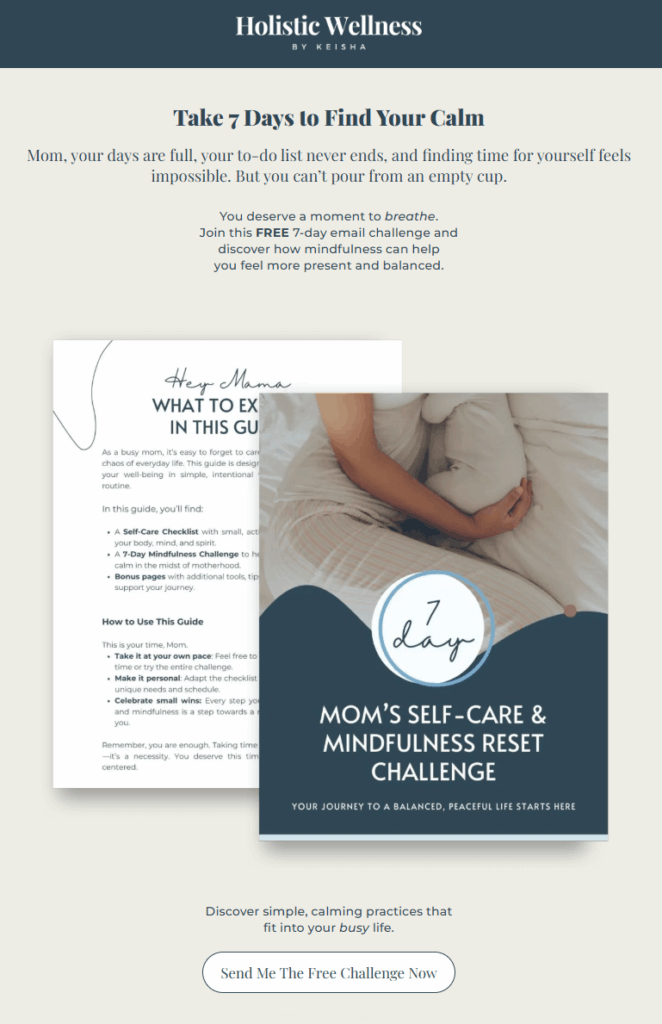
Holistic Wellness promoted a self-care reset challenge for moms with a simple yet beautiful landing page.
Why it works:
- The headline and supporting copy effectively introduce the challenge copy, written in an emotional tone to encourage busy mothers to join.
- The visuals in the middle clearly set expectations for the email content and supporting resources participants will get.
- The call-to-action button is easy to spot, including the words “free” and “now” to yield more clicks by emphasizing both value and urgency.
A Beautiful Mess
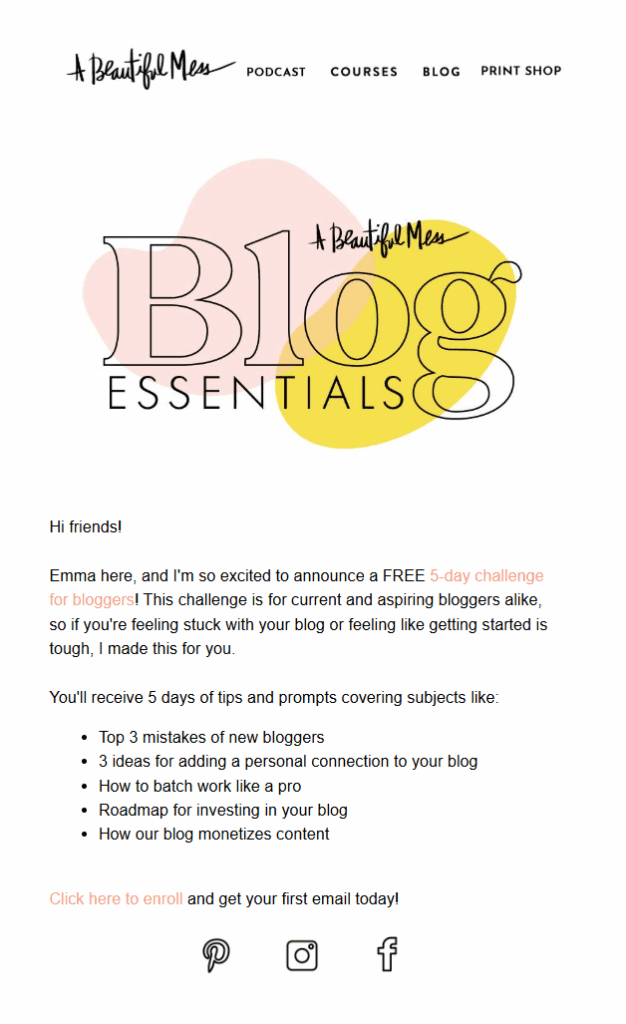
A Beautiful Mess invited their subscribers to their 5-day blogging challenge with this email.
Subject line: FREE 5-day blog challenge!
Why it works:
- The subject line introduces the email’s topic to attract the target audience straight away.
- The email copy outlines the intent of this email challenge and lists the main subjects in bullet points for better readability.
- The inline call-to-action is easy to spot and invites readers to join the challenge immediately.
The Recipe Well
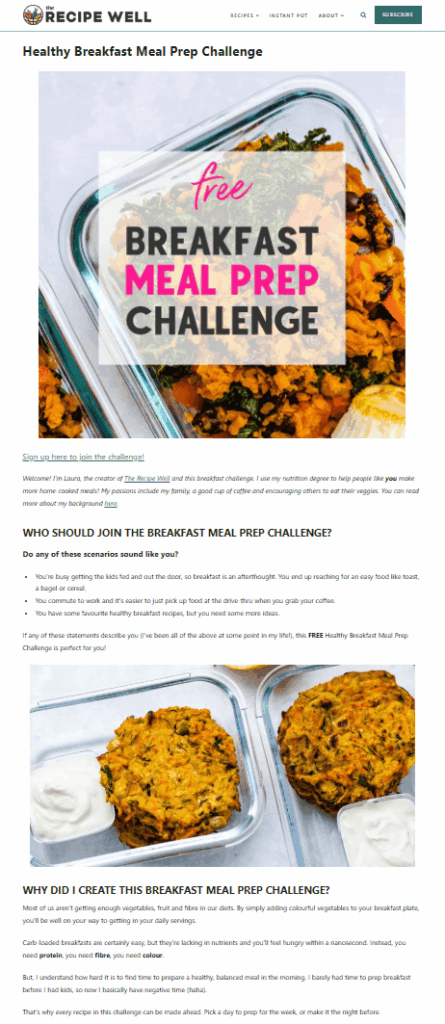
This breakfast prep email challenge from The Recipe Well is everything busy people need to begin their day healthily.
Why it works:
- The copy successfully focuses on describing the target audience for this challenge and the host’s mission, which instantly increases relevance and conversions for that specific segment.
- The images of delicious breakfast meals help readers visualize the outcome (what the recipes will be like).
- Even though they didn’t include a distinct CTA button, they strategically placed the signup link at the top of the content to boost visibility and enrollment.
JulieWG
Julie Winkle Giuloni created a 21-day habit-building challenge to help leaders grow their teams through skill development.
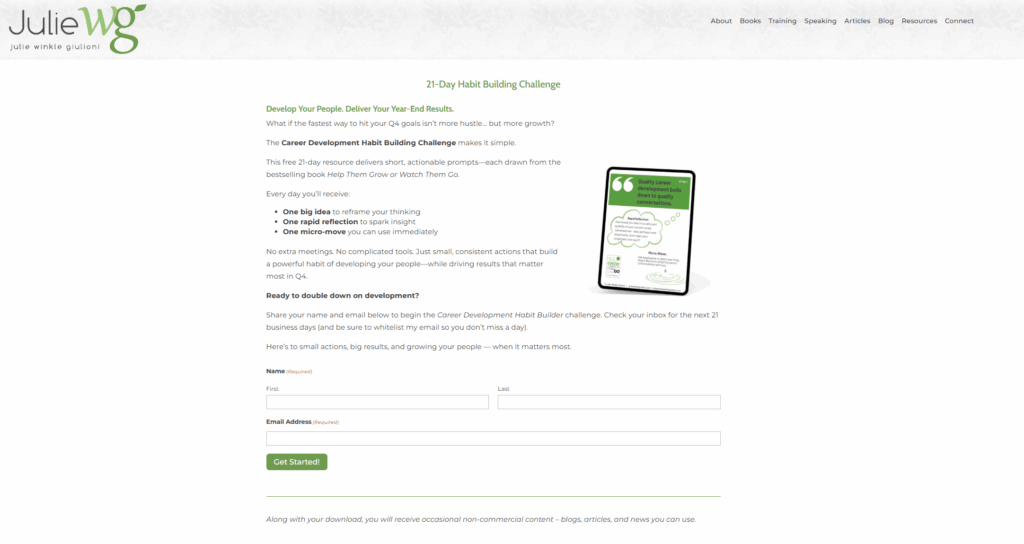
Why it works:
- The landing page copy is written in a motivational tone to promote immediate action and boost conversions among leaders seeking growth.
- They used a short listicle and bolded important phrases to make the key benefits immediately scannable and grab the reader’s attention faster.
- The signup form is short and readily visible (above the fold) to reduce friction and increase challenge subscriptions.
Plan Your Next Email Challenge
Ready to invite your audience on an inspiring mission? Find a goal that makes sense to them and commit to sharing value through content.
Remember: the goal isn’t perfection, but progress. Launch your challenge, learn from your first cohort, and iterate as you go. You already have the tools and the plan.
And if you don’t, Moosend has all the features needed to power up your email challenge, from a landing page builder to pre-made design templates to automation workflows. Sign up for an account today and give it a spin.
FAQs
Explore these frequently asked questions regarding email challenges.
1. How long should an email challenge be?
Most email challenges range from 5 to 7 days, which provides enough time to deliver a meaningful result without overwhelming your subscribers. However, some challenges can last longer (up to 30 days), especially when they aim at guiding participants through a larger, complex project step-by-step.
2. Should the email challenge be evergreen or live?
It depends on your goal. Evergreen email challenges are passive lead magnets that people can join at any time. Live challenges (where everyone starts on the same day) create a sense of urgency, but they require significantly more effort and scheduled promotion.
3. When is the best time to promote your paid product?
It’s best to pitch your offer at the end of your email challenge. This strategic timing works because participants have already experienced your expertise firsthand and are much more likely to trust you and purchase your next product or service.
Similar Posts

 Published by

Create, send and optimize your email marketing campaigns