









25 Marketing Automation Statistics You Need to Know in 2026
Published By John Desyllas
September 13, 2022

13/09/22
Every modern business strives to do more in less time, and this is true for businesses across all industries.
Digital marketing has evolved greatly in the last couple of years, and with the advent of AI, things are bound to change even more.
To help you stay ahead of the curve, we’ve conducted extensive research to compile the most recent marketing automation statistics from reputable brands and reliable sources. You’ll find them categorized for easier navigation.
Need a powerful marketing automation tool?
Automate your campaigns and lead generation from $9/month.
Try MoosendMarketing Automation Benefits
Let’s start with the benefits you get by using marketing automation:
- 80% of marketing automation users see improved lead generation, and 77% see more conversions. – Invespcro
- Using chatbots can help reduce customer support costs by up to 30%. – Chatbots Life
- 71% of marketers say that AI automation helps their teams create and launch campaigns faster, saving an average of 2.3 hours per campaign. – Emarsys
Such an increase can yield substantial revenue, especially if your business already has a proven sales pipeline.
Having a well-defined sales process is necessary before using marketing automation. Make sure the stages of your sales process are established so you know which ones to improve to increase your conversion rate.
Marketing Automation Usage Statistics
- HubSpot reports that 47% of marketers use automation to streamline their marketing processes and improve efficiency. – HubSpot State of Marketing Report (2026)
- More than 90% of marketers leverage automation to analyze data and produce reports – HubSpot
- The vast majority of marketers (93%) use automation for administrative tasks such as scheduling, note-taking, and documentation – HubSpot
- 58% of marketers use marketing automation for upselling
According to Amasty, there are three opportunities for upselling: before purchase (e.g., category pages, product pages, catalogs), during purchase (e.g., checkout page and abandoned cart emails), and after purchase (e.g., thank you emails).
- 86% of marketers look for ease of use in automation platforms
Planning marketing automation workflows should be easy and straightforward. An intuitive platform with a practical design will positively influence your daily experience. Make sure to check out our guide on the best marketing automation software for more!
- 35% of respondents report that a top reason for implementing marketing automation is to streamline marketing and sales efforts. A close second is improving customer engagement and experience.

The same study indicates that the vast majority of marketers (84%) describe their automation use as successful to some extent, but there is room for improvement. – Ascend2
- The top three marketing automation techniques used by marketers are email automation (64%), profiling and targeting (26%), and personalization using dynamic content (23%). – Getresponse
Marketing Automation Adoption Statistics
Being an early adopter can help you stay ahead of the competition, not only in marketing automation but also in content marketing, SEO, advertising, and social media. Let’s see what the stats indicate:
- 49% of companies are now using marketing automation. – Moosend
- 58% of B2B companies plan to adopt automation in their marketing campaigns. – Emailmonday
- 75% of marketers are either implementing or experimenting with AI. – Salesforce
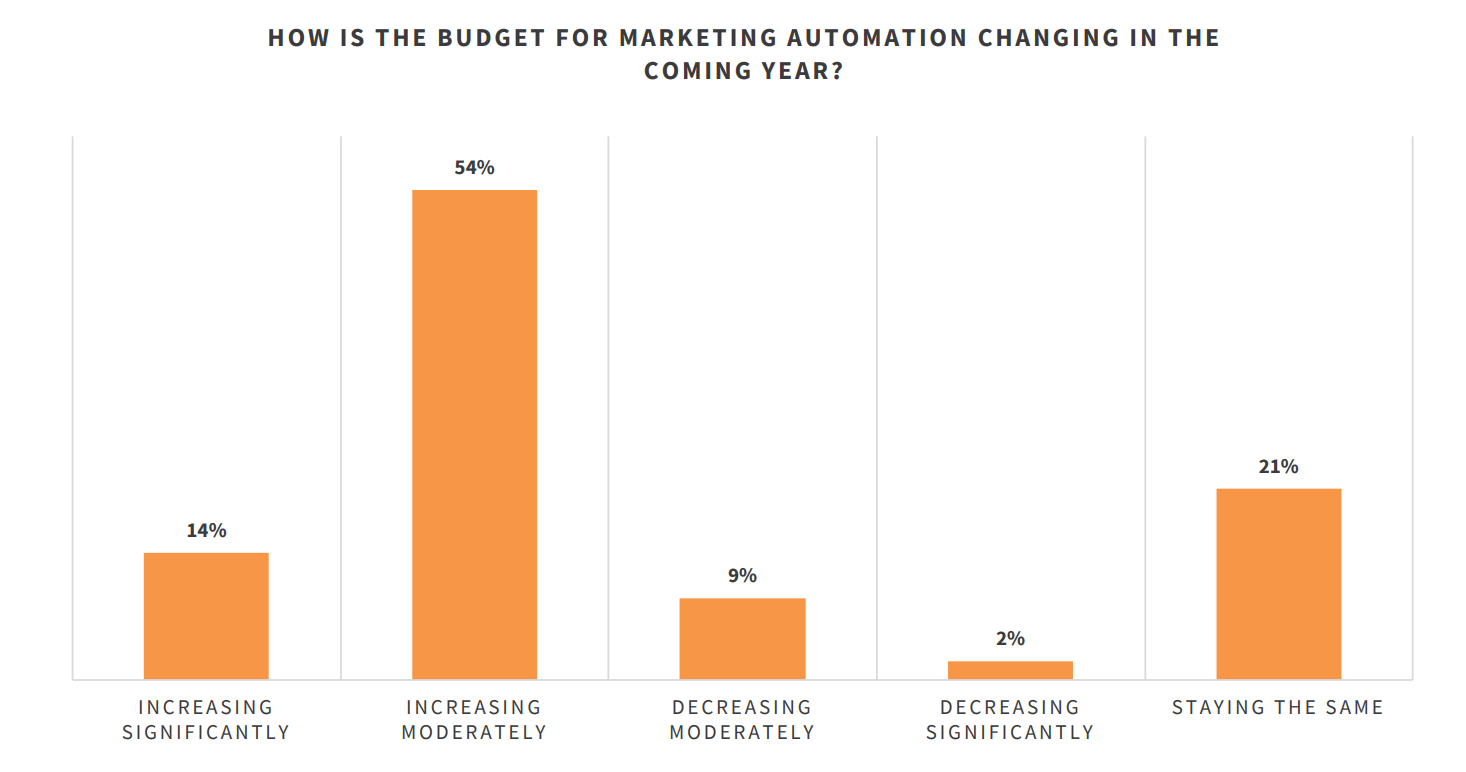
- In 2024, 54% of marketers planned to increase their marketing automation budget in the coming year. – Ascend2
- Email marketing is still the top use case for marketing automation at 58%, followed by social media management at 49% and SMS marketing at 30%. – Ascend2
- 13% of respondents from growth positions consider segmentation among the top challenges when it comes to automation. – Automizy
Marketing Automation ROI
- Businesses achieve an average return of $5.44 for every $1 spent on marketing automation.- Nucleus Research
Marketing Automation Trends
- The global marketing automation market is expected to grow from USD 5.7 billion in 2023 to USD 15.2 billion by 2033. – Market.us
- AI-driven workflow automation is a clear business priority: 46% of practitioners and 41% of executives rank it among their organization’s top AI investment goals. – Adobe
- In a 2024 martech replacement survey, 65% of respondents said they replaced at least one martech solution in the past year, and 31% replaced their core marketing automation platform. – Chiefmartec
Email Marketing Automation Statistics
- 84% of email marketing campaigns are automated to some extent. – Ascend2
- Triggered emails have massively higher open rates and click-through rates than blast newsletters, making them 497% more effective – Blueshift
- One in three people who click an automated message make a purchase, compared with one in 18 for scheduled messages. – Ecommerce marketing report 2025
- Automated flows can generate up to 30x more revenue per recipient than one-off campaigns. – Klaviyo
- More than 80% of marketers report using AI for content creation, including email copy. – HubSpot
Decoding Marketing Automation Statistics
Understanding these key marketing automation stats will help you improve your marketing efforts and optimize your strategy.
As you’ve noticed, marketing automation platforms not only help brands save crucial time but also enable marketers to drive business growth. The key to the whole process is doing it right!
Similar Posts




Create, send and optimize your email marketing campaigns