













How to Comply with Email Marketing Regulations in 2026
Published By Alexandra Marinaki
July 22, 2026

22/07/26
Email is one of the most effective channels for scaling your marketing. Through advanced automation and personalization, you can nurture your audience at key moments in the customer journey, delivering content that truly resonates.
But there’s a catch.
Failing to comply with evolving global email and privacy laws doesn’t just put your sender reputation at risk. In fact, it exposes your brand to significant financial penalties and legal costs.
In this guide, we share essential global email marketing regulations and provide actionable compliance steps to keep your outreach both effective and legally sound.
Disclaimer: This guide is for educational purposes only and doesn’t replace legal advice. Since compliance requirements vary by jurisdiction and sender volume and change regularly, you should consult with your legal counsel or data privacy expert to audit your specific strategy.
Secure your compliance with confidence
Choose an email marketing platform with a high deliverability rate.
Try MoosendKey Email Laws and Regulations Per Region
Compliance isn’t determined by where your headquarters are located, but by where your recipients are. Whether you’re a global startup or a growing enterprise, understanding these regional benchmarks is critical to protect your deliverability and bottom line.
Let’s explore noteworthy email laws by region.
United States
The CAN-SPAM Act sets the ground for commercial email in the US, and it’s overseen by the Federal Trade Commission (FTC). While you don’t need explicit consent to hit send, you do have to be transparent about your content and avoid deceptive practices. This means recipients should be able to tell right from the subject line that your email is for commercial purposes.
Other tactics, like including a physical address and an easy way to opt out of your list, are non-negotiable. Your domain name also needs to be accurate, showing the sender’s name without confusing the recipients. It’s generally a high-stakes law, as violating it can lead to penalties of up to $53,088.
Another major regulation to keep on your radar is the CCPA, which gave California consumers much more control over their personal data starting from January 1, 2020. Under this law, they have the right to know how their data is handled, ask to access or delete it, and opt out whenever they wish.
On top of that, consumers have a right to non-discrimination and can request the correction of their private data at any time. They can also stop businesses from selling or sharing their information with third parties. To stay fully compliant, it’s also important to have a clear privacy policy that’s easy for your audience to find and read.
Europe/UK
If you collect data from or contact citizens in the European Union or the UK, you need to comply with the GDPR (General Data Protection Regulation). This law was established in 2018 to protect the privacy and personal data of consumers in these regions. Even though the UK has its own version now, the standards remain just as high.
To reach out to consumers with commercial emails and messages, you need clear opt-in consent to process their data. This means no pre-ticked boxes; the user has to actively say “yes.” Once they’re on your list, consumers have the right to access, delete, or change their data, or even restrict you from processing it at any time.
Businesses should also implement strong security strategies to protect that data and must report any potential data breaches within 72 hours. The stakes are high: GDPR penalties can reach up to €20 million (or £17.5 million in the UK), or 4% of your global annual turnover.
In the UK, the PECR (Privacy and Electronic Communications Regulations) is also effective alongside GDPR. It adds even stricter rules on how you treat customer data in commercial electronic messages, including specific consent for tracking methods, such as maintaining an up-to-date cookie policy.
Canada
Canada’s Anti-Spam Legislation (CASL) is one of the strictest laws that regulates commercial electronic messages to protect Canadian residents wherever they are. Its legal requirements include clear express or implied consent, sender identification through name, valid postal address, and telephone number, and transparent opt-out mechanisms.
Non-compliance is a major issue in Canada. Violating CASL can result in fines of up to $10 million for businesses and $1 million for individuals.
Australia
The Spam Act 2003 applies to Australian businesses or anyone sending from or to Australia. It prohibits unsolicited emails and messages, including SMS and MMS, without consent, whether direct (express) or inferred by an ongoing relationship.
The sender and their contact information should be clearly identified, along with a functional unsubscribe process. Opt-out requests must be handled within 5 business days, and non-compliance can cost millions, especially in cases of mass violations.
South Africa
The Protection of Personal Information Act (POPIA) was enacted in 2021 to protect personal data in South Africa. As with the other regulations we’ve discussed, it protects the right to clear consent, transparent processing, and the user’s ability to access, withdraw, or change their information at any time. Businesses also need to be ready to report data breaches to the Regulator as soon as reasonably possible.
Brazil
In Brazil, a relevant regulation was introduced in 2020 called the LGPD (Lei Geral de Proteção de Dados), which is very similar to the GDPR. It applies to any business offering goods or services to people in Brazil, focusing on data-driven marketing, from ads to emails, regardless of where the company is based. The fines for non-compliance are significant and can reach up to R$50 million per violation.
Southeast Asia
Finally, the Personal Data Protection Act (PDPA) applies in Singapore, Malaysia, and Thailand, with similar requirements for handling data. In Singapore, for instance, the stakes are particularly high, as fines can reach up to 10% of an organization’s annual turnover (for those with revenue over S$10 million), which can be detrimental for organizations.
Best Practices for Complying with Most Email Marketing Laws
What do the above email marketing regulations have in common? Clear opt-in and opt-out, transparency, and the right to data access, usage purposes, and deletion are at their core.
The good news is that most email marketing platforms like Moosend or Contact Contact help streamline most assets successfully through built-in features and integrations with top tools. Use these tactics to ensure your email marketing efforts remain protected and compliant.
1. Collect and record clear consent
Besides the CAN-SPAM Act, which focuses more on opt-out, most email privacy laws require a clear opt-in process.
Consent can be express, where the data subject confirms during the signup process that they want to receive future emails with commercial content. Inferred consent (or implied consent) occurs when the relationship with the consumer is ongoing, typically because they’ve already purchased from you or made a business inquiry.
Most businesses collect users’ opt-ins through signup forms on their website, lead magnets, or landing pages. Keep the subscription process simple, request only mandatory data, and ask permission to contact them for marketing purposes. You can also enable a double opt-in process to get clearer permission and ensure the addresses on your email lists are valid.
Check out this opt-in form from Lush Cosmetics, which mentions what email content to expect. Plus, they added links to their Privacy Notice and Terms & Conditions for consumers who wish to be informed further and to prove good intent:
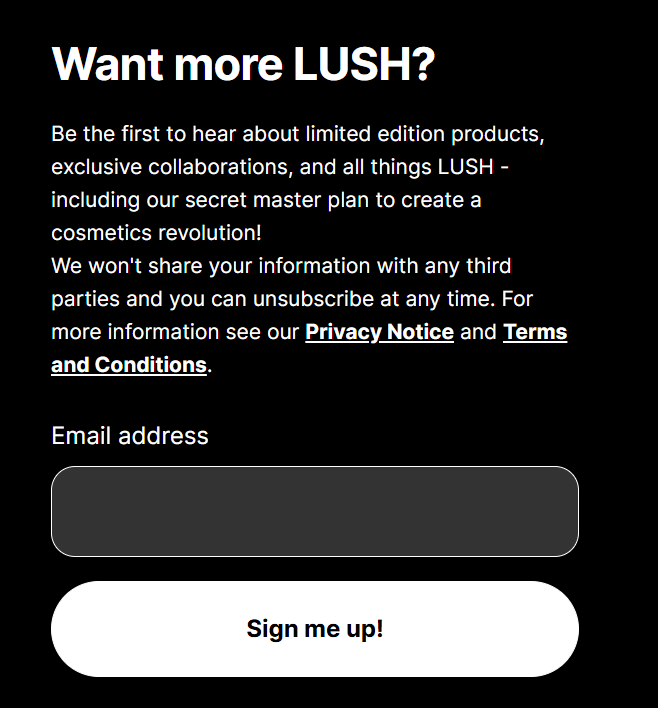
Keep in mind that manipulative tactics, such as pre-checked consent boxes, should be off the list. Always keep a record of the consents you’ve collected as proof. And remember, the consumer can withdraw it at any time, and you should honor that request immediately.
2. Make unsubscribe easy
A critical part of every global privacy and anti-spam law is the recipient’s right to say “no.” Providing a clear, functional way for users to opt out of your list at any time is paramount.
While most brands place the unsubscribe link in the footer, the secret to staying compliant is visibility. Don’t hide your link behind tiny, “soft” fonts or low-contrast colors. If a subscriber wants to leave, you want them to find the link easily.
Modern regulations and ISP requirements (including those from Google and Yahoo) require that users be able to unsubscribe without taking extra steps, such as entering their email address twice or logging into an account.
Take a look at how UNIQLO manages compliance in their promotional emails. By including clear links to unsubscribe, customer support, and their privacy policy, they stay transparent. They also proactively prompt recipients to add them to their address book, a simple move that signals to spam filters that the sender is “trusted” and helps keep their content out of the spam folder.
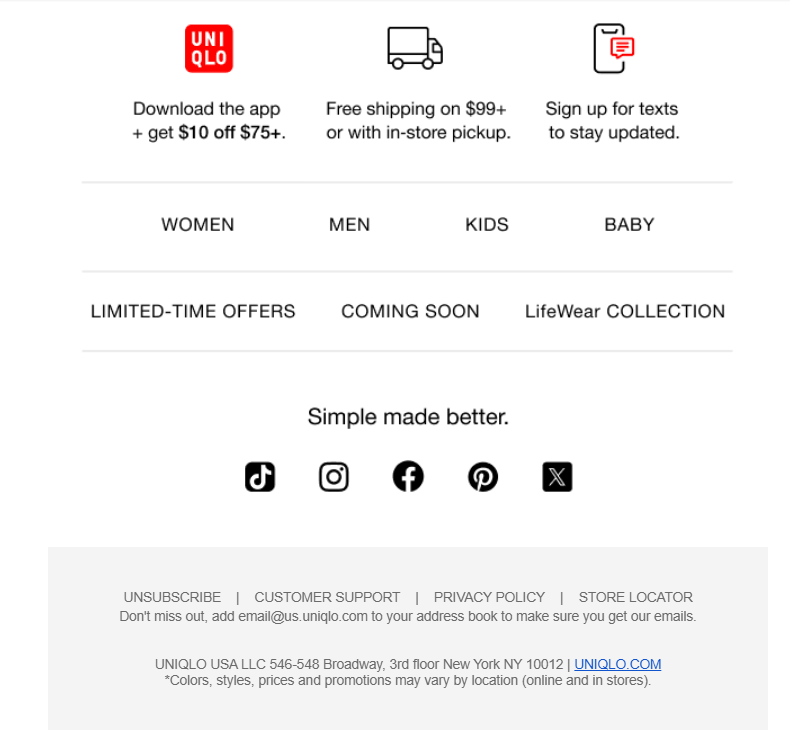
A good tactic is to offer a preference center alongside your unsubscribe link. This gives you one last chance to save the relationship by letting users manage their frequency and choose specific topics. This way, you can keep a subscriber who might have otherwise left, and you ensure your list stays clean and compliant.
3. Use email authentication
Email authentication signals to service providers that you’re a legitimate sender and not a scammer. Failing to provide this proof is a red flag that can spike your bounce rates and send your campaigns straight to the spam folder. Here’s what each authentication protocol does and why it matters:
- SPF (Sender Policy Framework): SPF is a DNS record that lists the servers authorized to send email on your behalf (such as your ESP or CRM). To protect your reputation, make sure to remove any outdated services you no longer use.
- DKIM (DomainKeys Identified Mail): This adds a cryptographic “seal” to your email header, proving that your content wasn’t altered after you hit “send.” It protects you against spoofing, where scammers impersonate your brand to steal data.
- DMARC (Domain-based Message Authentication, Reporting & Conformance): DMARC tells receiving servers exactly what to do (e.g., “Do nothing,” “Send to spam,” or “Reject”) if the SPF and DKIM protocols fail. If the domains on your SPF and DKIM don’t align with your “From” address, DMARC will fail.
Keep in mind that aligning your domain and hardening your DMARC policy protects your reputation from spoofers and ensures your resonant content actually reaches your audience.
4. Create transparent content
Email marketing compliance relies heavily on setting clear expectations and delivering on them. Urgency should never be used as a marketing trick but as a genuine nudge when a deadline is actually approaching. To stay on the right side of the law, avoid manipulative tactics like fake countdown timers or flashing “warning” alerts.
Also, never start a marketing subject line with “Re:” or “Fwd:” to mimic a personal conversation. This is a direct violation of CAN-SPAM and is easily flagged by filters. Your subject line and copy should always hint at the commercial purpose of the message without using deceptive language just to force an open.
Check out these examples to see the difference between being “clever” and being compliant:
| Strategy | Non-compliant (Deceptive) | Compliant (Transparent) |
| Prizes | You’ve won a $500 Gift Card! | Enter for a chance to win a $500 Gift Card |
| Personalization | Fwd: Thought you’d like this | Ideas for our upcoming meeting |
| Urgency | URGENT: Your account is expiring! | 24 Hours Left: Our Summer Sale is Ending |
Maintaining a consistent, recognizable sender name is also vital for helping recipients immediately understand who is hitting their inbox. But transparency goes beyond just the words.
Using alt text for images is a requirement for accessibility compliance. Additionally, using high-contrast colors and a clear hierarchy in your titles ensures your content is transparent for visually impaired readers, too.
Finally, ensure the information in your email footer is clear. Don’t place your opt-out link or preference center in a way that readers might miss. Hiding these elements doesn’t just frustrate your customers. It means you’re missing a serious compliance gateway that protects your brand’s reputation.
5. Manage your email lists
Effective list management is a core requirement for data privacy and high-performance marketing. By proactively removing inactive or incorrect addresses, you protect your deliverability and your brand’s reputation. For mailbox providers, a clean list is a primary signal that you are a compliant, trustworthy sender.
Compliance starts at the signup form. Using email verification tools and double opt-in ensures that the addresses entering your database are legitimate and not “spam traps” or disposable emails. Beyond the technical setup, segmentation helps you keep subscribers engaged by delivering resonant content tailored to their interests. This reduces the manual spam complaints that can hurt your sender score.
Before you permanently remove inactive subscribers, give them a chance to stay. A re-engagement series is a great way to rekindle the spark with inspiring content or by offering a “Preference Center” where they can adjust how often they hear from you. However, if they stay silent after a few attempts, it’s time to wave goodbye.
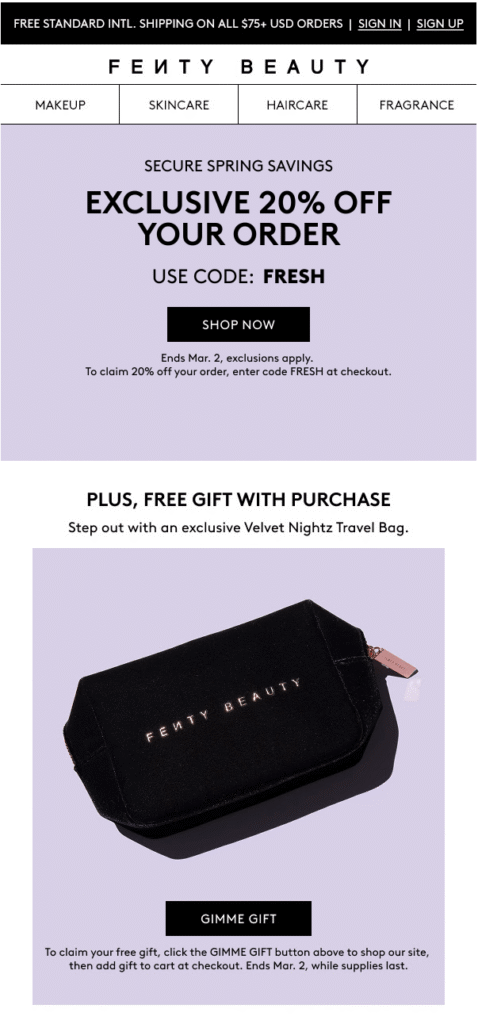
Take a look at this re-engagement campaign from Fenty Beauty, which uses a clear incentive and a friendly tone to check in with quiet subscribers:
Subject line: We’ve been missing you 🩷 Here’s 20% off
When someone unsubscribes, move them to a suppression List. This is an important compliance step as it acts as a permanent “do not contact” tag. If you accidentally upload a new lead list later, your system will cross-reference the suppression list and prevent you from re-importing someone who already opted out, a mistake that can lead to hefty fines under most email laws.
Finally, audit your lead sources and email metrics regularly. If you notice that a specific resource or sign-up form is resulting in high bounce rates, remove it immediately. Staying below the 0.3% spam complaint threshold is a requirement, and regular list hygiene is the only way to ensure you never cross that line.
6. Disclose your contact information
According to global laws, failing to disclose who you are and where you’re located is considered suspicious by default and can lead to significant fines. So, what information should you include in your email marketing campaigns to ensure compliance?
Seeing a real address builds immediate credibility and signals to your subscribers that you’re a legitimate entity they can contact if they have a problem. To increase this trust, always use your registered business name and include a clear link to your website.
Including a valid physical mailing address is also a requirement. If you’re working from home and value your privacy, it’s a wise move to invest in a P.O. Box or a virtual business address rather than using your own street address. It’s also helpful to include secondary contact methods, such as a professional email address or a telephone number.
Adding a “Contact us” button that leads directly to your customer support is an excellent way to reduce friction. So are links to your social media profiles, since most of them include built-in messaging apps that customers can use.
Keep in mind that using a placeholder like “123 Main St” or a fake address is actually worse than having no address at all. Modern email service providers (ESPs) use automated tools to verify address formats. If they spot a fake one, they may permanently block your domain’s reach to protect their own reputation.
7. Share your privacy policy
According to many privacy laws, such as GDPR, having a privacy policy hidden somewhere inside your website isn’t enough. You should make it accessible in your email campaigns so that subscribers can review it without having to search elsewhere.
Most businesses include their privacy policy in their email footer so readers can find their data-handling practices. Providing this also reduces the so-called “privacy anxiety” many people face and helps prevent them from marking your email marketing messages as spam.
Here’s what to include to ensure transparency:
- Private data categories: Explain exactly what kind of data you collect (e.g., name, email address, IP address).
- Third parties: Disclose who else has access to that data, such as your ESP and CRM.
- AI and automation: If you use artificial intelligence and automation, explain how these marketing practices work.
- Retention timeframe: Mention how long you retain private data before deleting it.
- Consumer rights: Clarify that consumers have the right to access, change, or delete their data.
Finally, according to CCPA and GDPR, you should proactively notify your customers and subscribers of any changes to your privacy practices to remain compliant.
8. Track upcoming compliance trends
The rise of AI and the subsequent changes it brought to data privacy have created a new landscape for email marketers. The EU AI Act will be fully effective as of August 2026. If you use AI for copywriting or design, you should disclose this to the recipient with a relevant “AI-assisted” tag. Consumers will also be able to opt out of ADMT (Automated Decision-Making) if they feel algorithms are making choices for them.
At the end of 2026, many states in the USA will also introduce their own specific privacy laws. For example, under the Global Privacy Control in many states, enabling a “Do Not Track” signal in a browser should automatically be considered an opt-out.
Moreover, if you fail authentication or exceed the 0.3% threshold in spam complaints, your emails are often rejected, not just landing in spam, but completely disappearing. As third-party data is increasingly marked as non-compliant, zero-party strategies, where a user intentionally shares their data with you, are the safest pathway to remain compliant.
To stay up to date, you can subscribe to relevant newsletters from top ESPs and organizations such as the IAPP (International Association of Privacy Professionals). Sync with your legal team to regularly monitor compliance updates and ensure your strategy remains future-proof.
Navigate Email Compliance Stress-Free
Maintaining a compliant email marketing strategy can be challenging at times, but everyone’s on the same boat. Moreover, following the above practices also secures a high deliverability rate and stellar email performance.
So don’t leave compliance to chance. Put sustained effort into maintaining and improving these habits to keep your business and your customers safe and sound.
If you’re looking for an email marketing platform that checks all the boxes for compliance, sign up for a Moosend 30-day free trial to have all the time you need before making a decision.
FAQS
Here are the most frequently asked questions regarding email marketing regulations:
1. What is email compliance?
Email compliance is the process of adhering to data privacy laws and technical standards when sending commercial emails. While requirements can slightly differ by region, it is built on four main pillars: Consent (getting a subscriber’s permission to send), Transparency (being honest about your brand and your purpose), Control (the user’s power to opt out or manage their data), and Authentication (using technical “passports” like SPF, DKIM, and DMARC).
2. Does GDPR apply to the UK?
Yes, through the version known as UK GDPR. While the UK introduced the Data (Use and Access) Act 2025 (which fully implemented new reforms in early 2026), the core principles remain very similar to the EU version. If you target residents in both the EU and the UK, you must comply with both sets of regulations, which largely overlap in their requirements for consent and transparency.
3. Do anti-spam laws apply to cold outreach emails?
Yes, but they vary significantly by region. In the US (CAN-SPAM Act), cold emailing is legal as long as your intent is transparent, you include a physical address, and you provide a clear opt-out method. In the EU/UK, you are generally only compliant if you have a “Legitimate Interest” and the email is highly relevant to the recipient’s professional role. Finally, in Canada (CASL) and Australia, it is much riskier, as express or implied consent is typically required before sending.
4. What is HIPAA?
HIPAA (Health Insurance Portability and Accountability Act) is a U.S. federal law protecting sensitive patient health information. For email marketers in healthcare, this means you cannot send that information via standard email without specific safeguards, such as encryption and a signed Business Associate Agreement (BAA) with your email provider. It applies to health practitioners, hospitals, insurers, and any business partners handling patient data.
Similar Posts

 Published by

 Published by
 Published by

Create, send and optimize your email marketing campaigns