













12 Best Referral Marketing Software: Our Picks for 2026
Published By Tea Liarokapi
May 13, 2026

13/05/26
You launch a referral program expecting your happy customers to bring in new ones, and at first, everything seems fine.
Then someone asks about a reward that never arrived, a coupon gets reused, and another team member wants to know which referrals actually converted.
What started as a simple word-of-mouth initiative quickly turns into a tracking and attribution headache. That’s where referral marketing software comes into play.
A good referral platform handles tracking, rewards, and attribution for you, so you don’t have to manage them manually.
Below, we break down the best referral marketing software based on where each platform fits, how it works in practice, and its pricing structure.
What Is a Referral Marketing Platform?
Referral marketing software is the system brands use to create, manage, track, and optimize customer referral programs. At a minimum, it should let you generate referral links or codes, manage the full referral process, reward both sides of the referral, attribute conversions, prevent abuse, and report on program performance.
The stronger platforms that can support a successful referral marketing program go further with A/B testing, segmentation, integrations, automated payouts, and loyalty or advocacy workflows.
Quick Overview of the Best Referral Marketing Software
To make the selection process easier, we’ve included a comparison table below so you can compare your options at a glance.
| Pricing | Best For (Industry) | Best Feature | |
| ReferralCandy | $39/month + 10.5% success fee | eCommerce and DTC brands | Unlimited referral and affiliate campaigns |
| Friendbuy | Custom quote | Mid-market and enterprise retail and eCommerce | One-click integrations with eCommerce tools |
| Talkable | Custom quote | Enterprise eCommerce and DTC | A/B testing suite with configurable reporting and preconfigured campaign templates |
| Referral Factory | $95/month | Startups, SMBs, SaaS | Template-based, no-code launch with webhooks/API and built-in rewards/payouts on higher tiers |
| Extole | Custom quote | Enterprise retail or customer-led growth | Refer-a-friend plus influencer, ambassador, loyalty, and welcome-offer programs |
| Yotpo Loyalty and Referrals | Custom quote | eCommerce brands that want referrals inside a retention stack | ROI dashboard, advanced analytics, and customer-level insights |
| Ambassador | Custom quote | B2B SaaS, eCommerce, enterprise advocacy programs | Referral, affiliate, partner, and employee program automation with advanced revenue attribution on Enterprise |
| LoyaltyLion | $199/month | Shopify brands and eCommerce retention teams | Shopify-native loyalty and referrals |
| ReferralHero | $249/month | SaaS, lead-gen businesses | Waitlists, contests, and referral campaigns |
| Referral Rock | $175/month | SMBs, B2B, professional services | Hosted member portal and referral lifecycle tracking with rewards for leads or new sales |
| Mention Me | Custom quote | Larger retail and eCommerce brands | Name Share, strategic A/B testing, predictive referral optimization |
What to Look for in Referral Marketing Software
Most referral marketing platforms look good at first. The trouble usually shows up later, when your team needs to explain results, track marketing productivity, localize the experience, prevent self-referrals, or connect referral campaign data to the rest of your stack. A strong tool should focus on the following.
Reward flexibility
You want more than one blunt instrument. A good referral marketing tool should support discounts, cash, gift cards, store credit, points, free shipping, and double-sided incentives. The more flexibility you have, the easier it is to match rewards to your margins, your audience, and your acquisition goals.
Referral tracking and fraud prevention
If the platform can’t help you distinguish a real referral from a self-referral or low-quality conversion, it isn’t helping much. Look for built-in fraud controls, referral validation rules, and approval workflows that prevent abuse without slowing down legitimate referrals.
Experimentation
The best referral programs succeed because someone keeps improving the share prompt, the incentive, the timing, the landing experience, and the approval rules. Your referral marketing software should make it easy to test and experiment, not lock you into a static setup.
Integrations
Your referral software needs to connect with your eCommerce platform, your Customer Relationship Management platform (CRM), email marketing, and analytics stack so referral data can actually inform your broader marketing and revenue reporting.
Reporting that marketers can actually use
If your dashboard only says “shares went up,” that’s not enough. Look for a referral platform that can show new customer acquisition, conversion rates, revenue contribution, reward costs, approval status, and customer-level activity, so you can tie performance back to actual business impact.
Fit by business model
Some referral platforms are built for eCommerce, while others work better for SaaS or lead generation. Some are primarily loyalty tools with referral features, and others sit closer to partner or advocacy infrastructure, extending a basic refer-a-friend program into a broader growth channel. The best platform is the one that matches how your business actually acquires customers and performs onboarding, and increases their lifetime value.
The Best Referral Marketing Software Platforms
On paper, most platforms look similar. However, once you know what to look for, choosing a referral platform becomes much easier. In practice, the differences show up in setup, integrations, reporting, and how well each one fits your use case.
Here are the best referral marketing software platforms, grouped by where they make the most sense and how they can help you track your marketing metrics and hit your KPIs.
1. ReferralCandy
Best for: eCommerce brands that want a dedicated referral tool with transparent pricing and a fast setup path.
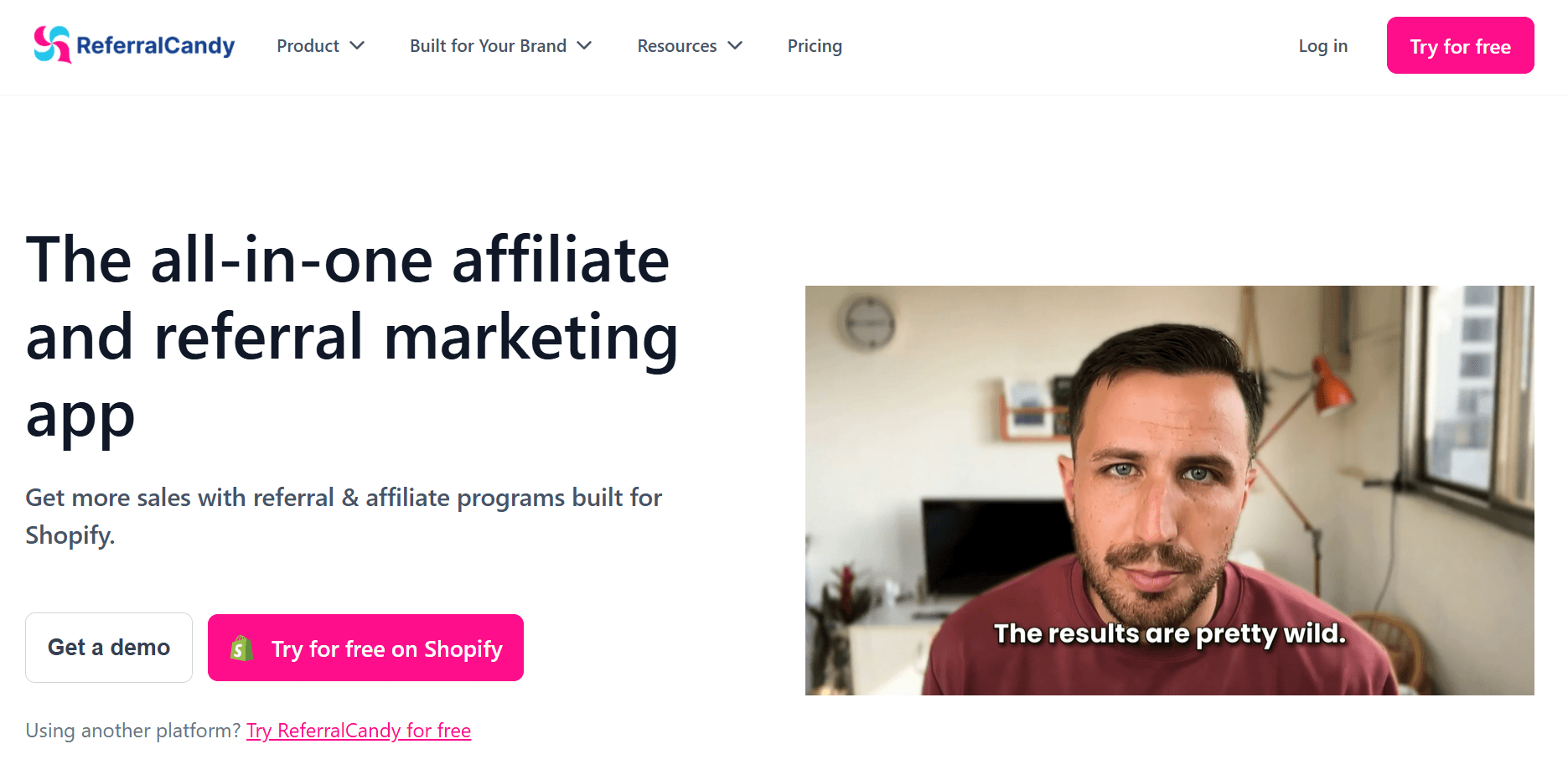
ReferralCandy is a strong fit for teams that want to get a referral program live without buying a broader loyalty or advocacy stack.
It covers the core referral workflow end-to-end, including referral and affiliate marketing campaigns, coupon-based rewards, cash or store credit incentives, fraud controls, reporting, and API access.
It also connects to a practical eCommerce stack, including ReCharge, Tremendous, Shopify, WooCommerce, BigCommerce, and Magento. User reviews consistently point to easy integrations and responsive support as strengths, which aligns with the product’s positioning as a straightforward eCommerce-first platform.
Best Features
- Unlimited affiliate and referral campaigns
- Custom coupon codes
- Cash and store credit rewards
- Fraud protection and management
- Full API access
- Integrations with core eCommerce tools (WooCommerce, Magento, Shopify)
Pros
- Easy to launch and manage for eCommerce teams
- Clear pricing compared to competitors
- Good fit for teams that want referral and affiliate campaign capabilities in one tool
- Strong support and integration experience
Cons
- Success-fee pricing may be hard to justify at higher referral volume
- Better for ecommerce than for complex B2B or offline referral flows
- Less suitable if you want loyalty, reviews, and referrals in one platform
Pricing: The Basic plan starts at $39/month plus a 10.5% success fee; Grow at $79/month plus a 3.5% success fee; Scale at $249/month plus a 1.5% success fee; and Enterprise at $799/month plus a 0.25% success fee. All plans include the same core feature set, so pricing mainly scales with referral volume and margin sensitivity rather than feature access. The vendor also offers a free trial for Shopify users.
2. Friendbuy
Best for: Mid-market and enterprise eCommerce brands that want customization and testing.
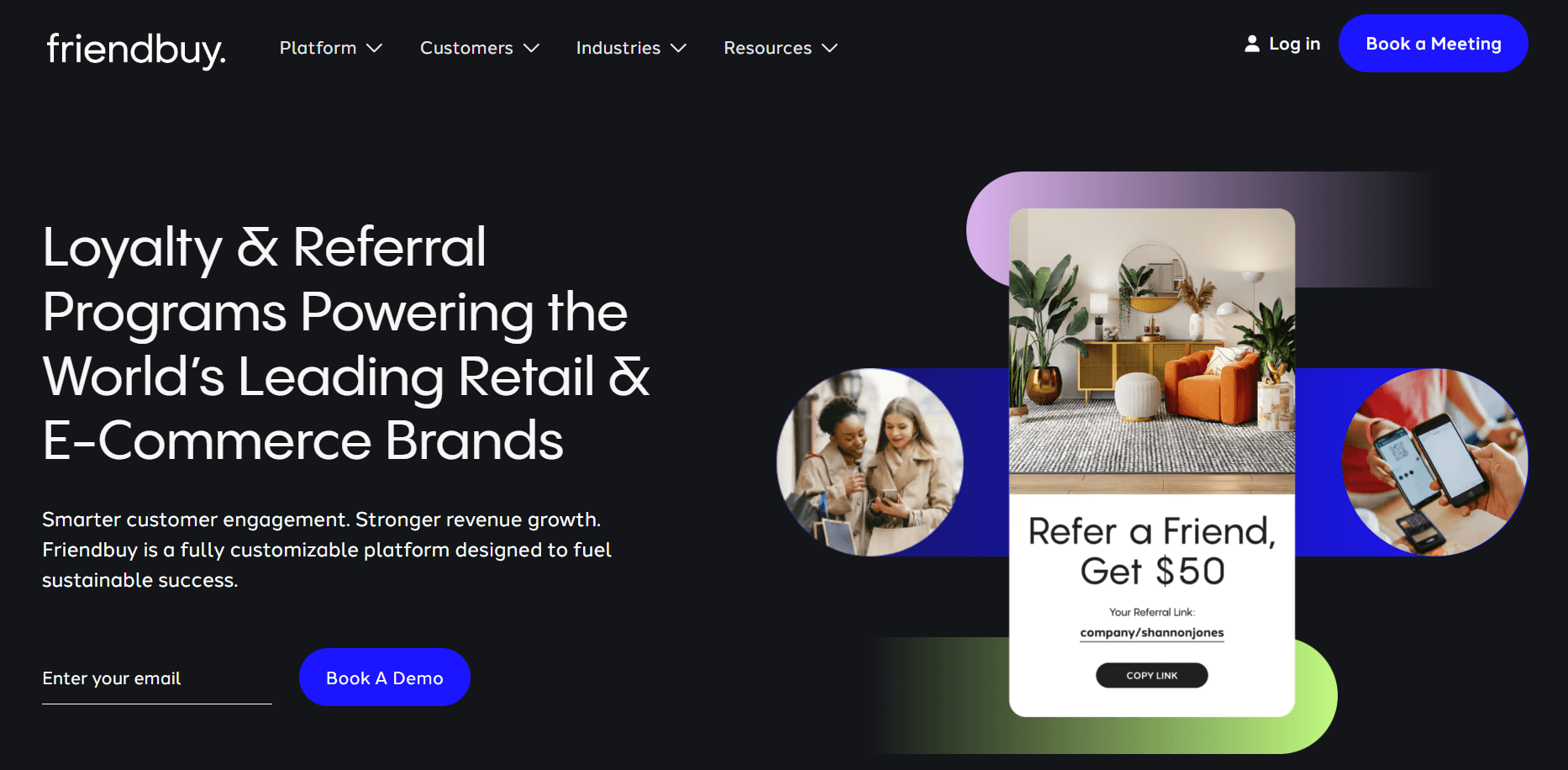
Friendbuy is better suited to teams that expect referrals to become a meaningful acquisition channel instead of a set-it-and-forget-it widget.
The platform focuses on branded referral and loyalty experiences, event-based triggers, analytics, and integrations that connect referral activity to the rest of the retention stack.
Its native ecosystem includes Shopify, Shopify Plus, Salesforce Commerce Cloud, Segment, Attentive, Braze, Iterable, and Recharge, with one-click integrations that reduce setup time. Recent user reviews are mixed but useful, as buyers consistently highlight support and ease of setup as positives, while some mention reporting limitations and integration friction depending on the use case.
Best features
- Widget builder
- Referral and loyalty program management
- Event-triggered campaigns
- Analytics and referral tracking
- API support
- Branded experiences
- Testing capabilities
Pros
- Better suited to customization than simpler plug-and-play tools
- Strong fit for eCommerce brands already using a mature retention stack
- Support team is a recurring positive in user feedback
- Easy enough to implement
Cons
- Too complex and feature-packed for smaller teams that just need a straightforward referral setup
- Public pricing is not available
- Some reviewers report limitations in reporting and data visibility
Pricing: Friendbuy doesn’t disclose its standard pricing on its main product pages, so you’ll need to request a quote and see whether it meets your business needs.
3. Talkable
Best for: Enterprise eCommerce brands that want referral marketing software built around testing, segmentation, and tighter program control.
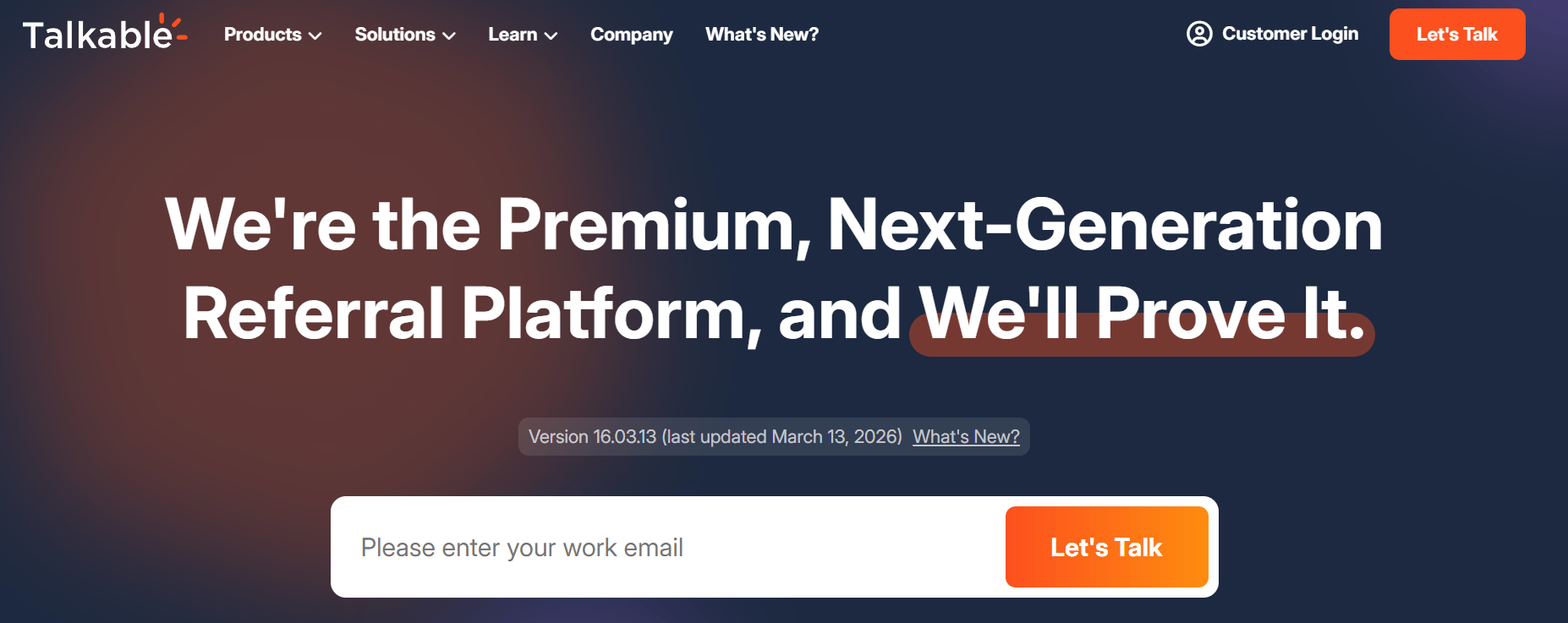
Talkable is a platform that prides itself on being a “premium, next-generation referral platform.” It’s ideal for teams that want more control over how their referral marketing program runs and plan to actively optimize it rather than launch it once and move on, with built-in A/B testing and configurable reporting designed for continuous optimization.
In addition to built-in A/B testing, the platform also supports segmentation, fraud prevention, post-purchase prompts, invite pages, floating widgets, product sharing, referral dashboards, and video referral formats.
It also integrates with platforms such as Shopify, Salesforce, Magento, Adobe Commerce, Attentive, and Tremendous. Review-platform summaries consistently position it as a better fit for brands with meaningful revenue scale and a need for hands-on optimization.
Best Features
- A/B testing
- Segmentation
- Fraud prevention
- Dashboard reporting
- Post-purchase and floating widget campaigns
- Product sharing
- Video referrals
Pros
- Strong integration ecosystem (Shopify, Salesforce, etc.)
- Broad campaign-format support
- Good option when referral and loyalty are managed together
- Designed to reduce ongoing engineering involvement for campaign changes
Cons
- Users report poor customer support
- Non-transparent pricing
Pricing: Talkable uses custom pricing. The company prices based on brand size and referral goals rather than fixed self-serve plans, so buyers should expect a demo-based sales process and plan sizing based on scale, complexity, and support requirements.
4. Referral Factory
Best for: Startups and lean marketing teams that need a referral marketing tool they can launch without engineering help.
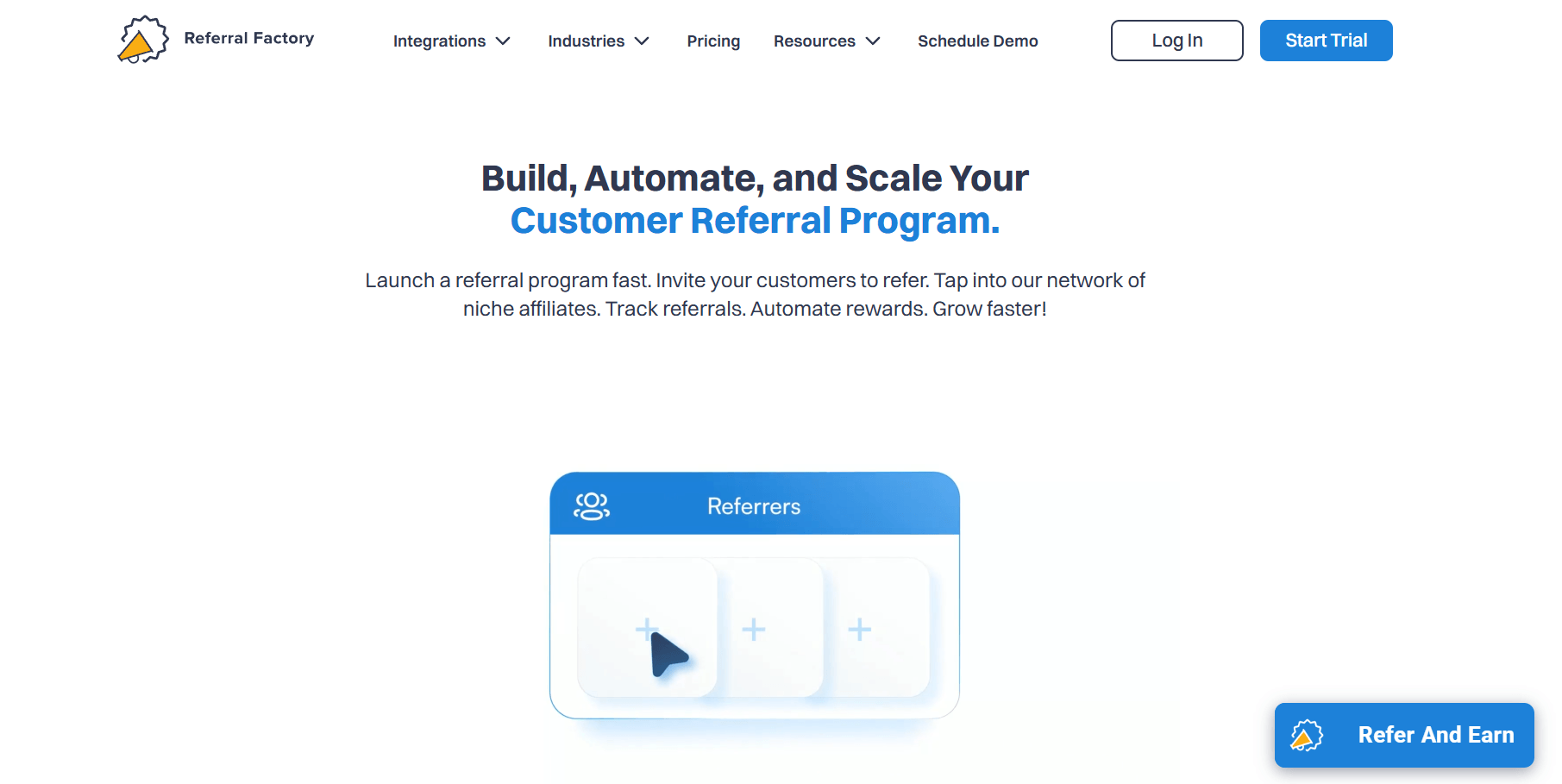
Referral Factory is a referral platform built for speed and simplicity. It lets you create and launch referral programs using pre-built templates, with minimal setup and no dependency on developers. The platform supports both referral and affiliate marketing use cases, making it flexible enough for different customer acquisition models.
You can build campaigns using a visual editor, embed referral flows into your site, and connect the platform to your existing stack through native integrations (Stripe, Zoho, Salesforce, etc.) or Zapier. Tracking, reward fulfilment and handling, and fraud detection are handled out of the box, which reduces the need for manual oversight.
It’s a practical option for teams that want to launch their referral program quickly and iterate without relying on developers.
Best Features
- Pre-built templates
- Visual campaign builder
- Embedded referral widgets
- Automated tracking
- Fraud alerts
- Wide range of reward types
Pros
- Quick to launch
- Broad integration support
- Multilingual customer support
- Easy to manage without technical resources
Cons
- Limited customization compared to enterprise platforms
- Clunky dashboard
Pricing: Referral Factory follows a tiered pricing model based on usage and feature access. The Starter plan begins at $95/month and covers 950 users and the basics for launching one referral program, including templates, referral tracking, and core integrations.
The Basic ($200/month) and Pro ($400/month) plans add more flexibility in terms of campaign volume, integrations, and reward options, while the Enterprise plan is custom and designed for higher-scale use cases, with expanded limits (100,000+ users), priority support, and more advanced capabilities. The platform also offers a 15-day free trial.
5. Extole
Best for: Enterprise brands that want referral software as part of a wider customer-led growth program.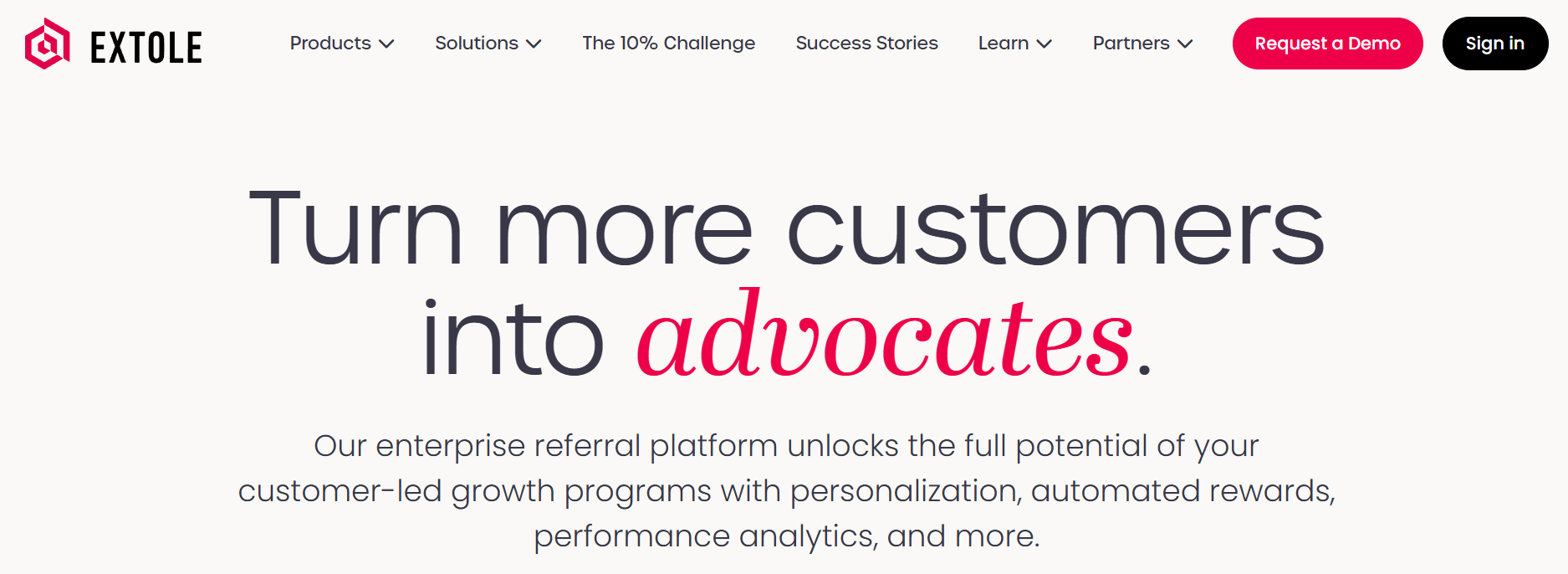 Extole goes beyond the standard refer-a-friend setup. Its platform covers referrals, engagement, loyalty, influencer, and ambassador programs, with built-in personalization, automated rewards, and performance analytics.
That makes it a stronger fit for enterprise teams that want one platform to support multiple advocacy motions. User and review-platform summaries also point to good customization, strong technical support, and a relatively seamless implementation experience for complex environments.
Best Features
- Referral, engagement, loyalty, influencer, and ambassador program support
- Personalization
- Automated rewards
- Performance analytics
- Enterprise-grade program management
- Developer-friendly implementation options
Pros
- Better fit than simpler tools for multi-program advocacy strategies
- Strong customization potential
- Good technical support according to recent review summaries
- Can support more complex enterprise use cases across channels
Cons
- No public pricing
- Likely too complicated for smaller teams
- Reporting may be complicated for new users
Pricing: Extole doesn’t disclose its pricing. For most buyers, that means the platform is best evaluated when you already know you need enterprise scope, broader customization, and support.
6. Yotpo Loyalty and Referrals
Best for: eCommerce brands that want referrals inside a broader retention stack.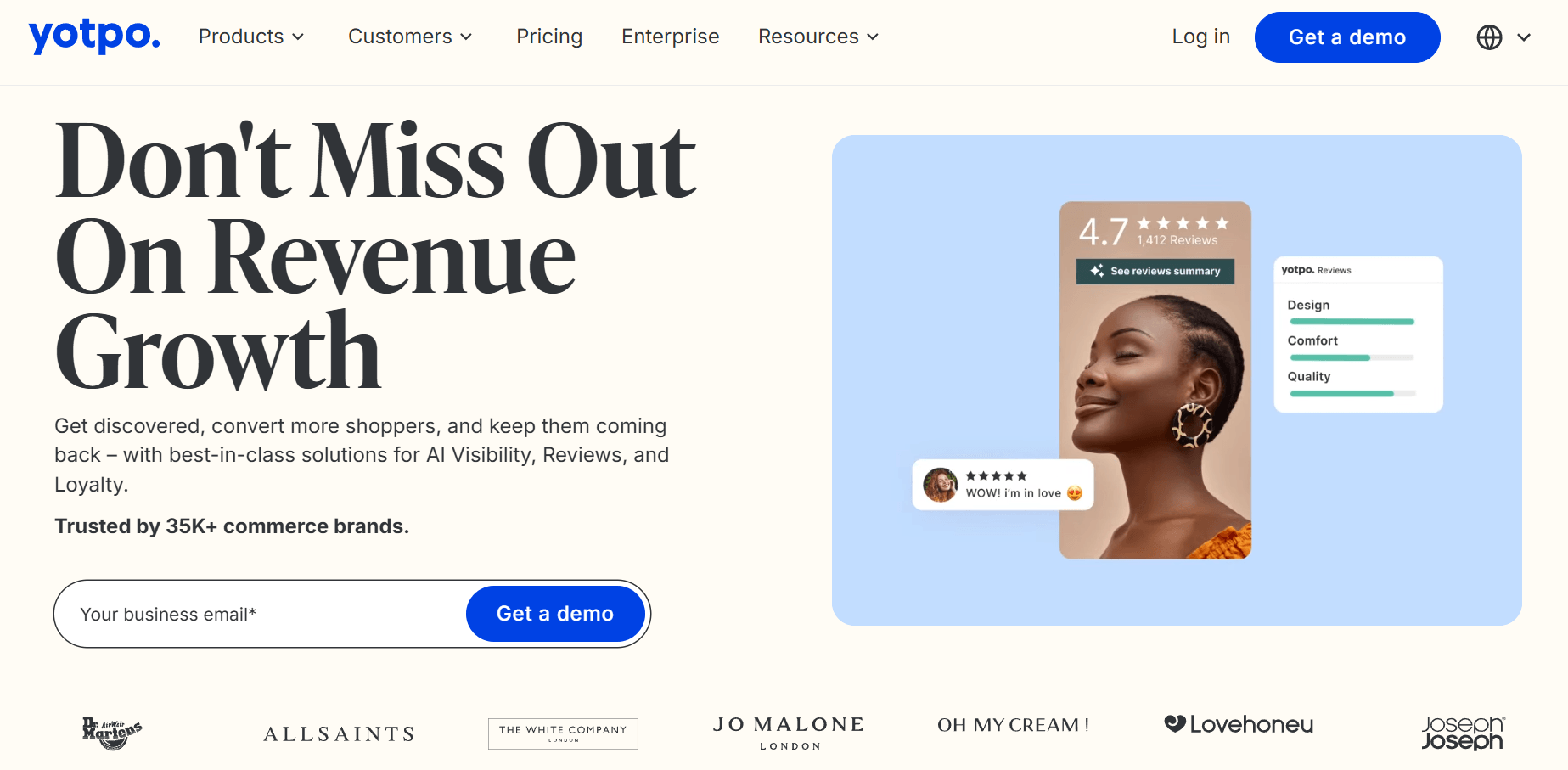 Yotpo makes the most sense when you aren’t buying referral software in isolation. Its loyalty and referral platform sits alongside reviews, SMS, email, subscriptions, and a broader eCommerce retention ecosystem.
The platform supports custom referral pages, intelligent popups, email promotion, ROI dashboards, customer-level activity tracking, and integrations with tools such as Recharge.
According to user feedback, the platform stands out for its ease of use, support, and the value of its integrated ecosystem. At the same time, though, reviews mention pricing as a concern for smaller brands.
Best Features
- Loyalty and referral program management
- Custom referral pages
- Intelligent popups
- Email-based referral promotion
- ROI and analytics dashboards
- Customer-level activity tracking
- Integrations across the wider Yotpo ecosystem, including Recharge
Pros
- Good option if you want loyalty, referrals, and retention tools connected
- Strong fit for eCommerce brands
- Generally easy to use, according to recent review summaries
- Support and integrations are recurring strengths in user feedback
Cons
- Pricing isn’t transparent
- May be more complicated than you need if referrals are your only goal
Pricing: Yotpo routes buyers through a demo-led pricing flow. That usually makes sense for brands evaluating multiple Yotpo products together, but it adds friction if you’re only trying to price a referral program.
7. Ambassador
Best for: Brands that want referral software plus partner, affiliate, influencer, or loyalty capabilities.
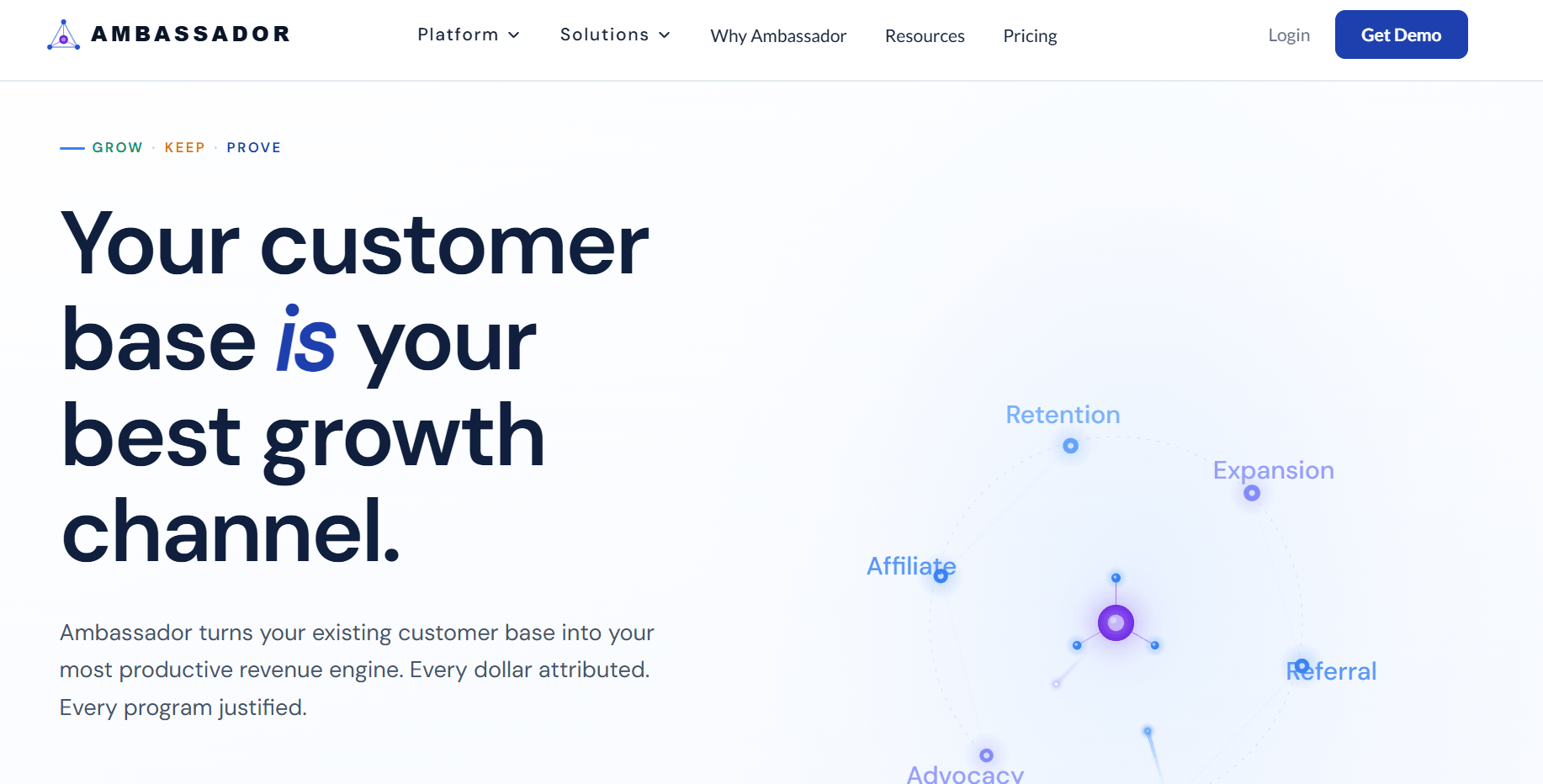
Ambassador is broader than classic referral marketing software. Its current platform positioning covers referral, affiliate, influencer, partnership, and loyalty functionality, with an emphasis on customer attribution, incentive management, reporting, and integration depth.
One of its clearest differentiators is the integration layer. The tool highlights two-way syncing across your CRM, Enterprise Resource Planning System (ERP), your Content Management System (CMS), email, SMS, product, and in-app environments, plus a Salesforce Managed Package. User reviews tend to praise ease of use, support, and customization, though onboarding can feel heavy depending on the team.
Best Features
- Referral, affiliate, influencer, partnership, and loyalty program support
- Attribution and reporting
- Incentive management
- Two-way data syncing
- Salesforce Managed Package
- Integrations across business systems and customer channels
Pros
- Better fit than referral-only tools for broader program strategies
- Strong integration story for larger organizations
- Good customization potential
- Support is a recurring strength in customer reviews
Cons
- No simple public pricing for the core platform
- Functionality can be too complicated for straightforward customer referral programs
- Onboarding may be more involved than lighter tools
Pricing: Ambassador’s referral and growth platform is sold through a custom pricing process. The company positions it for brands that need scalable infrastructure, complex data syncing, and multiple advocacy motions, so the real buying conversation is less about pricing plans and more about implementation scope.
8. LoyaltyLion
Best for: Shopify brands that want referrals tied closely to loyalty and repeat purchase strategy.
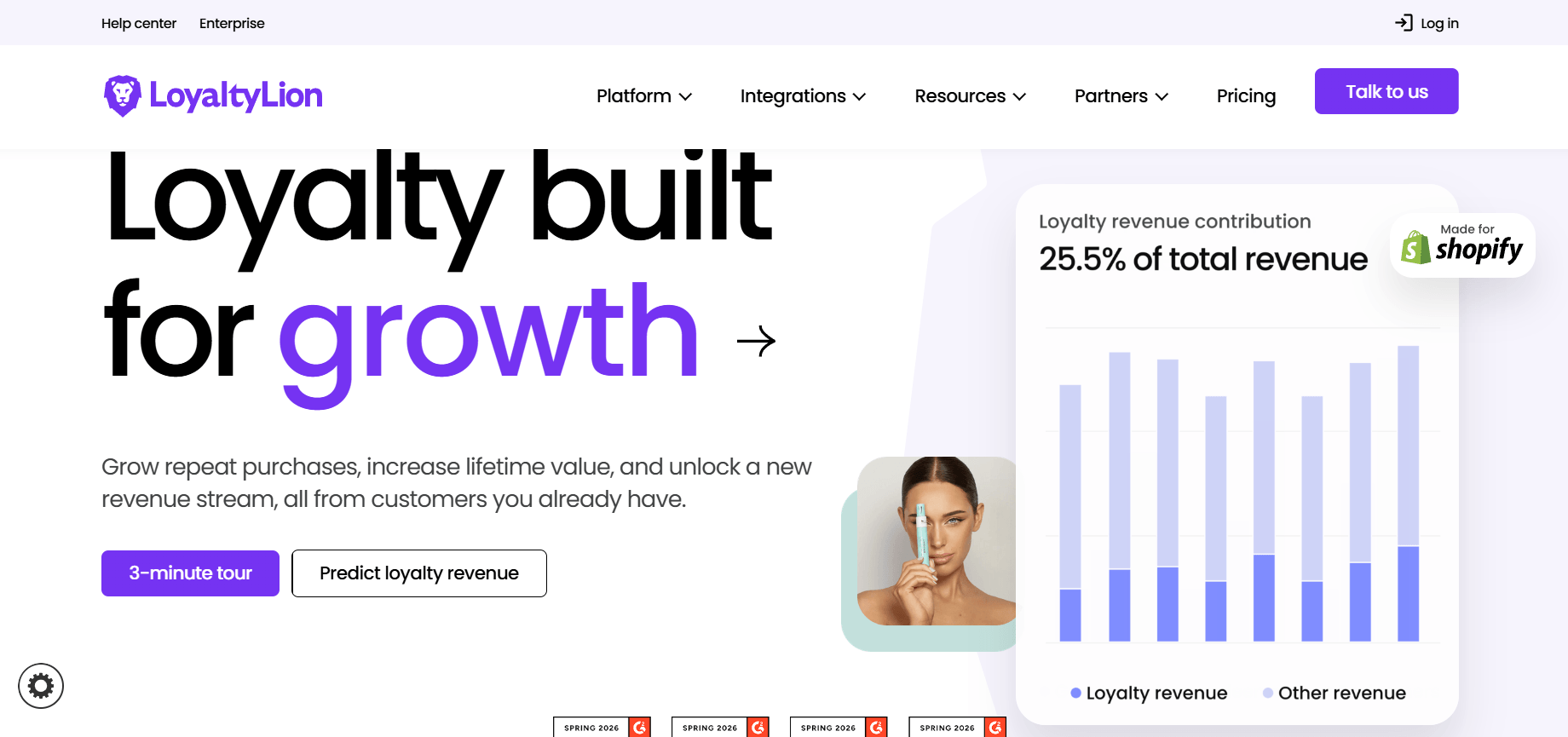
LoyaltyLion is strongest when referrals are one part of a broader loyalty program, not a standalone customer acquisition tactic.
The platform supports referral modules, shareable links, welcome experiences for referred friends, post-purchase and review-based prompts, top-referrer nurturing, and flexible rewards.
It also scales pricing by monthly order volume and is built specifically for Shopify brands. User reviews point to ease of use, strong support, and good customization. On the other hand, some users report the lack of deeper analytics or ongoing optimization help.
Best Features
- Loyalty and referral program management
- Referral modules and shareable URLs
- Post-purchase and review-triggered prompts
- Flexible rewards and a customizable reward structure with caps
- Top-referrer nurturing
- Shopify-native focus
- Integration with Klaviyo and subscription workflows on higher plans
Pros
- Strong fit for Shopify brands focused on retention
- Easy for teams to manage once implemented
- Support is widely praised in review summaries
- Good choice when you want one system for loyalty and referrals
Cons
- Limited fit outside Shopify
- Analytics depth may not satisfy every team
- Pricing scales with order volume, which can get expensive as stores grow
Pricing: LoyaltyLion uses a tiered pricing model based on monthly order volume and feature access. The platform offers three main plans:
- Classic – Starts at $199/month: covers 500 orders per month and includes core loyalty and referral functionality for smaller Shopify stores.
- Advanced – Custom pricing: adds more flexibility around customization, integrations, and program management.
- Plus – Custom pricing: designed for higher-volume brands with more complex requirements and support needs.
As you move up tiers, you get access to more advanced features, deeper integrations, and higher usage limits. Overall, pricing scales with store size and program complexity, which makes it predictable for growing eCommerce brands but potentially expensive as order volume increases.
9. ReferralHero
Best for: Startups, SaaS, waitlists, contests, and signup-driven referral campaigns.
ReferralHero stands out because it isn’t locked into a typical eCommerce refer-a-friend model.
The referral marketing software supports waitlists, contests, and affiliate and referral programs, making it more useful for SaaS, product launches, newsletters, and lead-generation campaigns.
The pricing page highlights branding controls, analytics, integrations, Facebook Pixel support, anti-fraud, coupon codes, custom sender domains, API access, webhooks, and cash payouts. It also keeps the barrier to entry low with a free plan and a flat-rate structure rather than success fees.
Best Features
- Referral, affiliate, waitlist, and contest campaigns
- Analytics
- Anti-fraud controls
- Coupon codes
- Automation emails
- Email marketing integrations (Mailchimp, Moosend, ActiveCampaign, etc.)
- Cash payouts
- Facebook Pixel support
- Branding controls and custom sender domains
Pros
- Good fit for non-eCommerce referral motions
- Transparent pricing with a free plan
- Flexible enough for lean growth teams
- No developer required for standard setup
Cons
- Less naturally aligned to loyalty-heavy retail use cases
- Enterprise functionality depends on bespoke packages
- Some plan presentation on the pricing page is a little confusing
Pricing: ReferralHero’s paid plans start with Basic at $249/month, Pro at $399/month, and Pro + Done For You Service with custom pricing that includes full setup, strategy, and priority support. You can try the Basic and Pro plans for 7 days for free.
10. Referral Rock
Best for: SMBs, B2B teams, and service businesses that want a practical referral platform with transparent pricing.
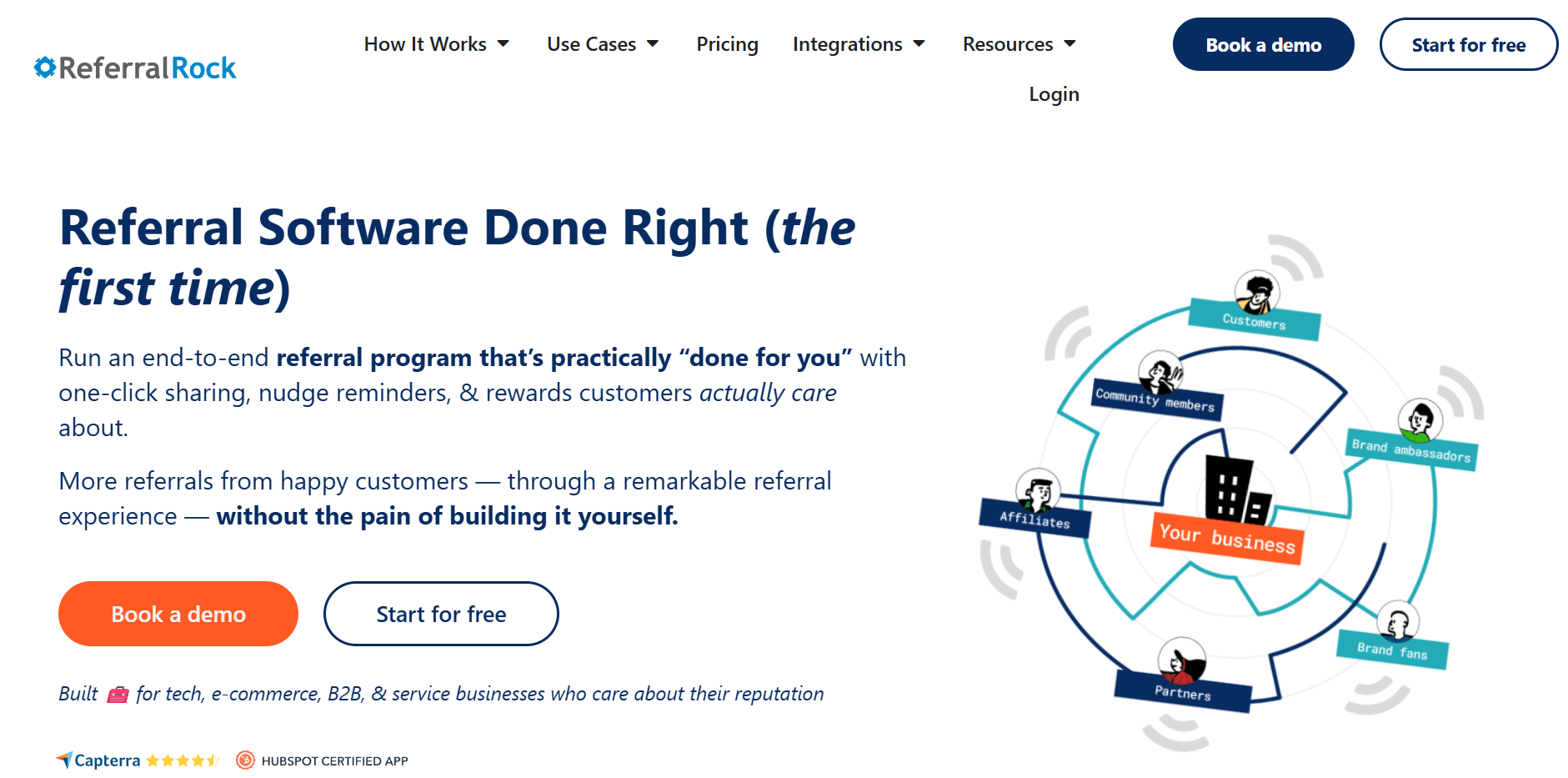
Referral Rock is a good fit for teams that want something more structured than a lightweight widget but less involved than an enterprise referral marketing software platform.
It supports end-to-end referral programs, hosted member portals, lifecycle tracking, landing pages, form tracking, CRM integrations, and payouts. Its integration library spans 50+ tools and supports both multi-step CRM-driven sales processes and more transactional flows. User reviews consistently point to ease of use, strong support, and solid integration value.
Best Features
- Hosted member portal
- Referral lifecycle tracking
- Hosted landing pages and form tracking
- Rewards for leads or new sales
- Gift card and cash payout options on higher plans
- API access
- 50+ integrations across CRM, eCommerce, email, forms, payouts, and automation tools
Pros
- Transparent pricing
- Useful for service businesses and B2B
- Strong support reputation
- Easy to connect to existing tools and workflows
Cons
- Overages can apply to referral volume
- Some add-ons are required for deeper CRM use cases
- Advanced flexibility is not as deep as more enterprise-focused platforms
Pricing: Referral Rock uses a tiered pricing model. Its Professional plan starts at $175/month, while Professional+ starts at $350/month. The lower tier covers the core program infrastructure, while the higher tier adds gift card options, cash payouts, support for custom domains, and a longer audit log.
Users should also note that overages may apply if monthly referral limits are exceeded, and guided onboarding is included with annual plans or available as a one-time paid add-on for monthly plans.
11. Influitive
Best for: B2B SaaS and enterprise brands that want referrals as part of a broader customer advocacy program.
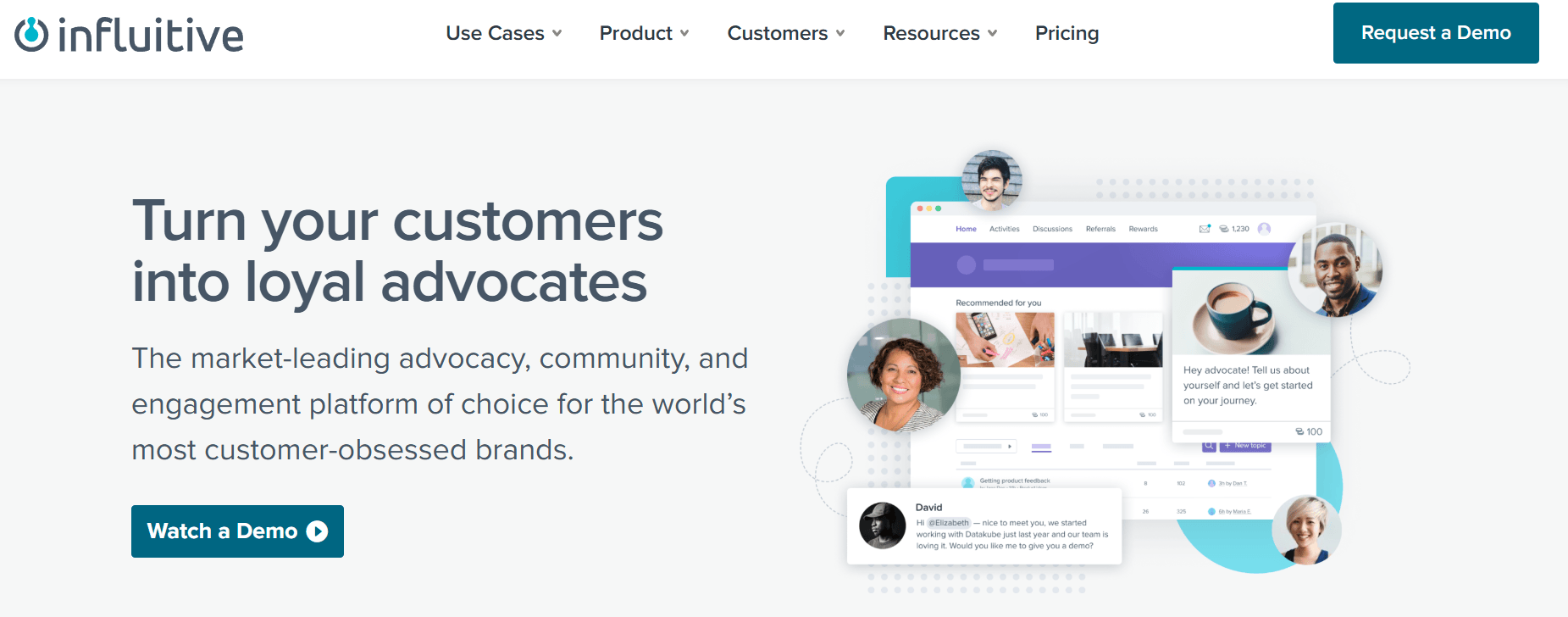
Influitive is built for companies that want to turn customer advocacy into an ongoing program covering referrals, references, reviews, feedback, onboarding, and community engagement. That makes it a better fit for B2B SaaS and larger organizations than for brands looking for a simple refer-a-friend setup.
The platform focuses on advocacy-driven engagement, with tools for personalization and targeting, loyalty and rewards, pre-built templates and campaigns, and analytics and ROI reporting.
If your team wants referral software that also supports customer marketing and advocacy at scale, Influitive is a strong option. If you only need a straightforward referral program, it is likely more complex than you need.
Best Features
- Customer advocacy and community platform
- Referral, reference, and review program support
- Loyalty and rewards
- Personalization and targeting
- Pre-built templates and campaigns
- Analytics and ROI reporting
- Community features such as discussions, moderation, knowledge base, ideation, and Q&A on the Digital Community plan
Pros
- Strong fit for B2B SaaS and enterprise advocacy programs
- Goes beyond referrals into references, reviews, and feedback
- Good option for teams that want advocacy and community in one platform
- Built to support ongoing customer engagement, not just one-off campaigns
Cons
- Not ideal for brands that only need a simple referral tool
- No public pricing
- A broader scope may add complexity for smaller teams
Pricing: Influitive uses a sales-led pricing model. Its pricing page shows two product paths, Customer Advocacy and Digital Community. Buyers need to talk with sales to get a quote based on scope, use case, and platform requirements.
12. Mention Me
Best for: Larger retail and eCommerce brands that use referral marketing as part of a broader customer advocacy strategy.
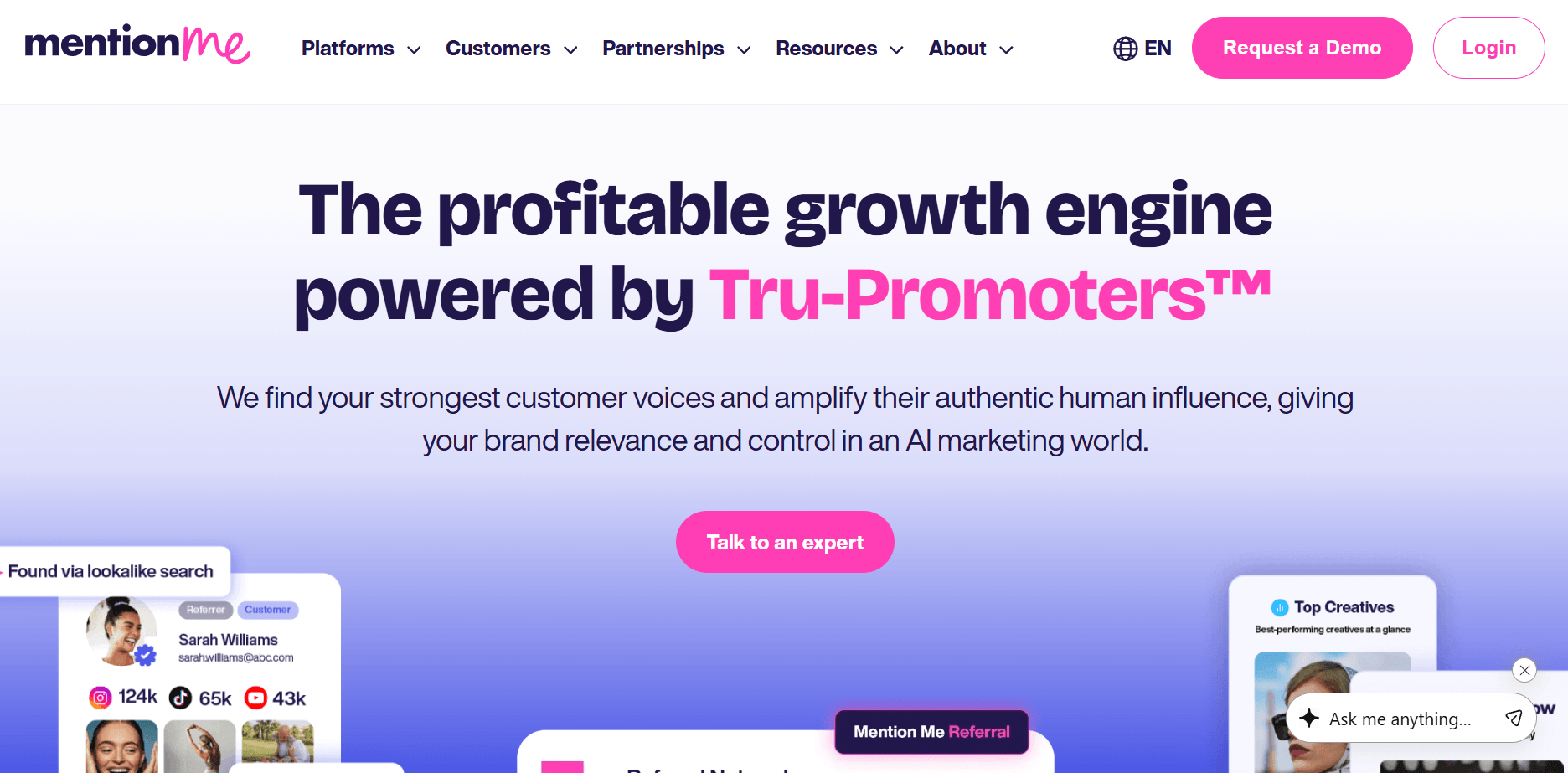
Mention Me focuses on customer advocacy, AI-powered referral optimization, personalization and omnichannel execution, including its Name Share feature, which allows referrals without links by using the customer’s name at checkout. The company also highlights that referral data can be pushed into broader automation and personalization workflows. This matters if referrals need to feed lifecycle, retention, and CRM programs.
User reviews consistently describe the platform as effective for acquisition and retention, with good support and generally easy management. However, some users mention interface complexity.
Best Features
- Referral and advocacy platform
- Personalization and omnichannel execution
- AI-powered optimization positioning
- A/B testing and performance improvement workflows
- Martech integrations for automation and segmentation
- Referral data activation across the wider customer stack
Pros
- Strong fit for brands treating referral as a real acquisition channel
- Better than simpler tools for broader advocacy strategy
- Support is a consistent strength in review summaries
- Can help connect referral performance to the wider marketing stack
Cons
- No public pricing
- More complicated than most smaller teams need
- The interface may take some getting used to for day-to-day users
Pricing: Mention Me doesn’t offer a standard subscription fee. As with other enterprise-leaning platforms, that usually means buyers should expect a consultative sales process and pricing based on scale, program design, integrations, and support requirements.
Ready to Make a Choice?
The best referral marketing software is the one that fits how your business actually acquires new customers and treats your existing customers.
Much like other marketing tools, choosing the right referral marketing software comes with nuance. Some teams need a lightweight tool they can launch quickly. Others need deeper integrations, tighter control, or a platform that connects referral experiences to loyalty, advocacy, or partner programs.
The mistake is choosing a provider that carries complexity you don’t need or skipping capabilities you’ll need six months from now. Start with your use case, your stack, and your reporting needs. The right shortlist usually gets clearer from there.
FAQs
Now, let’s answer some of the most common questions regarding referral program software.
1. What is the best referral marketing software overall?
There’s no single best referral marketing software for every business. For eCommerce-first teams, ReferralCandy is one of the strongest standalone options, while Friendbuy and Talkable make more sense for enterprise eCommerce, and Yotpo or LoyaltyLion work better when referrals are part of a larger retention system.
2. What is the best referral marketing software for eCommerce
For eCommerce, the strongest options are ReferralCandy, Friendbuy, Yotpo, LoyaltyLion, Talkable, and Mention Me, depending on brand size and whether you want standalone referral marketing software or a broader loyalty or advocacy platform.
3. Can small businesses use referral marketing software?
Yes. Referral Factory, ReferralHero, and Referral Rock are all viable options for smaller teams or simpler acquisition programs, especially when fast setup and transparent pricing matter more than enterprise complexity.
4. What features should referral marketing software include?
At minimum, look for referral links or codes, double-sided rewards, fraud prevention, integrations, reporting, and flexible reward controls. More advanced referral marketing software should also support testing, segmentation, customer-level activity tracking, and automated payouts.
5. What is the difference between referral marketing software and affiliate software?
Referral marketing software is usually built around customers becoming brand ambassadors by recommending a brand to friends, often with double-sided rewards. Affiliate software is more commonly built around leveraging an affiliate’s customer base, with ongoing promoter relationships, commissions, partner onboarding, and publisher-style tracking. Some platforms, like Ambassador and ReferralCandy, now blur that line by supporting both.
Similar Posts

 Published by

 Published by

 Published by

Create, send and optimize your email marketing campaigns