















Content Marketing Tips for Your Digital Marketing Strategy [2026]
Published By Milan Kordestani
June 10, 2026

10/06/26
Content marketing plays a bigger role in digital marketing than most teams realize. It gives your SEO, email marketing, social media, and landing pages something meaningful to offer in the first place.
Without useful content, campaigns become harder to sustain. Search visibility drops, emails become less relevant, and marketing messages start to feel disconnected.
Strong content helps connect those efforts. It gives people a reason to engage with your brand and move closer to taking action.
In this post, we’ll explore how content supports your wider marketing efforts and share content marketing tips for your digital marketing strategy.
How Does Content Marketing Support Digital Marketing?
Content marketing gives your digital marketing channels something useful to share, giving people a reason to find you, trust you, and take the next step.
Since every channel depends on it in different ways, content shouldn’t be treated as a separate blog function; it should support the entire customer journey.
For instance, someone might discover your brand through search, read an article, join your email list, click a newsletter, and eventually convert through a landing page. Content keeps those interactions connected.
In a nutshell, content marketing supports digital marketing by helping you:
- Show up when people search for answers
- Explain your value before someone talks to sales
- Give email campaigns more helpful material
- Keep your message consistent across channels
- Build trust with useful examples, proof, and education
- Move people toward the next step with less friction
Best Content Marketing Tips for Your Digital Strategy
The tips below will help you create more purposeful content, use it across channels, and connect it to measurable results.
1. Set clear goals before creating content
One of the easiest ways to waste content effort is to create pieces that have no real purpose.
Before you write a piece of content, define what it should accomplish. The goal may be brand awareness, email list growth, lead generation, or conversion support.
Each goal changes how the content should be written. For example:
- Awareness content should be easy to discover and simple to understand.
- Lead generation content should offer a clear reason to subscribe or convert.
- Nurture content should answer objections and build confidence.
- Conversion-focused content should make the next step feel natural.
This is where content becomes strategic instead of reactive.
A useful way to plan is to assign each asset a primary and a secondary goal. For instance, a blog post may be built to attract organic traffic first and support email signups second through a form.
Here’s an example from Drip’s blog:
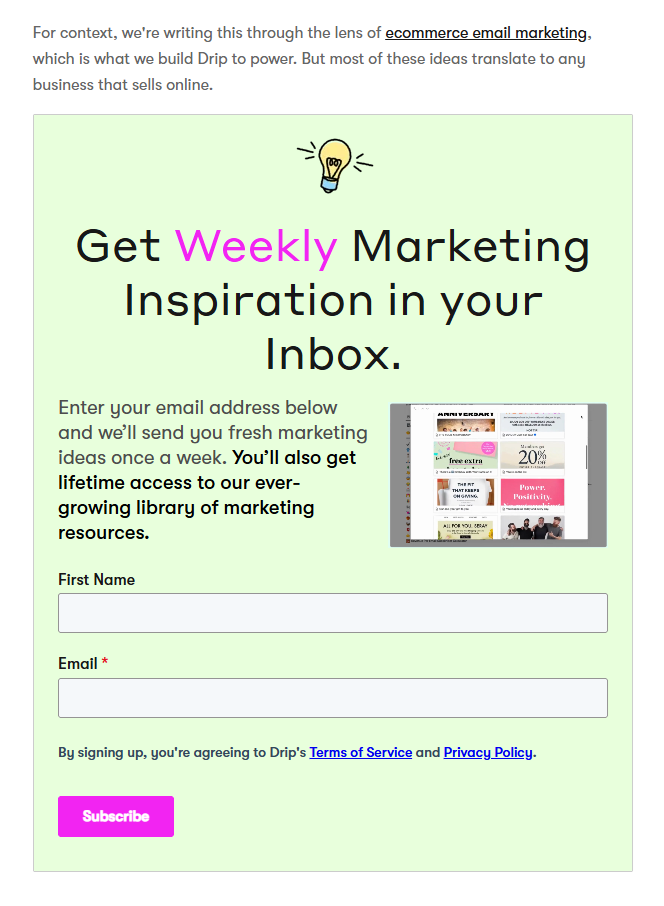
That small decision improves focus, helping you avoid generic content that fills the calendar but doesn’t support the business.
Broader marketing research also shows how important alignment has become for modern marketing teams. When content is tied to clear goals, it is easier to plan, approve, distribute, and measure.
2. Build content around real audience questions
The best content usually starts with actual customer queries.
Your audience is already telling you what they need help with. You can find those questions in sales calls, support conversations, search queries, comments, reviews, community discussions, and internal team notes.
Each of these questions is a content opportunity. So, start by grouping them into stages:
- What do people ask before they understand the problem?
- What do they ask while comparing options?
- What do they ask before they take action?
- What do customers ask after they buy?
This gives your strategy a greater range, allowing you to create content that supports discovery, evaluation, conversion, and retention.
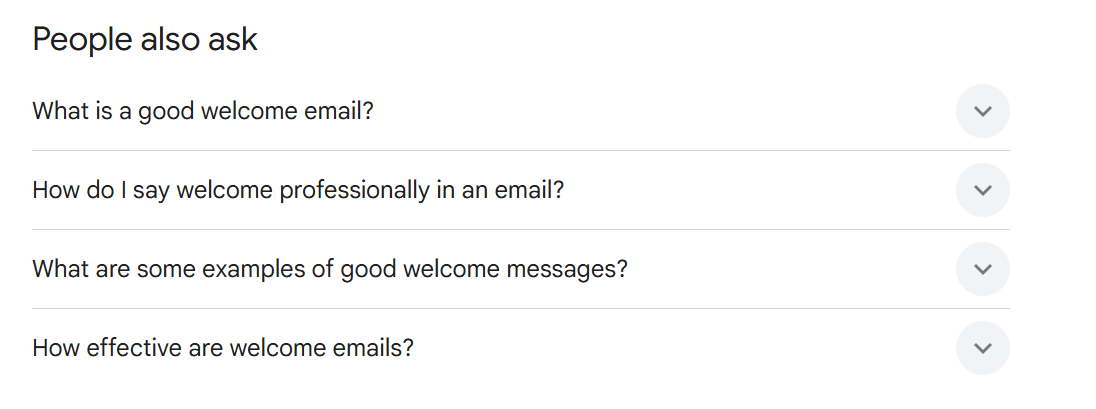
For example, a broad topic like “email marketing” may be too general on its own. A more useful question might be, “What should a welcome email include?” or “How often should small teams send newsletters?”
Those questions are easier to answer, easier to structure, and more useful for the reader. Also, you can find these queries on Google by scrolling down to the “People also ask” section, or use tools like Ahrefs and Semrush.
3. Improve visibility by optimizing content for LLMs
Search behavior is changing. People now search in more conversational ways, and AI-powered search experiences often prioritize content that answers questions clearly and directly.
That means that even if you answer audience queries, it may still not be enough to get your brand out there. Content that performs well today is structured, specific, and easy to understand.
So, to get better visibility, focus on:
- Answering the main question early
- Using clear headings and logical structure
- Covering topics with enough depth and context
- Writing naturally around related terms and concepts
- Creating focused sections that are easy to scan
This is especially important for AI Overviews and other AI-driven search experiences, where content needs to be clear enough for systems to interpret and surface confidently.
The goal is not to “write for AI,” but to create content that’s useful, organized, and easy to understand for both people and search systems.
4. Use content to strengthen your email marketing
Email marketing performs better when you have something useful to send.
Many email programs struggle because they rely too heavily on promotions, company updates, or repetitive reminders.
Content gives your emails more value. It helps you educate subscribers, stay visible between campaigns, and create better reasons for people to keep opening your messages.
Different types of email content support different stages of the customer journey:
- Welcome emails: Introduce your brand and guide new subscribers toward a useful next step, such as a guide, tutorial, or product walkthrough.
- Newsletter emails: Share educational content, industry insights, updates, or useful resources that keep your audience engaged consistently.
- Promotional campaigns: Add context to your offer by explaining the problem, use case, or value before prompting the conversion.
- Onboarding emails: Help new users understand your product, discover features, and reach value faster.
- Re-engagement emails: Offer useful content, updates, or new resources to reconnect inactive subscribers with your brand.
- Post-purchase emails: Support customers after conversion with tutorials, FAQs, recommendations, or educational follow-ups.
- Lead nurturing campaigns: Deliver content that gradually moves subscribers from early interest to sales readiness through education and trust-building.
For example, this welcome email from Fable immediately introduces the brand, explains its product philosophy, highlights safety and durability, and gives new subscribers a first-purchase incentive.

Instead of jumping straight into promotion, the email focuses on building trust and helping readers understand the brand first.
5. Repurpose content across digital channels
A strong content strategy shouldn’t make every channel start from scratch. One good idea can support several parts of your digital marketing plan.
Repurposing, though, doesn’t mean copying and pasting the same content everywhere. To make it work, you need to adapt a single useful idea across different formats and moments in the customer journey.
For instance, a blog post about analysis paralysis in marketing could become:
- A newsletter about over-reporting and decision fatigue
- A LinkedIn post on why “perfect attribution” slows teams down
- A checklist for making faster campaign decisions
- A landing page section about simplifying reporting workflows
For example, Moosend’s newsletter repurposed a broader discussion of analysis paralysis into a shorter, more focused email. Instead of trying to cover the entire topic again, it highlighted the core problem, explained the impact, and turned the content into actionable advice readers can apply quickly:
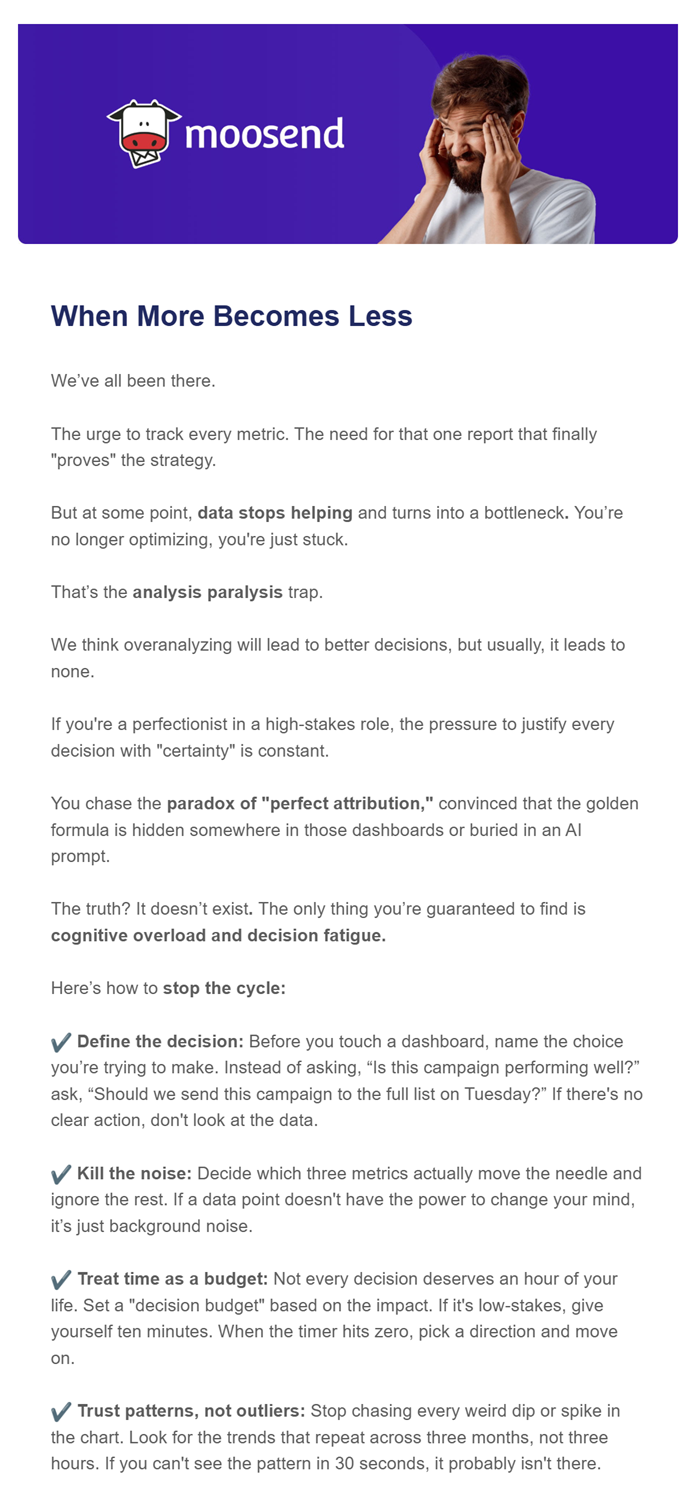
This helps you get more value from every idea and makes your message more consistent, since each version stems from the same core point.
Content repurposing matters because audiences consume information in different ways. Some people read long-form guides. Others prefer email, video, social posts, or shorter summaries.
6. Keep your messaging consistent across channels
When your blog says one thing, your email says another, and your landing page says something else, the experience feels fragmented. Even if each piece looks polished, the overall message becomes harder to trust.
Consistency entails using the same core promise, audience understanding, and tone across touchpoints.
This matters because people rarely move through a clean, one-step journey. Someone may find your article in search, subscribe through a form, read a welcome email, click a campaign, and land on a conversion page. If each step feels disconnected, confidence drops.
Good content helps prevent that by giving your team shared language. It clarifies the main themes, proof points, objections, and next steps that should appear across channels. It also helps your brand feel more recognizable without sounding repetitive.
7. Focus on quality over quantity
More content doesn’t automatically mean better results. In many cases, it creates the opposite problem. Teams publish quickly, but the work becomes thin, repetitive, or loosely connected to the customer journey.
Quality matters because your audience has limited attention. If a piece doesn’t answer a clear question or help someone make progress, it becomes noise.
Also, this doesn’t mean every article needs to be long or complex. A smaller number of strong pieces can often support your strategy better than a high volume of weak ones.
For instance, one useful piece can attract search traffic, feed an email sequence, and help sales conversations. Ten generic posts may do very little.
So before you publish more, ask whether each piece deserves to exist. Does it answer a real question? Does it support a clear goal? Can it be reused across channels? Does it help the reader make a better decision?
If the answer is no, volume won’t fix the problem.
8. Create a simple workflow your team can manage
A good content strategy should also be sustainable.
If your process depends on last-minute ideas, unclear ownership, or endless approvals, consistency will eventually break. That isn’t usually a creativity issue but a workflow problem. But does this mean you need a complex process to manage everything?
Well, no. For many teams, a simple flow works best:
- Choose one topic tied to a clear goal
- Define the audience question behind it
- Decide which channel will lead
- Draft the core asset
- Adapt it for email, social, or landing page use
- Review for message clarity
- Publish and measure the result
This kind of workflow keeps the team focused. It also reduces the chance of content getting stuck because no one knows who owns the next step.
A smooth flow is also important when content supports conversions. If the blog post, email, and landing page aren’t aligned, the journey becomes less effective.
9. Measure the results that matter most
You don’t need a complicated dashboard to understand whether content is helping your digital strategy.
Start with the signals that match the goal of the piece:
- For visibility, look at search impressions, clicks, and the types of queries that drive traffic.
- For engagement, check email interaction, scroll depth, page behavior, and repeat visits.
- For conversion support, take a look at form fills, assisted conversions, demo requests, or lead quality.
The point here is to measure the right things to get to the right conclusions.
Google’s Search Console is useful for understanding how people find your content through search. It can help you see which queries bring traffic, which pages earn clicks, and where there may be room to improve.
This matters because content performance is not only about traffic volume. A smaller audience with stronger intent may be more valuable than a larger audience that never takes action.
Useful measurements help you answer practical questions like: “Which topics attract the right people?” and “Which emails drive people back to useful resources?”
That’s how content becomes a strategic asset instead of a publishing habit.
Common Mistakes That Weaken Content Marketing Results
Most content problems stem from weak alignment. Some of the most common mistakes include:
- Publishing content without a clear goal
- Choosing topics that are too broad
- Writing for channels instead of real audience needs
- Treating email marketing as promotion only
- Creating one-off pieces with no repurposing plan
- Letting messaging drift across channels
- Measuring traffic without measuring quality or intent
- Chasing content trends that do not support the strategy
- Publishing content just to maintain volume
- Creating disconnected assets that don’t support the customer journey
Google’s starter guide is a helpful reminder that the basics still matter. Clear pages, useful content, understandable structure, and relevant links make content easier for both users and search engines to navigate.
The same principle applies to your wider marketing strategy. If the content is hard to understand, disconnected from the journey, or created only to fill a schedule, it’ll be harder to make it perform.
Building a Successful Digital Marketing Strategy with Content
Changes in search behavior, algorithm shifts, and AI are already transforming how people discover information online.
But one thing remains constant: people still look for useful content.
They still search for answers, compare options, learn new skills, and look for brands they can trust. AI may change how content is discovered, summarized, or delivered, but it doesn’t remove the need for clear, relevant, and genuinely helpful information.
That’s why content still sits at the center of strong digital marketing strategies, giving every channel more value, direction, and purpose.
So, to succeed, create content people actually want to engage with and build a strategy strong enough to support the entire customer journey.
FAQs
Here are some common questions about content marketing.
1. What is content marketing?
Content marketing is the practice of creating and sharing useful content to attract, engage, and support a specific audience. It can include blog posts, emails, guides, videos, case studies, landing pages, newsletters, webinars, and downloadable resources. The goal is to help people understand a topic, solve a problem, compare options, or take the next step with more confidence.
2. How does content marketing support digital marketing?
Content marketing gives each channel stronger material to use. Search uses content to answer queries. Email uses content to educate and nurture subscribers. Social media uses content to start conversations. Landing pages use content to build trust and guide action. That’s why content works best when it’s connected to a larger strategy. It helps every channel feel more useful and consistent.
3. What are the most popular types of content marketing?
Common types of content marketing include blog posts, newsletters, email sequences, videos, case studies, guides, webinars, landing pages, templates, checklists, and social media posts. The best format depends on your audience and goal. A blog post may work well for search visibility, while an email sequence may work better for nurturing leads over time.
4. How can small teams create content more consistently?
Small teams can create content more consistently by keeping the process simple. Start with one clear goal, choose topics based on real audience questions, create one strong core asset, and repurpose it across email, social, and landing pages. A lightweight workflow also helps. Assign ownership, set realistic deadlines, review for clarity, and measure only the signals that align with the content’s goal.
Similar Posts

 Published by



Create, send and optimize your email marketing campaigns