















Analysis Paralysis: Why More Data Doesn’t Mean Better Decisions [2026]
Published By Marilia Dimitriou
April 20, 2026

20/04/26
Everyone says, “trust the data.” So you do. You track opens, clicks, conversions, revenue, and every possible metric in between.
But somewhere between the nth dashboard refresh and just one more report, progress stalls, decisions slow down, and you even start questioning your own sanity.
That’s analysis paralysis, and marketing teams know it all too well. So, how do you stop wavering and start making decisions that actually move the needle?
In this post, we’ll look at what analysis paralysis really means, why it happens so often, and how to find a better balance between data, creativity, and confident decision-making.
What Does Analysis Paralysis Mean?
Analysis paralysis happens when you overanalyze information to the point that decisions are delayed or avoided.
Research by Sian Beilock suggests that under pressure, the prefrontal cortex, the part of the brain responsible for reasoning and decision-making, can become overloaded. When this happens, clear thinking declines and second-guessing increases.
Also, studies show that 78% of people feel overwhelmed by the growing number of data sources, and 70% have abandoned a decision because the information felt too complex.
However, analysis paralysis doesn’t only slow down performance. Over time, it can drain marketers as well. Constantly reviewing data, second-guessing decisions, and trying to find the “perfect” answer can lead to mental fatigue. Instead of feeling confident, teams feel stuck. And when every decision feels heavy, burnout isn’t far behind.
Who Is Most Prone to Analysis Paralysis?
Analysis paralysis tends to affect people who stress about making good decisions and feel the weight of getting them right.
You’re more likely to experience it if you are:
- A perfectionist, always looking for the perfect solution and afraid of making the wrong choice.
- Working in a high-pressure environment, where results are visible, and stakeholders expect constant justification.
- Responsible for big or important decisions, where the impact feels too large to risk a misstep.
- Managing many decisions at once, which leads to decision fatigue and drained mental energy.
- Surrounded by too much data, dashboards, reports, and opinions that make it harder to choose a clear course of action.
This combination of pressure, overthinking, and constant information creates the “ideal” conditions for analysis paralysis, especially in roles where decision-making never really stops.
The True Causes of Analysis Paralysis
Once you recognize who is most prone to analysis paralysis, it becomes easier to see what’s actually causing it.
1. Perfectionism disguised as caution
Perfectionism is often the root cause of analysis paralysis, even when it does not look like it on the surface. It presents itself as being thorough, responsible, and data-driven, but deep down, it desperately craves control.
When the goal is to make the best possible decision, every choice starts to feel risky. There is always another variable to consider and another scenario to account for. Instead of clarifying the decision, the constant search for certainty drains mental energy and slows progress.
Consequently, perfectionism turns overthinking into a habit. Progress is postponed not because information is missing, but because no option ever feels safe enough.
In reality, most good decisions aren’t perfect but iterative, meaning they improve through small adjustments over time rather than getting everything right from the start.
2. The pressure to prove performance
In many roles, decisions are expected to be supported by evidence. Results need to be measurable, defensible, and easy to explain, especially in high-pressure environments where performance is closely monitored. This constant scrutiny can slow the decision-making process and make it more cautious.
In email marketing, for instance, this pressure is even stronger. Every campaign, automation, and subject line is tied to open rates, click-through rates, and conversions. When performance is visible and immediately quantified, decisions feel exposed, and teams may hesitate longer before taking action.
This pressure becomes even harder when the impact isn’t easy to measure. Elements like creativity, tone, or brand awareness don’t always translate into immediate metrics. You might know something works, but proving it takes time. And in environments that favor quick, visible results, this makes decisions feel even riskier and easier to delay.
3. Too many options and the paradox of choice
In theory, more options should lead to better decisions. In practice, though, they often do the opposite.
Psychologist Barry Schwartz, in “The Paradox Of Choice: Why More Is Less,” explains how an abundance of choice can increase anxiety and reduce satisfaction. When faced with too many options, people are more likely to overthink big decisions, procrastinate, or avoid making a decision altogether.
Modern marketing tools are a perfect example of this paradox. Teams can choose from endless segments, channels, targeting options, creatives, formats, and optimization rules.
What’s meant to provide flexibility can easily become overwhelming. As a result, you start searching for the perfect combination, convinced that the ideal strategy is “hidden somewhere in the data.”
4. Imposter syndrome and external validation
Imposter syndrome (also impostor phenomenon or impostorism) is the ongoing feeling that your success is due to luck and that one mistake will reveal you as unqualified, even when your experience and results prove otherwise.
Especially when performance drops, this mindset shifts focus inward. Instead of considering external factors or the broader context, people begin to doubt their own judgment and skills.
In business, this often shows up in environments where stakeholders closely monitor performance. When expectations are high and results are visible, people may hesitate to make decisions. Asking for another report or reviewing projections again can feel safer than committing to a choice.
5. The illusion of perfect attribution
Modern analytics make performance look straightforward. Dashboards are full of charts, timelines, and metrics that promise clear answers about what worked and why.
In reality, attribution is rarely that straightforward. Blog posts, email campaigns, ads, and social media often influence results together. A conversion usually happens after several touchpoints, not just one.
Because each channel measures performance differently, the full picture is rarely clear. Instead of gaining certainty, teams can spend too much time piecing everything together, leading to decision paralysis.
6. AI burnout and cognitive overload
AI tools are designed to make work easier, but they can also contribute to analysis paralysis. Suggestions, predictions, new versions, and performance insights appear constantly, and each one requires attention.
Instead of simplifying decisions, the steady stream of recommendations adds another layer of evaluation. Teams feel the need to review every suggestion before moving forward.
Eventually, this leads to AI burnout. Mental energy drops, confidence weakens, and decisions are delayed. What begins as helpful automation can end up slowing action when input volume becomes overwhelming.
How to Overcome Analysis Paralysis When You Feel Stuck
Breaking free from analysis paralysis is less about thinking harder and more about changing how decisions are made. Here’s a simple step-by-step process to help you move forward.
Define the decision before you look for answers
Overanalysis thrives when the decision itself is unclear. If you do not know what you are deciding, no amount of data will help.
Before opening a dashboard, reading reports, or asking for opinions, write the decision down in one sentence. Make it concrete and time-bound. Vague questions invite endless analysis, while clear ones narrow your focus.
For example, instead of asking, “Is this campaign performing well?” define the decision as, “Should we send this campaign to the full list next week or revise it?” The second question immediately limits which data matter and which can be ignored.
Another useful tip is to ask yourself what information would actually change your course of action. If a metric won’t influence the choice you’re about to make, don’t include it. This prevents overanalysis and keeps your attention on what moves the decision forward.
Once the decision is defined, set a clear next step and act. Clarity at the start often removes indecision faster than collecting more data ever could.
Limit external input
As mentioned, too many inputs drain mental energy and make decision-making harder than it needs to be.
Start by deciding which signals are allowed to influence the decision and which ones are not. Limit yourself to the few indicators that genuinely affect the outcome. Everything else becomes background noise.
For example, when deciding whether to move forward with a campaign, one or two core metrics are usually sufficient. Tracking every secondary metric simultaneously only adds friction.
External input can also contribute to overload. Feedback from multiple people is valuable, but not all at once. If opinions are pulling you in different directions, pause them temporarily until a direction is clear. You can always bring people in after you have narrowed the options.
Ask yourself, “If this signal disappeared today, would it change my decision?” If the answer is no, remove it from the process.
Use deadlines
Analysis is productive, but without boundaries, it quickly becomes the opposite.
Decide in advance how much time a decision deserves based on its impact. Important decisions may require careful consideration, but small decisions should not receive the same level of attention. Treat the amount of time you need as a resource you intentionally allocate, not something you react to.
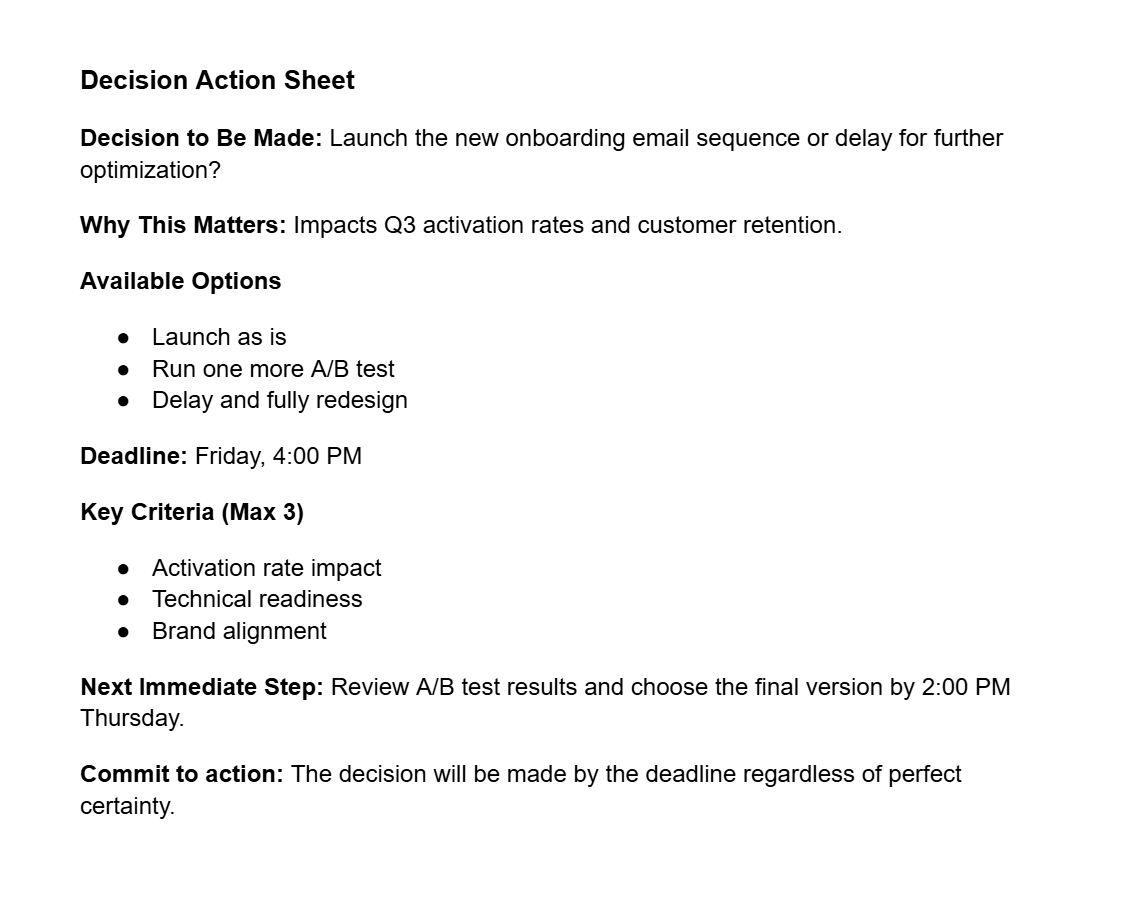
A simple approach is to set a clear deadline before you start analyzing. For example, give yourself 30 minutes to review information, then make the call. When the time window closes, commit to a course of action and move forward, even if the answer does not feel perfect.
If it helps, create a to-do list and write down the decision, the deadline, and the next step. This makes the commitment visible and harder to postpone.
Here’s a simple example:
Trust patterns over isolated outcomes
One outcome rarely tells you what actually happened, especially when timing, context, or external factors are involved.
Instead of reacting to one result, look for trends across similar situations. Ask what keeps repeating, what consistently works, and what fails under the same conditions. These patterns are often more reliable than any single metric.
Also, a practical tip is to review outcomes in groups rather than in isolation. For example, compare several similar decisions instead of dissecting one in detail. This helps you spot recurring signals and reduces the urge to overcorrect when information is limited.
Healthy Analysis Over Paralysis
Analysis paralysis is a signal that your mental energy is being stretched too thin. And when overthinking becomes the default, both judgment and well-being suffer.
Setting boundaries, accepting imperfection, and allowing yourself to move forward protect your focus, confidence, and mental health.
When you create space to think clearly and act with intention, better decisions follow. That’s why you need to take steps to overcome and prevent cognitive overload as soon as possible.
Remember, a healthy decision-maker helps maintain a healthy business. So, take care of your well-being first, and your work will reflect it.
FAQs
Below, you’ll find answers to common questions regarding analysis paralysis.
1. Is analysis paralysis a data issue or a decision-making problem?
Analysis paralysis is usually a decision-making problem, driven by mental overload, pressure, and fear of making the wrong choice. Data often becomes the excuse to delay action, especially when decisions feel high-stakes or visible. In those cases, more information does not create clarity. It creates indecision.
2. How can you tell the difference between healthy analysis and overanalysis?
Healthy analysis helps you move toward a clear course of action. Overanalysis keeps you stuck in comparison mode. A simple test is to ask whether new information is still changing your decision. If you keep analyzing without narrowing options or committing to next steps, you are likely in analysis paralysis rather than thoughtful decision-making mode.
3. Does analysis paralysis affect mental health and well-being?
Prolonged indecision and constant overthinking can drain mental energy and negatively affect well-being. Research and workplace studies consistently show that decision fatigue increases stress, anxiety, and burnout. When people feel unable to move forward, even on small decisions, the psychological cost often outweighs the risk of making an imperfect choice.
4. Who are Barry Schwartz and Sian Beilock?
Barry Schwartz is a psychologist best known for “The Paradox of Choice: Why More Is Less,” which explains how too many options can increase anxiety and reduce satisfaction, making decisions harder instead of easier. His work helps understand why modern tools and endless possibilities can fuel analysis paralysis.
Sian Beilock is a cognitive scientist whose research focuses on performance under pressure. Her work shows that stress and evaluation overload the prefrontal cortex, disrupting cognition and causing people to second-guess decisions they would normally make confidently. Together, their research explains both the emotional and cognitive sides of overthinking.
5. What is the fastest way to break out of analysis paralysis next time it happens?
The fastest way is to define the decision clearly and limit the factors that can influence it. Write the decision in one sentence, set a time limit for analysis, and decide what information actually matters. Once those boundaries are in place, commit to a course of action. Progress, even imperfect progress, is often what restores clarity.
Similar Posts

 Published by



Create, send and optimize your email marketing campaigns