












10 Nonprofit Landing Page Examples That Drive Social Action
Published By Alexandra Marinaki
March 16, 2026

16/03/26
Most nonprofit organizations find it hard to turn website visitors into active donors or volunteers. The right information is usually there, but supporters often fail to find what they need, lost in cluttered websites.
Landing pages solve this challenge. By removing the extra digital noise, they guide users toward a single call-to-action (CTA). For instance, rather than asking a visitor to “Explore Our Mission,” a landing page directs them to a specific outcome, such as “Sponsor a Classroom.”
In this post, we’ll share impactful nonprofit landing page examples across various categories, along with practical tips to help you better connect with your community.
Engage your community with powerful tools
Access landing pages and similar growth assets at a low cost.
TRY MOOSENDWhy Create Landing Pages for Your Nonprofit Organization
Before we dive into the ins and outs, here is why landing pages are so effective at boosting the performance of your marketing campaigns and outreach:
- Limit distractions: By removing elements that typically draw attention, such as menus or secondary links, you keep supporters focused on your CTA. This way, the landing page responds to the specific reason they clicked in the first place.
- Optimize the user experience: Landing pages offer a simpler path than a standard website, making it much easier for someone to sign up or donate in just a few clicks. Instead of making a donor navigate from “Home” to “About” to “Donate,” a landing page puts the donation form right in front of them.
- Boost conversion rates: This narrowed focus helps users support your cause faster. Reducing the “time to give” often leads to higher fundraising results and a better chance of securing recurring donations.
- Provide better insights: It’s much easier to track the performance of a dedicated page. You can see exactly how many people arrived from a specific source and how many contributed, giving you a clear picture of what truly resonates with your community.
In a nutshell, creating dedicated pages for specific goals is well worth the effort. Better yet, it’s simpler than it sounds, especially when you have the right tools and a few best practices.
What Should a High-Converting Nonprofit Landing Page Include
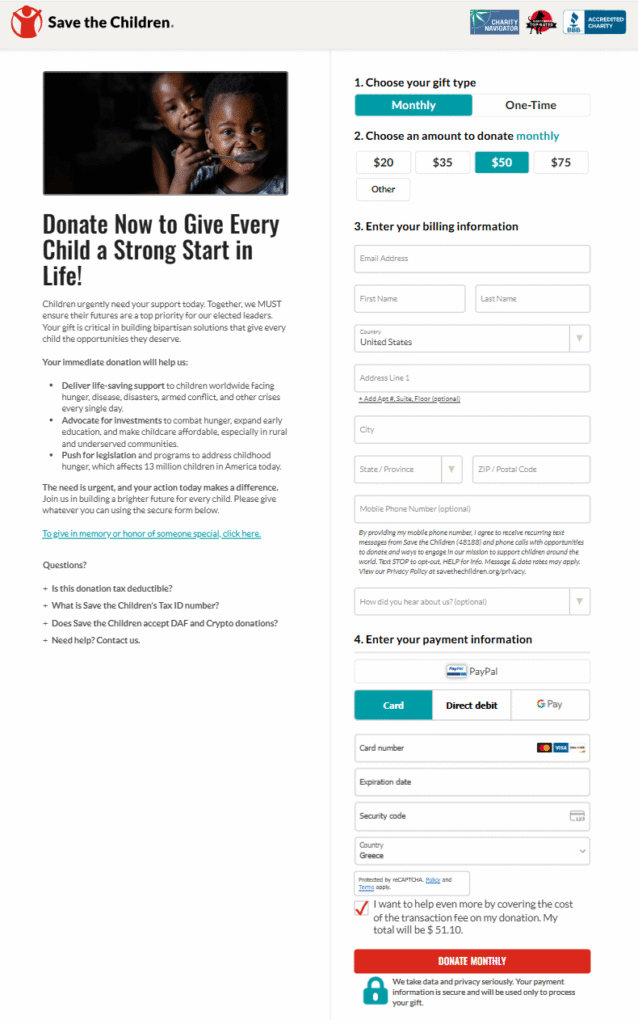
Let’s explore the elements that can make your landing page stand out by focusing on this example from Save the Children.
Compelling headline
Make an impactful first impression by placing your call-to-action directly or subtly in your headline. Rather than simply stating what the visitor should do, emphasize why they should do it.
In this example, Save the Children combines urgency (“Donate Now…”) with mission-driven language to immediately engage the audience. A headline like “Give Every Child a Strong Start in Life” is difficult to dismiss. Since the visitor has already clicked through to this page, they likely have a high intent to help, and the headline encourages them to act.
Visuals
Following the Save the Children example, placing a powerful, high-quality image at the top of your page instantly bridges the gap between the supporter and the cause.
You can also use supporting visuals to clarify your mission without overwhelming the reader. For instance, instead of a complex spreadsheet, a simple “impact thermometer” that shows how close you are to a $5,000 goal can give donors a sense of real-time progress. Always keep your layout clean so that these graphics complement your text rather than burying it.
Finally, while stock photos are convenient, authenticity should remain your greatest asset. Using real photos of the people, animals, or environments you serve is far more impactful and ethical than a staged image.
Landing page copy
Your landing page copy should act as a spotlight for your mission statement, driving action without sounding salesy. Shift the focus from your organization’s needs to the real-world impact a supporter will create. For example, instead of describing your logistics, explain that a $50 gift provides an emergency medical kit for a family in a war zone.
To maintain engagement, your page should be structured into clear sections with subheadings that guide the reader’s eye. This creates a logical flow that prevents “information overload.”
You can see this reflected in the Save the Children example, where they use the “Questions?” dropdown. This FAQ section addresses common supporter concerns without cluttering the page. Moreover, by answering these questions in advance, you remove potential barriers to a donation while keeping the layout clean and professional.
Signup form
The signup form is one of the most important elements of your page. This is the moment where visitors take the time to subscribe or donate by sharing their personal information. The rule here is simple: the fewer the clicks, the higher the conversion potential.
Donation forms should include essential information without overdoing it. You don’t want supporters to question their privacy or safety, especially when making larger donations. For example, including a small “Secure Checkout” padlock icon near the payment field can reassure a donor instantly.
While Save the Children’s form may seem long at first glance, it makes the donation process feel secure and straightforward. It gives supporters a clear choice between one-off and recurring donations and allows them to select from various payment methods, such as PayPal or credit cards, to cater to different preferences.
Call-to-action
The CTA button represents the exact moment a supporter joins your mission. To be effective, this button should visually pop against the page background. Many high-performing organizations also place a secondary CTA at the very top of the page, such as a “Donate” button in the navigation bar to maximize visibility.
You can do the same by using a sense of urgency as Save the Children did with “Donate Now.” Keep your language actionable by writing copy that focuses on the mission. For instance, using “Give Water” or “Save a Life” instead of a generic “Submit” makes the impact feel more personal and feasible.
Finally, your landing page call-to-action should be unique. If you offer too many competing choices, such as asking for a donation while also promoting a newsletter, the primary goal of the page can easily get lost.
Social proof
To build trust quickly, many organizations add credible forms of social proof to their landing pages. Case studies, testimonials from beneficiaries, or charity ratings, such as a “4-star” badge from Charity Navigator, can significantly influence a donor’s decision to join your cause. These trust signals reassure supporters that their money is being handled responsibly.
Alternatively, you can share an infographic with impact stats to visualize the progress a charity has made. For example, a simple graphic stating “5,000 Trees Planted This Year” helps a donor see exactly how their contribution comes to life, making the mission feel achievable.
Effective Nonprofit Landing Page Examples & Why They Stand Out
Need inspiration before crafting your next nonprofit landing page? In this section, we’ve collected examples from well-known NPOs to help you get started.
Doctors Without Borders
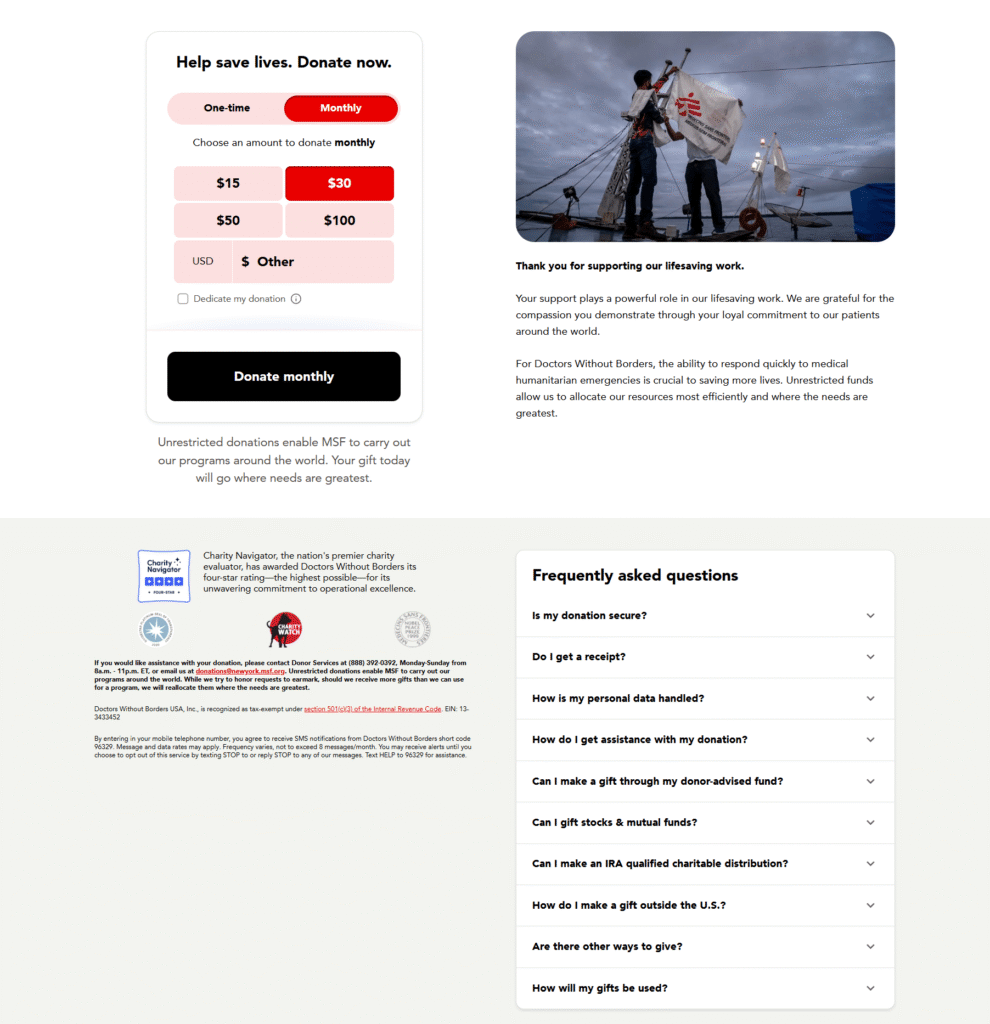
Doctors Without Borders is a leading medical humanitarian aid organization providing care globally. They crafted a donation landing page specifically designed to increase fundraising.
Why it works:
- The signup form is positioned at the top of the page, letting users choose between monthly and one-time donations.
- A powerful hero image is followed by a direct thank-you note to donors, explaining exactly why their contribution matters.
- The badges placed directly below the form, like that from the Charity Watch, act as social proof and help earn trust faster.
- The FAQ section resolves common concerns that might otherwise cause a donor to hesitate at the final step.
Room to Read
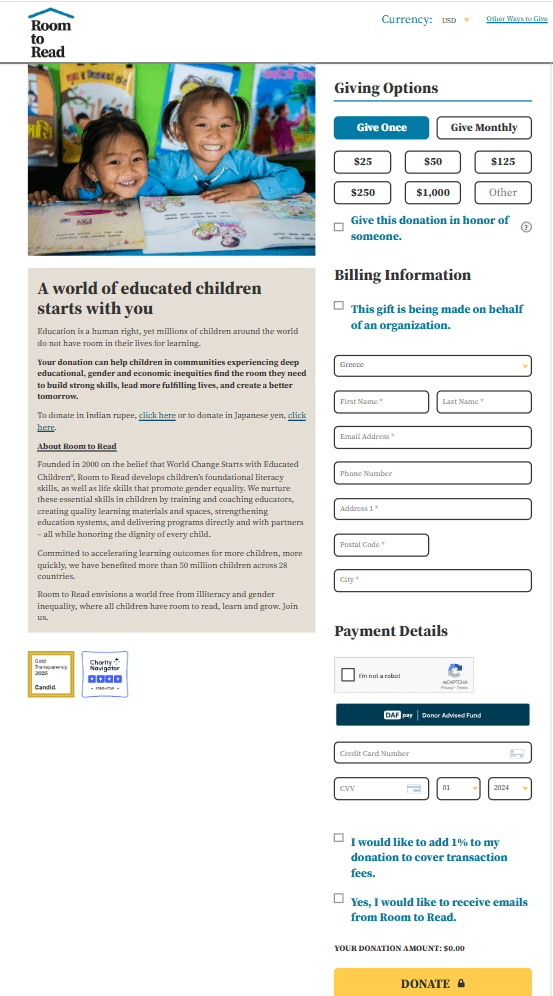
Room to Read envisions a “world free of illiteracy and gender inequality” and invites supporters to join their mission through a dedicated fundraising landing page.
Why it works:
- The heartwarming image of the girls sets a positive tone for the entire page, reflecting the cause’s successful impact.
- The headline informs readers that their contribution can make a significant difference, positioning the donor as the story’s hero.
- The landing page copy stays focused on specific fundraising goals to help the reader visualize their impact.
- They offer an option to donate in honor of someone else, such as a birthday or memorial gift, while maintaining a simple signup process.
Amnesty International
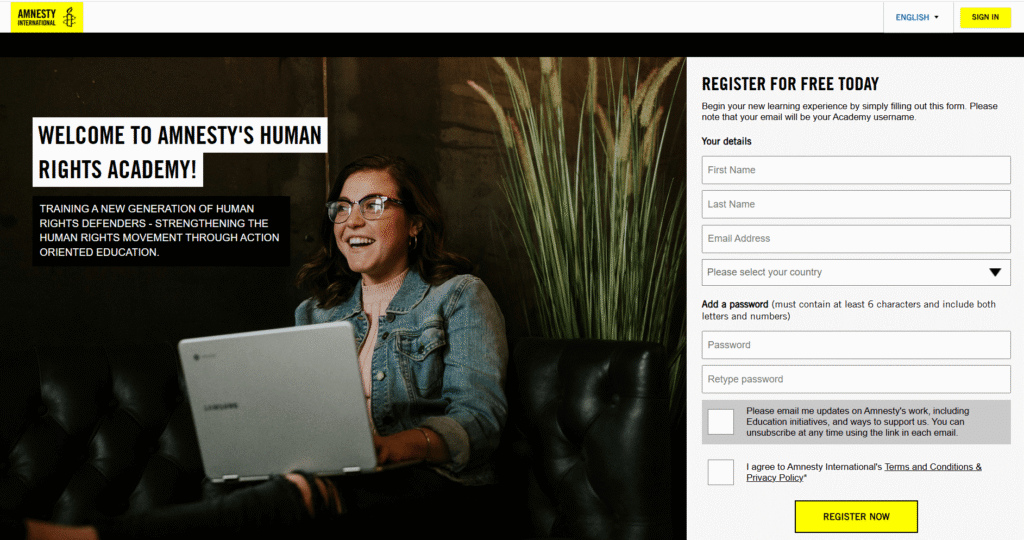
Amnesty International protects the human rights of millions of people globally and offers online courses to educate the public on these critical topics. Here is a look at their Academy landing page:
Why it works:
- The landing page copy welcomes readers and briefly informs them of the workshop’s primary goals.
- The signup form is incredibly simple to fill in, reassuring visitors that they are subscribing for free. This reduces reluctance and keeps the focus on education.
- The yellow CTA button stands out against the page while remaining perfectly on-brand. Using actionable text like “Register Now” alongside this bold color encourages immediate signups.
Heller Keller Intl
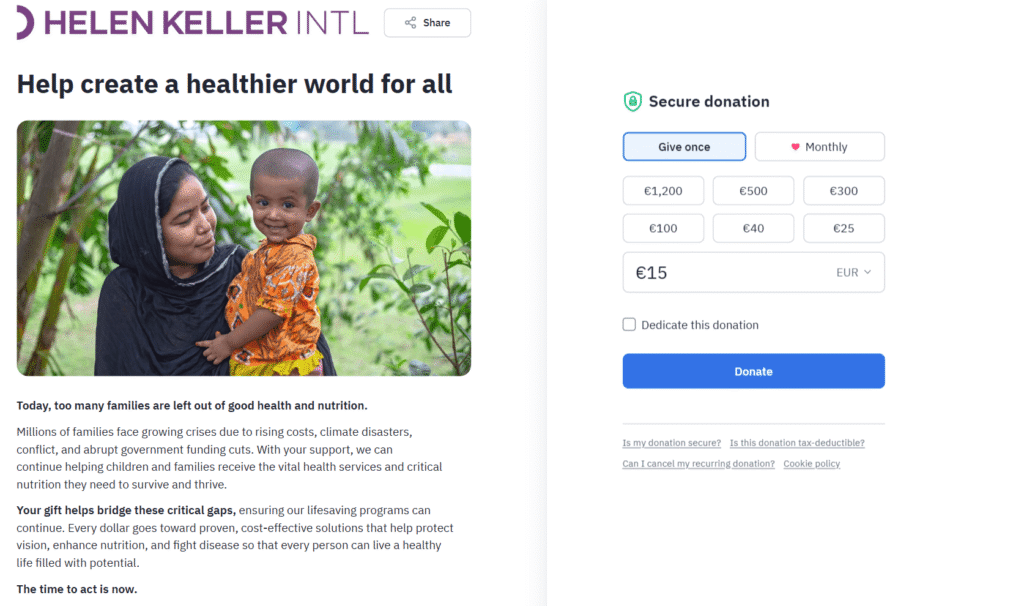
Helen Keller International aims to provide better health and nutrition to families worldwide facing crises caused by rising costs, climate disasters, and conflict. This is their donation landing page.
Why it works:
- The hero image helps potential donors visualize the direct effect of their contribution.
- The simple form allows supporters to complete their donation quickly and securely.
- The copy clearly outlines the organization’s mission, using bolded sentences to grab attention quickly.
- Below the form, visitors can find links to FAQs and the cookie policy to address concerns regarding data privacy.
Clean Air Task Force
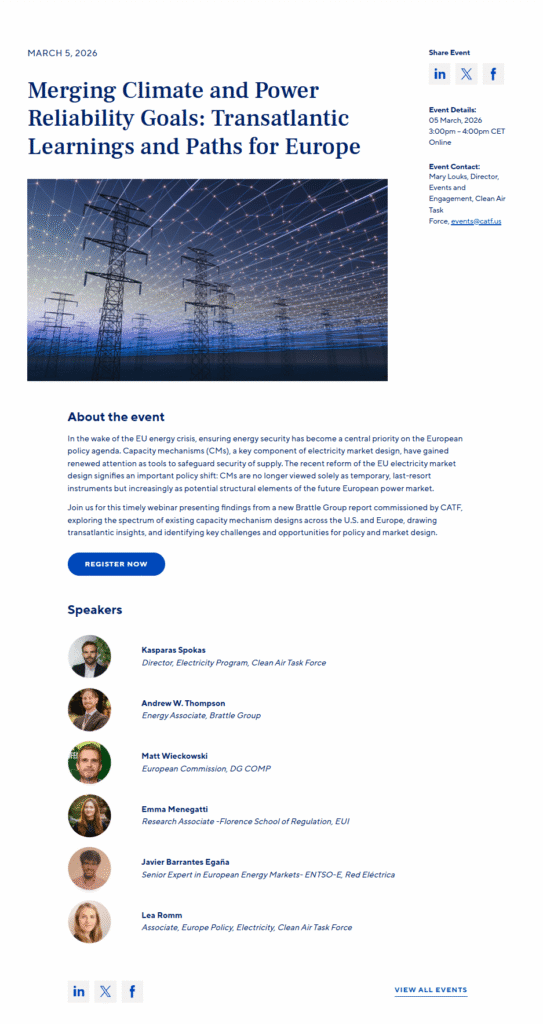
This nonprofit aims to create a zero-emissions future by promoting technological and policy advances to manage climate change. As part of their agenda, Clean Air Task Force hosts niche industry events, and here is the landing page for one of them.
Why it works:
- The event details and agenda are placed at the top, letting readers instantly spot important information, such as the date, time, and location.
- The gallery of event speakers adds credibility and authority to the page due to their high expertise.
- The social media buttons invite visitors to share the event with their professional networks.
- The “Register Now” button is the central focus of the page.
Internet Archive
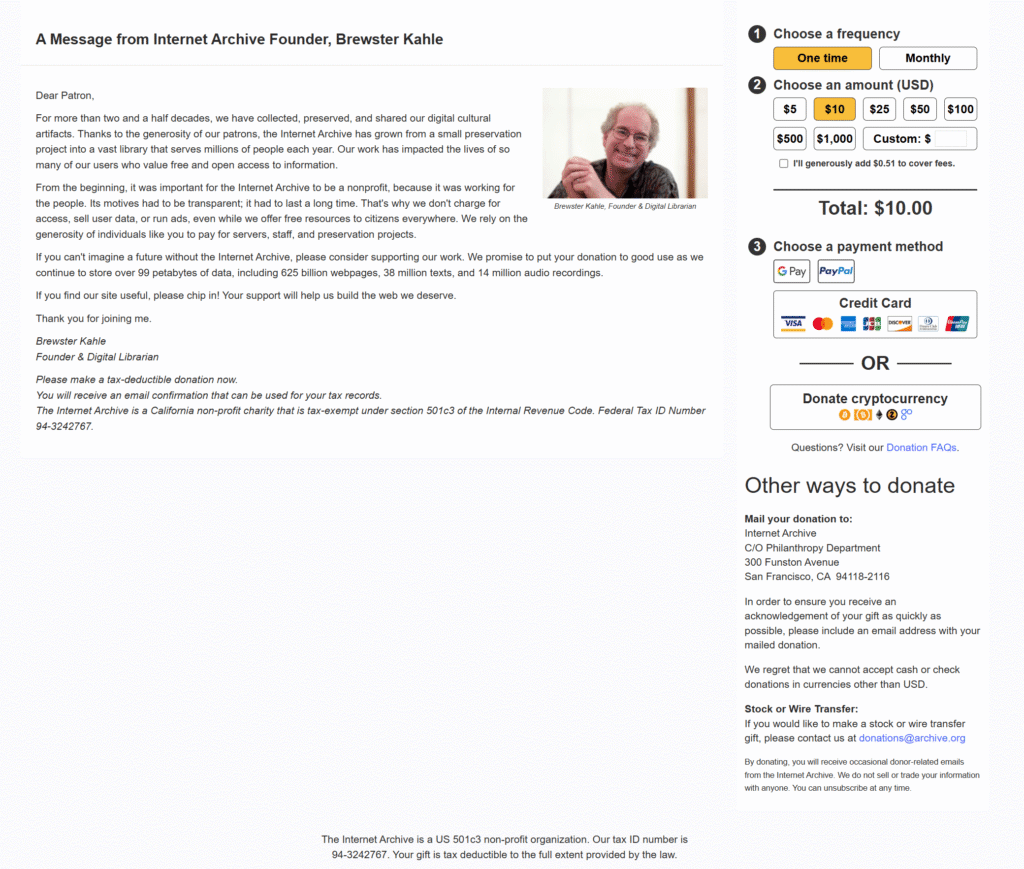
The Internet Archive is a non-profit digital library that provides free access to millions of books, web pages, and audio files. Their donation page is simple, with a consistent look and feel with their website design.
Why it works:
- The mission statement comes directly from the founder, adding a personal tone and a sense of accountability.
- The signup form is quick to complete and offers a wide range of payment options, including cryptocurrency.
- They include a clear link to their FAQs, which addresses common technical or tax-related concerns without cluttering the main page layout.
Cancer Research Institute
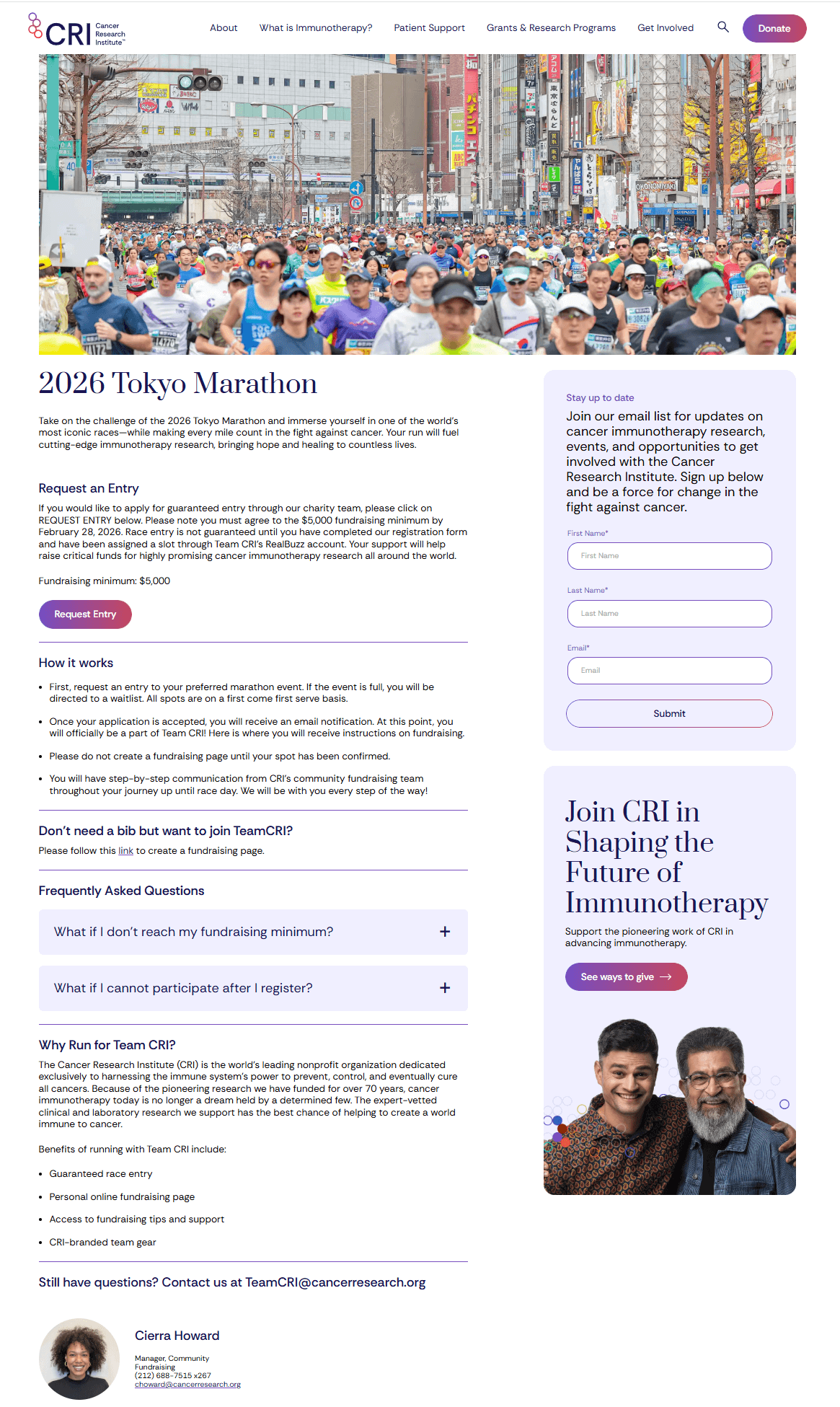
The Cancer Research Institute is a pioneer in healthcare, contributing to the discovery and development of immunotherapies for cancer treatment. Here’s the landing page for their dedicated fundraising marathon.
Why it works:
- The landing page copy informs readers how they can get involved in detail.
- They include both an FAQ and a “Why Join” section to address common questions and help convert hesitant visitors by highlighting the specific impact of the race.
- While the primary focus is on the “Request Entry” CTA, they also include a secondary newsletter signup to boost lead generation, which can be risky for conversions.
Charity: Water
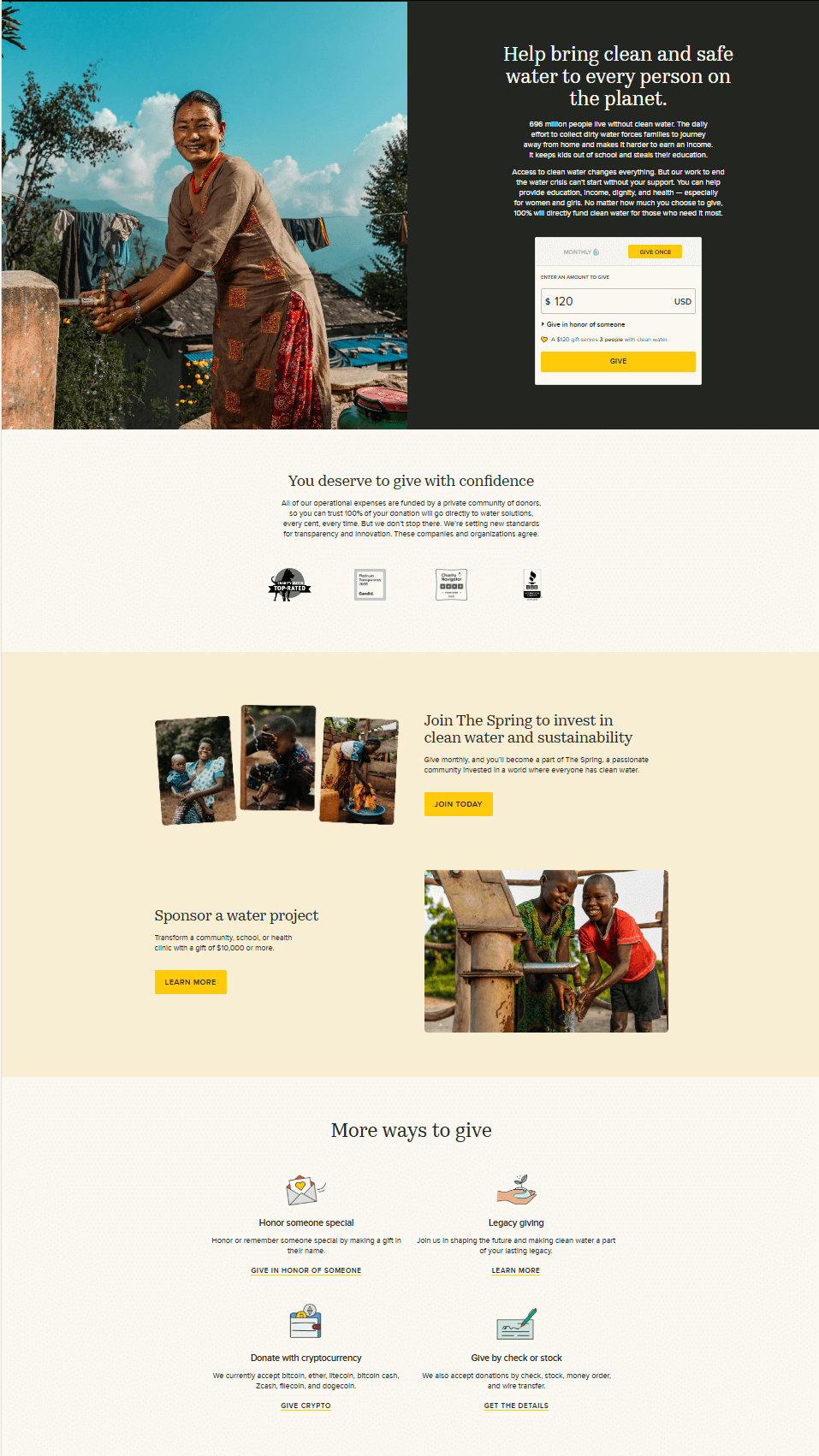
Charity: Water provides clean and safe water to people in developing nations. Their landing page is a masterclass in transparency and visual storytelling.
Why it works:
- The hero image perfectly reflects the donation results, followed by real images in other sections that trigger emotions.
- Above the donation button, they added a note explaining how many people can receive clear water with a specific donation.
- They added social proof to be transparent and help people feel safer with their donations.
OutCare
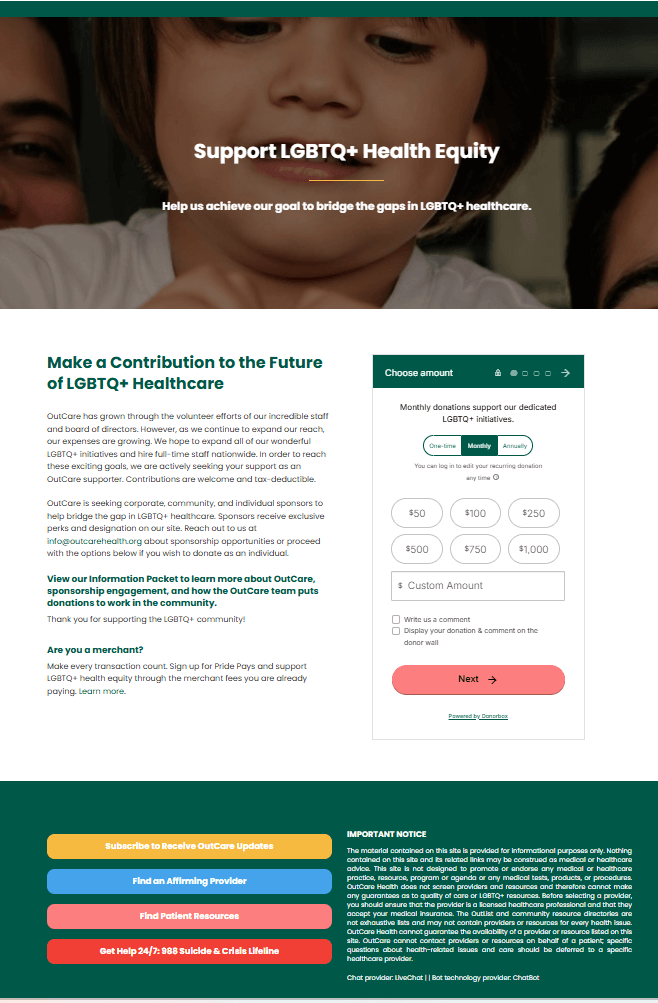
OutCare supports LGBTQ+ health equity and has created a user-friendly landing page designed to increase donations and community support.
Why it works:
- The hero image and title clearly depict the organization’s mission, providing an immediate summary of their work.
- The landing page copy informs readers exactly what the organization hopes to achieve, making donors feel they are part of a larger strategy.
- The multi-step signup form is brief and offers various “donation packages” for every budget.
- They include important notices and additional sections in rainbow colors to honor their mission.
How to Create a Landing Page for Your Nonprofit Organization
Ready to attract new supporters, donors, or charity event attendees? Learn how to create a landing page from scratch to meet your goals.
1. Create a plan for your landing page
First, determine the primary goal of your landing page to ensure every element serves that purpose. Whether you’re seeking one-time donations, volunteer recruitment, or charity event signups, the more concrete your objective, the more effective your page will be.
Next, develop a marketing plan based on the supporter journey to determine how your target audience arrives on the page. You might guide them there through:
- A targeted email campaign sent to recent newsletter subscribers.
- A timely social media post announcing a specific fundraising goal.
- A pop-up on your homepage for visitors who spend more than 30 seconds on your website.
This strategic plan also allows you to track metrics and refine your approach over time. By analyzing your data, you can make informed improvements to your storytelling style, signup form placement, or your promotional channels, among other factors. For example, if you notice high traffic from Instagram but low conversions, you might realize your mobile checkout process needs to be faster.
2. Understand your target audience
Before you begin building your page, identify exactly who you’re targeting. Understanding the psychology of prospective donors and volunteers allows you to spot the specific motivations that drive them to support your cause.
Developing these personas will help you shape the messaging and design in a way that truly moves your audience. Regarding financial support, it’s best to provide several options to cater to supporters from different backgrounds.
For instance, a college student might prefer a $5 “micro-donation” or a volunteer shift, while a corporate donor might opt for a $500 sponsorship. By offering varied donation packages, diverse payment methods, or even the choice to contribute time through charity work, you ensure there is a meaningful way for everyone to get involved.
3. Build your landing page
You don’t need design or coding skills to create a high-converting landing page. All you need is a landing page builder with pre-made templates that ensure user-friendly functionality. You can resort to dedicated platforms like Leadpages or more comprehensive marketing tools like Moosend.
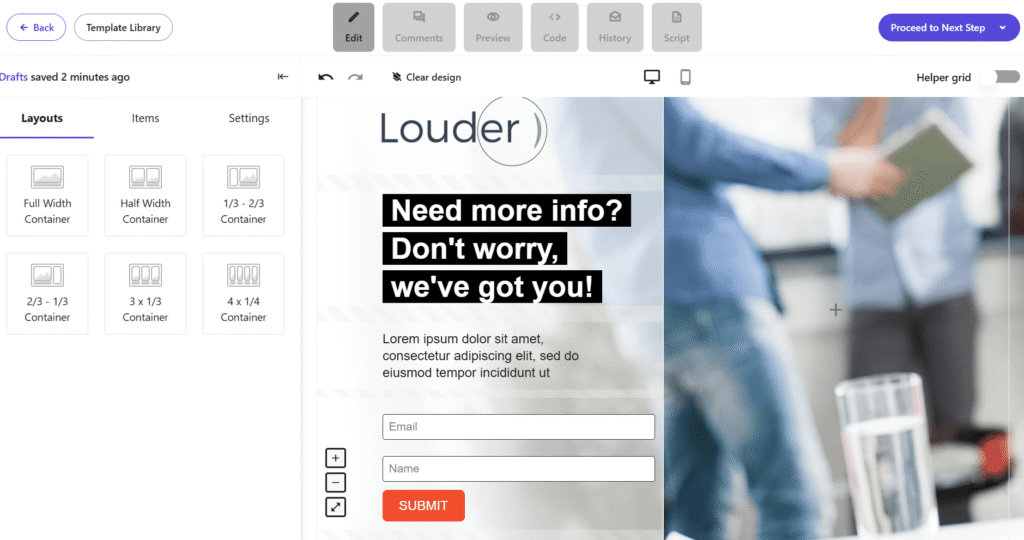
Find a landing page builder that matches your needs and customize your favorite template with your fonts, colors, and design assets. This creates a consistent experience across all your marketing channels. Ensure your design prioritizes readability by using white space, bullet points, and subheadings. Your CTA button should also be placed prominently to ensure it stands out.
Moreover, feel free to tailor the pre-set blocks of text or drag and drop new sections as needed. For instance, if your chosen template doesn’t have a section for social proof, you can easily add one yourself.
Finally, keep in mind that you can build landing pages without a website, a perfect solution if your NPO is newly established or still in the founding process.
4. Optimize your page for SEO
To make your landing page discoverable through search engines, which is essential for driving donations, you should follow a few core SEO best practices. One of the most effective strategies is to incorporate specific long-tail keywords into your content, particularly within your headers. This helps your page rank higher for niche search queries.
Adding metadata, such as a compelling SEO title and an actionable meta description, is also vital for increasing click-through rates. Finally, ensure your images load quickly to improve the user experience and keep your URL structure clean and descriptive.
5. Ensure mobile-responsiveness
With so many people browsing on their phones, providing a good mobile experience is essential. Mobile-friendliness is also an important ranking factor for search engines. If your page isn’t optimized for smaller screens, your visibility will be constrained.
Fortunately, most landing page builders provide mobile-responsive templates. However, you should still manually test your page on different devices. Ensure that all key information is easy to read and that your call-to-action button is large enough to be tapped easily.
6. Lean into data-driven tactics
You can adopt a data-driven strategy even if you’ve never launched a page before. A/B testing allows you to compare different versions of your landing page to see which one resonates best with visitors and drives the most conversions. For example, try experimenting with different headlines, signup form placements, and CTA button colors.
For those with existing data, tools like Google Analytics can reveal how previous assets performed and which traffic sources were most effective. You can also use heatmaps to visualize where visitors focus their attention. By seeing exactly where users click or scroll, you can strategically place key elements to boost engagement and click-through rates.
Bring More Supporters Through Landing Pages
Creating dedicated landing pages is one of the most effective ways to boost your fundraising and charity initiatives. To see the best results, stick to one clear call-to-action per page and communicate it directly to your target audience, while always keeping the focus on your organization’s mission.
Finally, remember that adding social proof, such as trust badges or real stories from beneficiaries, makes a powerful difference. Sharing these stories proves to visitors that your NPO is transparent, trustworthy, and, most importantly, delivering on its promises.
FAQs
Here are some frequently asked questions regarding nonprofit landing pages.
1. What is a nonprofit landing page?
A nonprofit landing page is a standalone marketing asset designed to promote an initiative, such as recruiting volunteers, registering event attendees, or securing donations. Unlike a full website, it focuses on a single desired action to prevent distractions and increase conversion rates.
2. What is the difference between a nonprofit website and a landing page?
A nonprofit website includes various types of information and a navigation menu for browsing. In contrast, a landing page removes navigation to focus on a single call-to-action, guiding the visitor toward a specific goal.
3. How many CTAs should a nonprofit landing page include?
To be most effective, a landing page should focus on a single goal. However, if your page is long, you can place multiple CTA buttons in different sections (such as the top, middle, and bottom) to make it easy for visitors to convert wherever they are on the page.
4. How important is mobile-responsiveness for landing pages?
A large percentage of your supporters will discover your page via mobile devices. Ensuring an optimal mobile experience is essential for both user trust and search engine rankings.
Similar Posts
 Published by

 Published by

Create, send and optimize your email marketing campaigns