











Why Email Marketing Is Still Important In 2026
Published By Alexandra Marinaki
July 29, 2026

29/07/26
You’ve probably heard that email marketing is dead. Is it, though?
Think about it. Today’s consumers are looking for brands that respect their time, protect their privacy, and provide solutions tailored to their specific needs. Email is the perfect “space” to honor those preferences. It’s a private, direct line to your customer, away from the noise of public feeds and the unpredictability of algorithms.
When these campaigns are thoughtful and human, they don’t just work. They work miracles.
In this guide, we’ll explain why the importance of email marketing is beyond doubt, how it stands apart from other popular channels, and what makes it a marketing powerhouse.
Email marketing to the rescue
Nudge your audience with the right message at the right time.
Try MoosendTop Email Marketing Benefits that Last in Time
Let’s explore some of the key reasons why email marketing stands out and can truly elevate a business’s marketing strategy.
1. High return-on-investment (ROI)
Based on recent email stats, the average email ROI is $36 for every $1 you spend. Moreover, the global email marketing revenue is expected to reach $17.9 billion, proving that the channel is only gaining momentum. These are exceptional results, considering that email marketing is both cost-effective and highly scalable.
This high revenue also shows how well email marketing has adapted to privacy-led marketing. With traditional tracking methods gradually disappearing, consented connection is a big must.
2. Direct communication
One of the biggest benefits of email marketing is that you have complete ownership of your email list members without relying on social media algorithms or third-party platforms to reach subscribers. You can overview your exact target audience and access their data whenever you want.
Think of your email list as digital insurance against the ‘rented land’ of social media. You aren’t just renting a space in a feed. You own the direct connection to every person who has invited you into their inbox.
3. Hyper-personalization
Consumers no longer respond to impersonal promotions and broadcasts. They expect tailored experiences that take their needs and preferences into consideration. And with email, this is more than “workable.”
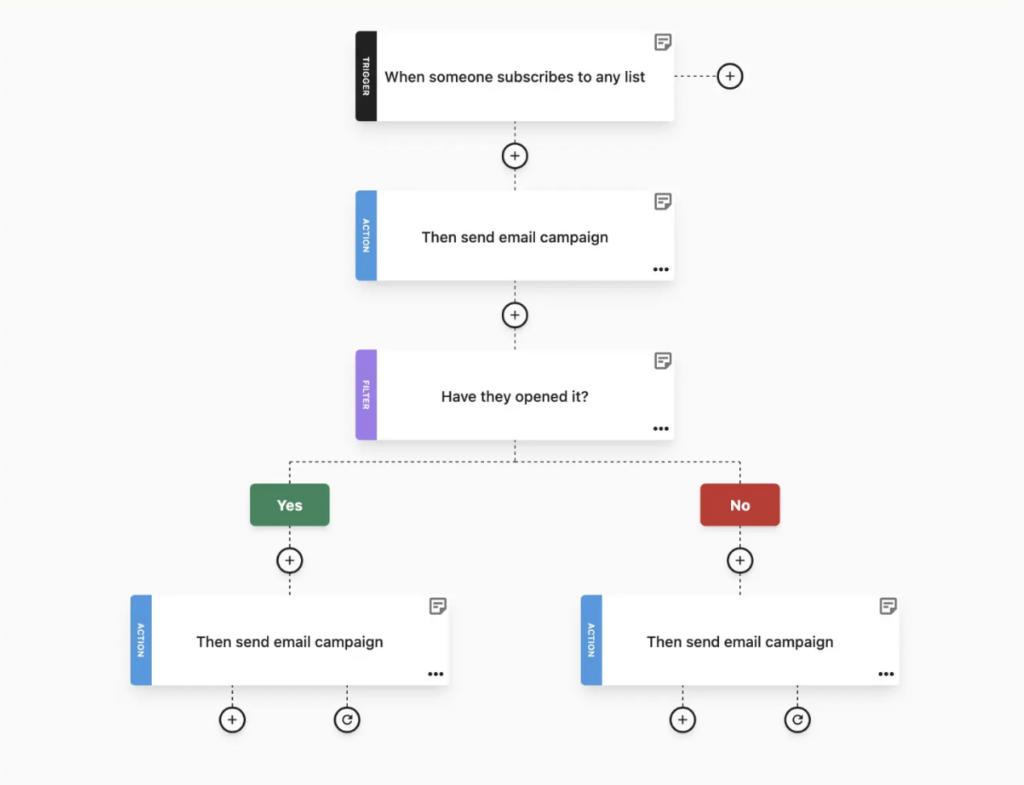
Email segmentation, automation workflows, and dynamic content help deliver relevant and resonant content to subscribers based on their demographics and behavioral data, such as previous purchases and browsing habits. Therefore, with the right email marketing strategy in place, it’s hard to miss out on customer engagement.
Check out this pre-made template to get a better understanding of what an automated workflow looks like:
4. Permission-based marketing
Email marketing is subject to strict compliance standards. To start mailing customers and prospects, you first need to get their opt-in, the permission to reach out via email. Moreover, consumers can retrieve access to their data at any time or opt out of a brand’s list. You can also share preference centers so they can choose which topics they want to receive and how often.
Considering that people are increasingly protective of their digital footprints, serving these boundaries isn’t just a legal requirement but a competitive advantage. And by giving subscribers total control over their data and an easy way to leave, you build a level of brand trust that simply can’t be bought with a social media ad.
5. High conversion rates
Since subscribers have chosen to join your email list, they’re more likely to convert than random website visitors or social media scrollers. Combine this with personalization tactics and more people will start taking action, leading to more purchases, signups, or downloads.
Smart email copywriting and design play a key role here. As long as your call-to-action is easy to grasp at first glance and the button is prominently placed, it gets harder to miss the clicks of interested subscribers.
Check out this email marketing campaign from Velasca. Would you skip it if it landed in your inbox after browsing that pair of shoes?

6. Diverse content
Email isn’t just for promotions and sales. You can use it to educate your audience around your brand, send transactional emails that secure a smooth customer experience, and even collect their honest feedback through anonymous email surveys.
By combining these different types of emails, you support your customers at every stage of their journey. This helps keep your brand top-of-mind, as long as your email frequency isn’t overwhelming or spam-looking.
7. Measured results
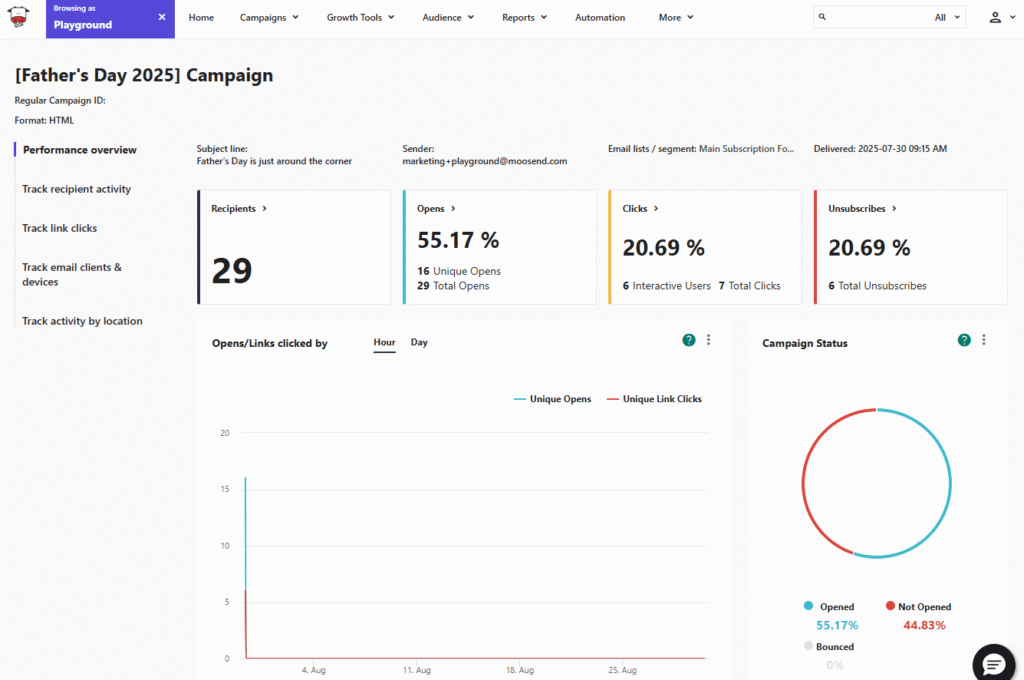
Modern email marketing tools provide users with real-time analytics and reporting capabilities. You can keep track of significant metrics, including:
- Open rates
- Click-through rates
- Spam complaints
- Unsubscribes
- Bounce rates
This data can help you recognize patterns that work for your audience and what needs improvement. Moreover, it gives insight into metrics that can hurt deliverability rates, allowing you to fix these issues before they harm your brand reputation and keep the momentum steady.
Here’s Moosend’s analytics dashboard to get a better grasp:
8. A/B testing
Another benefit of email marketing is that it lets users experiment with different email variations through A/B testing. For example, you can test two different subject lines, one with the recipient’s first name and one without, to see how a small segment reacts to them. Then, the winner is automatically sent to the rest of your list.
Being able to predict an important amount of user behavior in advance is a big win. Once you collect more data about your audience, you can reach safer conclusions and secure better email performance.
9. High scalability
As your business grows, your email channel has all the potential to grow, too. Most platforms let you upgrade your plan with a few clicks and reasonable price changes when you gain more subscribers.
In most cases, you still get access to key email marketing features and can explore more advanced capabilities through add-ons. But at the end of the day, your revenue will surpass costs, and you’ll reap the benefits of an owned list.
Email vs. Other Platforms: Comparison Table
We’ve already mentioned some of the key differences between email and other marketing channels, such as social media and ads. Find them in more detail in the table below:
| Feature | Email Marketing | Social Media / Ads |
| Ownership | You own the list. It’s a permanent business asset. | You “rent” the audience. The platform owns the data. |
| Reach | Reliable. If you send it, it lands in the inbox. | Uncertain. Algorithms decide who sees your posts. |
| Longevity | Permanent. It stays in the inbox until acted upon. | Temporary. It disappears in the “scroll” within minutes. |
| Context | Private. It’s a personal, one-on-one conversation. | Public. It’s competing with millions of other posts. |
| Data | Deep. You know exactly what “this” person likes. | Broad. You only see general trends and “likes.” |
Does that mean that you swap these methods for email marketing? No, this digital marketing tactic isn’t a replacement for other channels, but the glue that holds them together. While social media and ads excel at discovery and building hype, email is your “owned” territory where you nurture those leads into loyal customers through direct, personalized communication.
By integrating these platforms, using social media to grow your list and email to secure the final conversion, you create a balanced system that respects consumer privacy while driving consistent, long-term growth.
Additional Resources
Need more insights? Check out these relevant blog posts:
- Email Marketing Vs. Social Media: Which Is Best For You
- Effective Cross-Promotions: When and How They Work Best
Email Marketing Success Stories that Grabbed Our Attention
Let’s explore three different email marketing success stories to better understand its impact.
Anastasia Blogger
As a blogger and content marketing expert, Anastasia Blogger has a growing subscriber base of 27,000. This channel helps her drive traffic, build brand awareness, and promote her products. To maintain engagement as her audience grew, she focused on several key strategies, including:
- Deliverability practices to ensure emails reach inboxes.
- Optimized subject lines to boost open rates.
- Automated flows to support sales and promotions.
The result? She achieved an average open rate of 25%, maintained good inbox placement, and supported her sales through automation. The email marketing capabilities provided by modern platforms (Moosend, in this case) helped her successfully meet her business goals.
Sephora
Sephora needs no introduction. This popular eCommerce beauty brand wanted to reduce cart abandonment and turn high-intent visitors into loyal buyers. To achieve this, they implemented several key tactics:
- Automated targeted email campaigns to reach visitors at the right time.
- Abandoned cart emails to recover lost interest.
- Unique, high-engagement campaigns tailored to both current and potential customers.
The results speak for themselves: the brand achieved a 240% increase in open rates and saw a 5% increase in sales. Abandoned cart emails became one of their strongest assets
Overall, the brand sends unique email campaigns to current and potential customers that are hard to skip. Here’s an example that speaks for itself:
Subject line: As seen in GRWMs everywhere ⚡

Outsider Tart
The bakery Outsider Tart needed a channel to communicate consistently with its audience to promote key events and products. The bakery used email to build that “space” inside recipients’ inboxes. Through a combination of specific tactics, they reached phenomenal results:
- Segmentation to target the right audience members.
- Automation to ensure consistent communication.
- Personalization to make every email feel relevant.
They achieved a year-over-year 45% list growth, a 53% open rate (unique in this industry), and a 5% click-through rate. They proved that small businesses have loads to gain from email marketing.
Best Practices to Get More from Email Marketing
Success in email marketing is the result of consistent, intentional efforts. Follow these steps to polish your process and get the most out of your email channel.
- Create an email marketing plan: Set clear goals for each stage of the customer journey to nurture your audience from welcome through customer loyalty. Determine the marketing budget you’ll allocate to this channel and the marketing stack that will help bring your plan to life.
- Stay consistent with your brand: Keep a consistent customer experience across your marketing touchpoints to develop brand awareness. This way, it will get easier for visitors and customers to recognize your emails and resources at a glance.
- Send targeted messaging: Use marketing automation to set up triggered workflows, such as abandoned cart and welcome emails, with timely and relevant content. Plus, segment your audience by demographics or browsing behavior to consistently hit the mark.
- Follow regional compliance regulations: Obtain your subscribers’ opt-in and comply with regional email laws regarding data privacy access and the right to withdraw. Ensure that subscribers can easily opt out upon their request by adding transparent unsubscribe buttons to your email footer.
- Clean your email lists regularly: Remove inactive or mistyped email addresses to maintain high deliverability. Using verification tools and double opt-in can save you from lots of trouble.
- Ensure mobile-responsiveness: Make sure all your emails read well on mobile devices for a smooth user experience. For example, use single-column layouts, make your CTA clickable, and keep your subject line up to 60 characters so that it is not cut off.
- Make data-driven decisions: Monitor key metrics, such as open and conversion rates, to optimize your strategy in the long run, and explore industry benchmarks. Moreover, use A/B testing to experiment with email variations when you see fit.
Seize the Power of Email Marketing
No, email isn’t vanishing. In fact, it’s getting stronger and stronger. Through direct communication, personalized content, and even synergy with other marketing platforms, it can be your key to customer retention and loyalty.
Still hesitant? Choose an email marketing platform like Moosend or Constant Contact, sign up for a free trial, and see what it can do for you.
FAQs
Let’s review some frequently asked questions about the importance of email marketing.
1. Is email marketing dead because of AI?
No, it’s actually the opposite. AI has helped email evolve through smarter segmentation and copywriting. As long as you use it ethically, as an assistant and not a replacement, it can help you elevate your email marketing efforts.
2. What are the 5 C’s of email marketing?
They stand for Clear, Concise, Correct, Consent, and Considerate, and they sum up what an effective email marketing strategy should strive for. Following them helps ensure strong performance and compliance with email regulations.
3. How do you grow an eCommerce business through email?
To scale your eCommerce business through email marketing, start by automating key customer journey workflows, such as welcome and re-engagement emails. Segment your audience based on demographics and preferences, and use AI-driven recommendations and dynamic content to increase your email revenue.
4. Should I buy an email list to get started faster?
No. It’s considered an unethical marketing practice and can have a detrimental impact on your bounce rates and spam complaints. In fact, many email marketing regulations, such as GDPR and CASL, consider this an important violation, which can lead to fines and a compromised sender reputation that is hard to restore.
Similar Posts
 Published by
 Published by
Create, send and optimize your email marketing campaigns