












Email Marketing For Higher Education: Guide With Examples
Published By Alexandra Marinaki
October 7, 2026

07/10/26
Choosing a college or university is one of the most life-changing and, at times, difficult decisions a person will ever make. Prospective students must balance financial, emotional, and intellectual factors to find the institution that best suits them.
Addressing this unique mix of needs is the ultimate marketing puzzle. While social media is the go-to channel for Gen Z and Gen Alpha, email bridges the gap from initial interest to conversion. It also keeps students engaged throughout college, making them more likely to become lifelong advocates for your institution.
In this post, you’ll learn the ins and outs of email marketing for higher education, including tips for beginners and optimization tactics for pros. You’ll also find email campaign examples from top institutions to get inspired.
Why Use Email Marketing For Higher Education
While some think of email as an outdated channel, recent stats tell a different story. For every $1 spent, email marketing campaigns generate $36, and 78% of respondents say they prefer content tailored to their needs.
While AI tools now handle much of the initial degree search, the real impact happens when a prospective student willingly shares their information with you. Email gives your university a direct line to keep the conversation going, letting you guide students step by step from their first inquiry to enrollment and beyond.
Let’s see some of the main benefits of higher education email marketing:
- Higher ROI: Unlike paid ads that require a big budget, your email list is an owned asset. You can reach your audience directly without being affected by unpredictable platform changes.
- Hyper-personalization: Through advanced segmentation and dynamic content, you can deliver tailor-made experiences. Whether it’s a high school senior or a returning adult learner, personalized messaging significantly increases the likelihood of conversion.
- Sophisticated automation: Triggered workflows ensure you meet prospects at key decision points, from welcome sequences for applicants to onboarding series for newly enrolled students.
- Data-driven decision-making: Modern email platforms offer access to significant engagement metrics. By tracking open rates and conversion paths, you can make strategic adjustments, even in real time.
Common Higher Ed Email Campaign Types
What types of campaigns help higher ed institutions deliver a stellar experience and meet their marketing goals? Let’s break them down by lifecycle stage:
Recruitment and inquiry
During this phase, you can set up a welcome series for new prospects, whether they signed up for a newsletter or downloaded a brochure. Follow up with program-specific, educational content to keep the momentum going. You can also trigger re-engagement emails featuring interesting campus news or success stories to rekindle the spark with inactive leads.
Admissions and enrollment
How do you support students who have just applied or enrolled? Start with transactional emails that clearly confirm their application status. Create an onboarding series with essential details, such as accommodation, funding, facilities, and study guides, to ease their transition into student life. To keep the excitement high, send vibrant emails featuring user-generated content (UGC) to help them feel part of the community.
Student retention and engagement
The post-enrollment stage is vital, as current students are your biggest brand advocates. Share emails that guide them through daily life, from meal prep tips to campus events and skill-development workshops. You can also set up academic support triggers as part of an early warning system. For example, if a student misses two classes, an automated nudge can remind them of the attendance policy to help them stay on track.
Alumni loyalty
Finally, the loyalty phase targets your graduates. Send nostalgia campaigns featuring “then vs. now” photos, invite them back for career fairs, or send targeted donation requests to fund important initiatives like new research or scholarships.
How to Create an Effective Higher Ed Email Marketing Strategy
To set up these campaigns successfully, you can integrate your email marketing service with a Customer Relationship Management (CRM) solution to save time and effort without compromising outreach quality. Most platforms, like Moosend or Constant Contact, have built-in tagging systems and custom fields to streamline personalization more effectively.
Once you’ve selected the right stack for your needs, follow these best practices to engage your target audience, from recruitment to graduation.
1. Set clear goals for each stage
To build your strategy, you need crystal-clear objectives. What do you want to achieve at each stage of the journey? How will you move a person from a casual website visitor to an enrolled student, and finally, to a lifelong advocate?
To define what “conversion” means, think about the student’s mindset, emotions, and needs at each phase. For instance, during the awareness phase, focus on sharing your institution’s “vibe” and values. Providing social proof like testimonials and quotes from current students and highlighting campus culture can really move the needle.
On the flip side, you need to be more proactive during the consideration stage. Promoting 1:1 consultations with admissions officers or presenting prospects with financial aid and housing solutions will help them envision campus life more easily.
Remember, student recruitment and engagement is a long game. To build a library of success stories, you need a carefully designed system that’s easy to track. Set your goals in advance so you can remain flexible and tweak your strategy if you notice engagement dropping.
2. Grow your email list
To start communicating with prospective and current students, you first need their opt-in. But how do you collect these email addresses in a value-driven, GDPR-compliant way to build your email list?
Offer “gated” content that solves a specific problem. Think application checklists, career outcome reports, or interactive tools like tuition calculators. Use dedicated landing pages for these offers to keep users focused and boost conversion rates.
Virtual campus tours and major-specific Q&A webinars appeal to highly interested prospects. These are perfect opportunities to capture email addresses. For in-person recruitment, share pamphlets with QR codes at college fairs so students can instantly join your list while your institution is top-of-mind.
“Chat with a student” forms are also incredibly effective. Peer-to-peer interactions often build trust much faster than traditional “professional” marketing, making prospects more willing to share their contact details.
Make your site “opt-in friendly” by placing exit-intent pop-ups or strategic calls-to-action (CTAs) within your content. For example, a quiz titled “How to find the best major for your personality” is a fun, low-pressure way to collect emails while providing value to the student
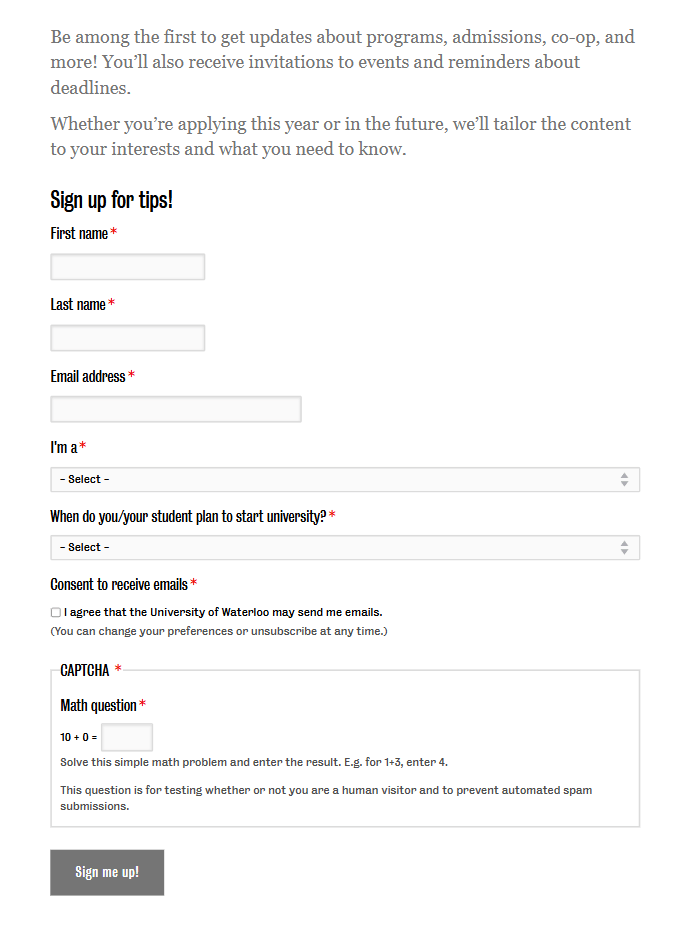
Here’s a website signup form from the University of Waterloo to get a better grasp:
3. Use personalization and segmentation
Personalized messaging is non-negotiable for younger generations. Instead of sending “blast” emails that can frustrate or turn away your audience, use behavioral insights and first-party data to reach students with relevant content that actually matters to them. For instance, you can send different content based on the program a student viewed, an event they attended, or where they are in the application process.
Segmentation is one of the most effective ways to boost conversion. Divide your subscribers into distinct groups based on demographics, academic interests, or lifecycle stage. For instance, if a prospect has shown interest in your Engineering programs, don’t send them general updates. Send them deep dives into lab facilities, faculty spotlights, and alumni success stories within that specific field.
Use dynamic content blocks to personalize specific parts of a single email. You can automatically swap out hero images to show a student’s preferred campus or faculty building, ensuring the visual experience matches their unique interests the moment they open the message.
Moreover, many email platforms use AI to analyze real-time behavioral data. This allows you to automate personalized campaigns based on actual student actions, ensuring your marketing decisions are driven by data rather than guesswork.
4. Master your email subject lines
If you think about it, the single element that can determine whether your email gets clicked or dismissed is the subject line. It’s your first, and sometimes, only chance to grab a student’s attention.
Here are some effective options for different intents:
- Inspiration: Your future at [College Name] starts here!
- Urgency: Reminder: The final deadline to apply to [College Name].
- Invitation: You’re invited: Tour our campus from home 📅
- Information: Important update regarding your housing 🏠
To ensure your subject lines are fully responsive and mobile-friendly, aim for 20–40 characters. Remember, a good subject line does more than just reflect the email’s content. It should trigger curiosity or excitement to drive higher open rates.
If you’re struggling to find the right words, use an AI writing assistant to experiment with different styles, from professional and academic to casual and hype-driven. You can also run A/B tests to compare different angles, such as educational versus FOMO-inducing (Fear Of Missing Out), to see which resonates most with your specific audience.
5. Save time with marketing automation
The real value of email automation is that it saves your team from hours of manual work while helping you send timely, relevant messages when students are most engaged.
By following “if/then” logic and pre-selected criteria, you can set up triggered emails and follow-up sequences that run in the background. For example, you can create a welcome series, triggered immediately when a student signs up for a brochure, or automatically send post-enrollment drips to co-pilot the student through their first weeks on campus.
While these workflows can take some time to set up, most email marketing providers simplify the process with dedicated guides and pre-made workflow templates you can easily adjust to fit your specific needs.
For instance, Moosend offers ready-made workflows for welcome sequences, onboarding, website engagement, and re-engagement, along with a user-friendly builder to help you tweak every step of the student journey.

6. Maintain brand consistency
Every higher education institution has a unique brand voice, and you should maintain yours across all promotional assets, including your emails. Use your brand’s logo and color palette consistently. Select fonts that match those on your website to create a unified experience as students move between your emails and your portal.
If your email has multiple sections or imagery, ensure that each part of the message has “room to breathe.” Use clear subheadings and plenty of white space to ease the reader’s gaze and make the content easy to digest on mobile screens.
Remember that your primary target audience consists of young learners. So, replace academic jargon with actionable language and a vibrant, energetic tone.
Also, adapt your storytelling based on the intent of each email. This newsletter from Washington University targets the broader community, from prospective students to alumni, by focusing on the inspiring, innovative, and groundbreaking stories they contribute to.
Subject line: Bringing early breast-cancer screening to women

7. Include user-generated content
Recent statistics show that 93% of marketers believe user-generated content performs better than traditional branded assets. For higher education, this is a game-changer, as the age groups most institutions target rely heavily on peer validation when making decisions.
To make the most of this, place UGC strategically throughout your email content. For example, instead of using polished, corporate campus photos, embed a video of current students showing off their favorite study spots or hangout nooks. This feels more “real” and relatable.
Beyond consultations with admissions officers, offer a “Contact a Peer” CTA if your institution has a student-ambassador system in place. Finally, in the pre-enrollment phase, you can share blog posts or video interviews featuring alumni. Showing how your university helped them land their dream careers provides the emotional “nudge” needed to boost conversion rates.
8. Ensure mobile responsiveness and accessibility
Since most students will open your emails on their smartphones, providing a good mobile experience is essential. Stick to single-column layouts, which render better on smaller screens. Ensure your CTA buttons are easy to tap, and use plenty of white space to keep your content readable and uncluttered.
Keep in mind that many students use dark mode to save battery or reduce eye strain. To keep your campaigns dark-mode friendly, use transparent PNGs for logos and icons. Also, ensure your font colors maintain a high contrast ratio against both light and dark backgrounds so your message never “disappears.”
Higher ed institutions hold high accessibility standards, so your emails should be inclusive by design. Use descriptive alt text for all images and screen-reader-friendly URL links and phrases like “Click here.” Additionally, use a clear heading hierarchy (H1, H2, H3) to help screen readers navigate the logic of your message.
9. Monitor key email metrics
Tracking email metrics like open rates and click-through rates will help you discover which patterns work and which require optimization. By analyzing your data, you can pinpoint exactly which content types or writing styles resonate most with your audience and how different segments respond to your messaging.
To report performance clearly, you must define what “conversion” means at each stage of the funnel. This could range from a brochure download or a campus tour sign-up to a final application submission.
Beyond engagement, watch spam complaints, unsubscribes, and bounce rates. These metrics provide vital information about your deliverability and list growth. Keeping an eye on these allows you to spot concerning trends and address them before they hurt your sender reputation.
Most email marketing platforms provide thorough reporting and analytics to help you improve your strategy moving forward. Dive into these insights regularly to understand the strengths and weaknesses of your marketing plan.

Effective Higher Education Email Marketing Examples and Why They Work
Let’s explore higher ed email campaigns and the email marketing best practices they used to perfect their email strategy.
University of Cambridge – Welcome email
Subject line: Alexandra, welcome to our mailing list!
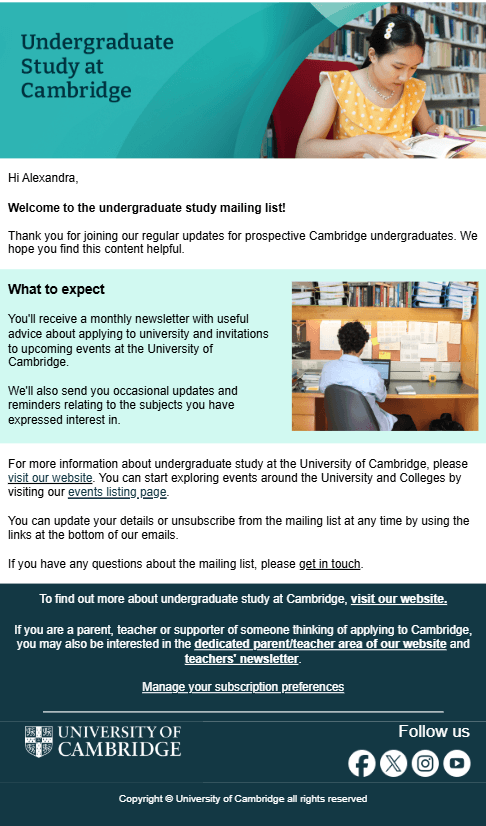
The University of Cambridge welcomes new email members with a thoughtful, triggered email that instantly establishes a relationship.
Why it works:
- Using the recipient’s name right away adds a personal touch that stands out in a crowded inbox.
- They inform recipients what type of content they will receive, which builds trust and reduces future unsubscribe rates.
- By collecting specific interests during the sign-up process, they can tailor the initial experience to the student’s academic preferences.
- They cleverly include a link to a dedicated section for parents and teachers, acknowledging that the decision-making process often involves a support network.
Texas Lutheran University – Student recruitment campaign
Subject line: Passionate About Helping People?

This email from the Nursing Department of Texas Lutheran University is a great example of a top-of-the-funnel email designed to drive applications.
Why it works:
- The subject line speaks directly to the aspirations of subscribers motivated by the nursing profession and its mission.
- The copy blends an informational and inspirational tone, leading directly to a clear, yellow CTA button that is hard to miss.
- By including a success metrics graph, they provide social proof that builds trust and adds academic weight to their claims.
- The featured image of a happy nurse in action allows prospective students to visualize themselves in the role, making the goal feel attainable and rewarding.
University of Chicago – Information newsletter
Subject line: Natural brain booster | Obama Foundation Scholars

In this newsletter, the University of Chicago provides educational value, institutional updates, and event highlights to keep their community engaged.
Why it works:
- They kick off with expert advice from a university psychologist on the mental health benefits of spending time outdoors, providing immediate value to the readers.
- By featuring the Obama Scholars and high-level research, they reinforce the institution’s status as a center for global leadership and cutting-edge science.
- A list of upcoming university events acts as a soft call to action, encouraging students and alumni to re-engage with the campus.
- Mentioning coverage from notable news sites can provide strong social proof and boost the university’s credibility and prestige.
University of Groningen – Course announcement email
Subject line: Want to improve your English skills?
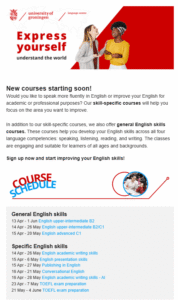
The University of Groningen offers regular English language courses to help students of all levels sharpen their skills. This is their announcement email.
Why it works:
- By starting with a clear question, the university immediately identifies and captures the attention of high-intent students.
- The email focuses on the tangible purpose and benefits of the courses, explaining why a student should invest their time.
- Including a detailed course schedule helps recipients see how the classes fit into their busy lives, removing a major barrier to enrollment.
- Adding a referral link encourages word-of-mouth marketing, making it easy for readers to share the opportunity with peers who have similar academic needs.
Durham University – Alumni newsletter
Subject line: Keeping you connected – March Newswire

Durham University uses a dedicated alumni newsletter to keep its graduates connected to the community and motivated as brand ambassadors.
Why it works:
- The copy opens by highlighting the value of a lifelong relationship, framing the email as an exchange of ideas and experiences.
- They use a mix of striking imagery and brief, punchy copy to showcase various updates. White space also prevents the newsletter from feeling overwhelming.
- The “Read More” buttons are bold yellow and contrast sharply with the background.
Common Higher Ed Email Marketing Mistakes to Avoid
Throughout this guide, we’ve highlighted best practices to elevate your college and university emails. Now, let’s look at the pitfalls that could undermine your hard work:
- Don’t send from “no-reply” addresses: Using a “no-reply” address sends a message that you aren’t interested in what the student has to say. Instead, use a monitored inbox to show you’re eager to receive questions and build a real connection.
- Don’t neglect list cleaning: High deliverability is the key to email success. Protect your sender reputation by enabling a double opt-in process and regularly cleaning your list of inactive or invalid email addresses.
- Don’t treat all prospects the same: Avoid sending generic bulk emails. Segment your audience and tailor your messaging to each group’s specific needs and preferences to boost performance.
- Don’t ignore your metrics: If you don’t track your analytics regularly, you’ll miss the patterns that tell you what actually resonates with your audience. Always review past performance before launching your next campaign.
- Don’t have an inconsistent schedule: Ghosting your audience or suddenly flooding their inbox hurts trust. Maintain a consistent sending frequency to set clear expectations and stay top-of-mind.
Make Email Your Ultimate Growth Tool
Are you ready to incorporate email into your university’s digital marketing strategy? Start by setting clear goals for every stage of the student journey. By understanding exactly what information your prospects need at each milestone, you can help them decide that your institution is the best choice for their future.
If you’re looking for an email marketing service with robust functionality, professional pre-made templates, and powerful automation workflows, Moosend could be the perfect fit for you. Sign up for a free trial today and see how it can help you scale your higher ed reach.
FAQS
Here are some frequently asked questions about higher education email marketing.
1. How often should we email prospective students?
Your email frequency should vary based on your intent and the student’s lifecycle stage. In general, once a week is enough to nurture an audience. However, during critical windows, such as the final weeks before an application deadline, you can increase engagement to 2–3 emails per week to ensure your institution remains top-of-mind.
2. How do we prevent our emails from going to the Spam/Promotions folder?
Ensure your domain includes SPF, DKIM, and DMARC authentication. Beyond the technical side, avoid “spammy” language or excessive urgency in your subject lines, as these can trigger filters. Plus, encouraging recipients to reply to your emails signals to Email Service Providers (ESPs) that you are a legitimate, human sender, which improves your sender reputation.
3. Can we use AI tools to craft student recruitment emails?
AI is a great tool for experimenting with high-impact elements like subject lines and headlines. While you should avoid using AI for generating an entire message, it is incredibly effective for inspiration and optimization. Many platforms, including Moosend, offer built-in AI writing tools designed specifically to help you refine your storytelling and increase engagement.
Similar Posts
 Published by
Create, send and optimize your email marketing campaigns