














Email Marketing Growth: Trends & Benchmarks from the Greek Market
Published By Sarah Papadopoulou
January 8, 2026

08/01/26
While AI tools, privacy updates, and social algorithms keep changing the digital space, email remains the one channel you can rely on to reach real people.
Recent reports back this up. Global open rates climbed from around 33% in 2023 to over 36% in 2024, and more than 80% of digital marketers now use email as a core part of their strategy. Most of them rely on automation for welcome flows, abandoned cart recovery, and order confirmations, proving that relevance and timing make all the difference.
With more brands moving toward automation and audience-first content, engagement today depends on quality, not volume. To see what truly works, we analyzed verified human activity across 30 industries from September 2024 to September 2025.
The Digital Context in Greece
Internet penetration, the percentage of the total population actively using the internet, reached around 87% at the start of 2025. This means that roughly 9 out of 10 people use the internet daily for email, eCommerce, social media, and mobile apps.
On a device level, Greece still leans heavily on desktop browsing, with 57.8% market share in September 2025, followed by 40.52% on mobile and 1.69% on tablets. This makes email a channel that adapts easily to how Greeks interact online, regardless of screen size or device.
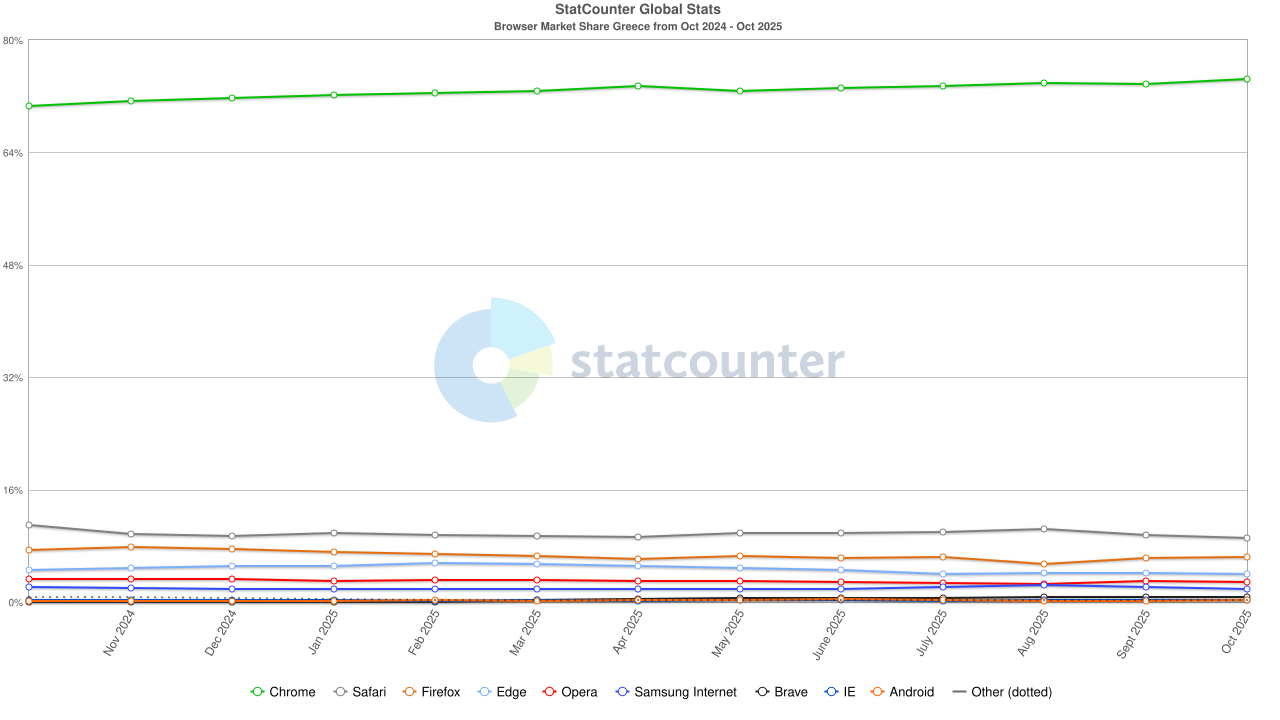
Browser preferences in Greece are also clear, which simplifies email design decisions. The majority of users rely on only a handful of platforms:
According to the data:
- Chrome dominates with 70.56%
- Safari stays around 11%
- Firefox (7.37%), Edge (4.6%), and Opera (3.26%) are among the least used
In the Mobile OS market, Greek users have a strong preference for Android devices.
- Android leads at 74.2%
- iOS follows with 23.24%
- Samsung and Unknown have 0.88% and 0.12% respectively
But why are these numbers significant for email campaign performance?
These patterns create a highly predictable rendering environment. When most people use the same browsers and devices, emails behave more consistently, reducing the risk of layout or display issues across segments.
This stability makes email one of the most dependable channels for reaching real users. And when brands layer this predictable environment with automation and personalization through Moosend’s automation or transactional API, their campaigns become more relevant, consistent, and practical to maintain.
Moosend Benchmarks: Real Open Rates (Sept. 2024 – Sept. 2025)
Below is a table of real open rates across 30 industries in Greece. These numbers reflect verified human activity and exclude artificial interactions.
| Industry | Avg. Open Rate (%) |
| Government | 37.70 |
| Bank / Finance | 37.36 |
| Religion | 36.56 |
| Sports | 36.29 |
| Education and Training | 35.97 |
| Entertainment and Events | 35.69 |
| Higher Education | 35.17 |
| Hobbies | 34.89 |
| Medical, Dental & Healthcare | 34.17 |
| Health and Fitness | 33.17 |
| Legal | 32.17 |
| Music and Musicians | 32.12 |
| Restaurant | 31.65 |
| Media and Publishing | 31.64 |
| Marketing and Advertising | 30.07 |
| Consulting | 30.07 |
| Travel and Transportation | 29.97 |
| Arts and Artists | 29.92 |
| Non-Profit | 29.84 |
| Real Estate | 29.42 |
| Insurance | 28.70 |
| E-commerce | 28.67 |
| Public Relations | 28.67 |
| Manufacturing | 28.60 |
| Retail | 28.27 |
| Computer and Electronics | 26.47 |
| Construction | 26.14 |
| SaaS | 26.07 |
| Daily Deals / Coupons | 25.87 |
| Beauty and Personal Care | 25.79 |
| Telecommunications | 25.67 |
What the data shows:
- Trust-based industries like Government, Finance, Religion, and Education have the highest open rates, underscoring the importance of updates in driving attention.
- Community-driven sectors such as Sports, Entertainment, and Hobbies perform well thanks to timely, event-based communication.
- Retail, eCommerce, and other competitive industries stay in the mid-range, where segmentation and automation become essential to maintain engagement.
- B2B and service categories see stable performance, benefiting from educational content and recurring updates.
- Technology-heavy sectors like SaaS and Telecommunications face lower open rates, indicating the need for more personalized lifecycle flows.
- Story-led industries such as Non-Profit and Arts maintain healthy engagement, demonstrating the impact of emotionally driven, value-based messaging.
Overall, industries that send targeted, helpful, and expected emails consistently achieve higher open rates.
Industry Insights: What Works and How Brands Use Moosend
Here you’ll see how different industries achieve their results and which Moosend tools support those workflows.
Each example highlights a real use case to help you understand how automation and personalization improve engagement across sectors.
| Industry | Avg. Open Rate | Winning Strategy | Using Moosend |
| Retail | 28.27% | Weekly segmented campaigns + Automations (Welcome & Abandoned Cart) | Moosend’s abandoned cart automation + RSS feed of new arrivals |
| Insurance | 28.7% | Monthly newsletters + Transactional API reminders | Trigger policy-expiry notifications 3 days before due date via Transactional API |
| Education & Training | 35.97% | Automated learning journeys & event invitations | RSS automation for new courses + follow-ups when certificates are issued |
| Government | 37.7% | Clear communication & high trust updates | Transactional API for notifications + accessible preference centers |
| Beauty & Personal Care | 25.79% | Product recommendations + interactive content | Personalized dynamic blocks based on previous purchases |
| Media & Publishing | 31.64% | RSS auto-newsletters segmented by topic | Automatically deliver fresh stories using Moosend’s RSS-to-Email |
| SaaS | 26.07% | Drip campaigns & renewal flows | “Trial expiring soon” emails triggered via API |
| Non-Profit | 29.84% | Emotional storytelling + donation follow-ups | Year-end donor thank-you automation |
| Hospitality / Travel | 29.97% | Pre-trip sequences + loyalty engagement | Pre-departure tips + post-stay feedback emails via transactional API |
This breakdown helps each sector understand which tactics drive performance and how automation or API-driven communication supports better results.
Multilingual Audiences & Real Email Engagement in Greece
Email engagement improves when communication matches real user behavior. In Greece, this behavior is shifting fast due to the growing number of foreign-born residents and digital workers settling in the country.
During the Omnichannel Retail Conference in Athens, Daniel Meck (CCO of Moosend) shared insights showing how quickly Greece’s audience is changing. Non-Greek residents now contribute an estimated €1.7 billion in annual everyday spending. This includes digital nomads, Golden Visa holders, and international professionals who often prefer English or another language.
However, while foreign-born residents make up 11.3% of the population and have higher purchasing power, many Greek businesses still communicate only in Greek. And the poll conducted during the conference confirms this gap.
Attendees were asked two simple questions. Here’s what the data showed among 122 participants:
Q1: In which languages is your website published?
- 68% publish their website in both English and Greek, showing clear awareness of the multilingual audience in Greece.
- 25% operate Greek-only websites.
- 7% offer websites in more than two languages, targeting a broader international audience.
Q2: In which languages do you send newsletters?
- 57% send Greek-only newsletters.
- 43% send bilingual newsletters (English + Greek) based on subscriber preference.
- Less than 1% send newsletters in more than two languages.
Subscribers may browse in English but receive emails they can’t fully understand. This friction directly affects engagement, conversions, and customer retention. And with a growing multilingual audience in Greece, this gap becomes even more costly.
How to target a multilingual audience with email marketing
So, what does this mean for Greek businesses relying on email marketing?
The mismatch between bilingual websites and Greek-only newsletters shows a missed opportunity. Closing this gap can significantly improve engagement.
Here are a few steps that can help drive email growth:
- Asking subscribers for their preferred language at signup
- Segmenting subscribers based on language
- Offering English versions of core campaigns
- Using your ESP’s multilingual content generation feature in emails, forms, and landing pages
Given Greece’s strong internet usage and consistent device patterns, combined with an expanding international community, aligning email content with subscriber language preferences becomes essential.
When communication reflects the way people use the web in their daily lives, open rates and engagement metrics increase steadily.
Additional Resources
Here are some helpful email marketing guides for different industries.
- The Complete B2B Email Marketing Guide
- Ecommerce Email Marketing: Grow & Engage Your Audience
- Email Marketing For Hotels: Step-By-Step Guide
- How To Do Email Marketing For Small Businesses
- Email Marketing For Hospitals: The Ultimate Guide [2025]
- The Ultimate Email Marketing for Real Estate Businesses
- Email Marketing Guide For Nonprofits
Real Engagement Starts with Relevance
Email continues to evolve, but the fundamentals remain unchanged. When messages are timely, useful, and tailored to real user needs, engagement follows. Moosend’s data shows that once artificial signals are removed, authentic interactions become clear and measurable across every industry.
Brands that invest in relevance and automation see stronger performance, whether they operate in government, education, retail, or SaaS. Real engagement comes from understanding your audience and delivering content they expect and trust.
If you want to power campaigns with verified human activity, explore Moosend’s automations and transactional API to reach people with accuracy and impact.
Similar Posts

 Published by
 Published by

 Published by

Create, send and optimize your email marketing campaigns