













Inbound vs Outbound Marketing: What’s the Difference? [2026]
Published By Tea Liarokapi
August 19, 2026

19/08/26
At some point, most marketers run into the same problem: The outcome falls short even when the work is there. You publish, send, promote, and optimize, yet growth stays flat because not every marketing method works the same way. Results can stall even when activity doesn’t.
Some tactics attract prospects who are already looking for a solution. Others put your message in front of people before intent exists. That distinction sits at the center of inbound vs outbound marketing.
Getting the distinction right—and knowing how to act on each—impacts your budget, how fast you see results, and your long-term growth.
Let’s go ahead and look closely at how each works, where each fits, and what each actually delivers.
Guide leads from first touch to conversion
Turn inbound and outbound into one customer journey with lead generation, email campaigns, and automation.
Try MoosendWhat Is Inbound Marketing?
Inbound marketing is a marketing strategy that attracts potential customers through content and experiences they choose to engage with. It relies on owned and permission-based channels such as your website, blog, email list, and organic social presence. It aims to attract people, educate them, build trust, and move them closer to conversion while strengthening customer relationships.
What makes inbound marketing distinct is intent. The prospect isn’t being contacted out of the blue. They’re already searching, comparing, researching, or showing interest in a topic related to what you offer. Your job is to meet that intent with something useful enough to earn the next step.
That’s why inbound works best when content goes beyond brand messaging and aligns with real search behavior, customer pain points, and decision-stage questions.
How it works
In practice, inbound marketing guides people along a gradual path that starts with discovery, continues with engagement and conversion, and culminates in retention.
- At the top of the funnel, the goal is visibility. An SEO-optimized blog post, landing page, social media post, or downloadable resource helps someone discover your brand while they explore a topic or problem.
- In the middle of the funnel, the focus shifts to consideration. That is where stronger educational content, targeted marketing messages, email nurturing, product-focused pages, webinars, or case studies help prospects evaluate whether your solution fits.
- At the bottom of the funnel, inbound supports conversion through targeted offers, demos, trials, testimonials, and clear calls to action.
Of course, the process doesn’t stop at acquisition. Strong inbound marketing also supports retention by continuing to educate customers, pinpointing product value, and creating reasons to stay engaged after the first conversion.
Common inbound marketing channels and tactics
Since inbound marketing is a coordinated mix of digital marketing tactics designed to attract, qualify, and nurture demand, it goes beyond one channel.
One of the core inbound marketing tactics is Search Engine Optimization (SEO), which takes advantage of how heavily search engines are used across industries and buying stages:
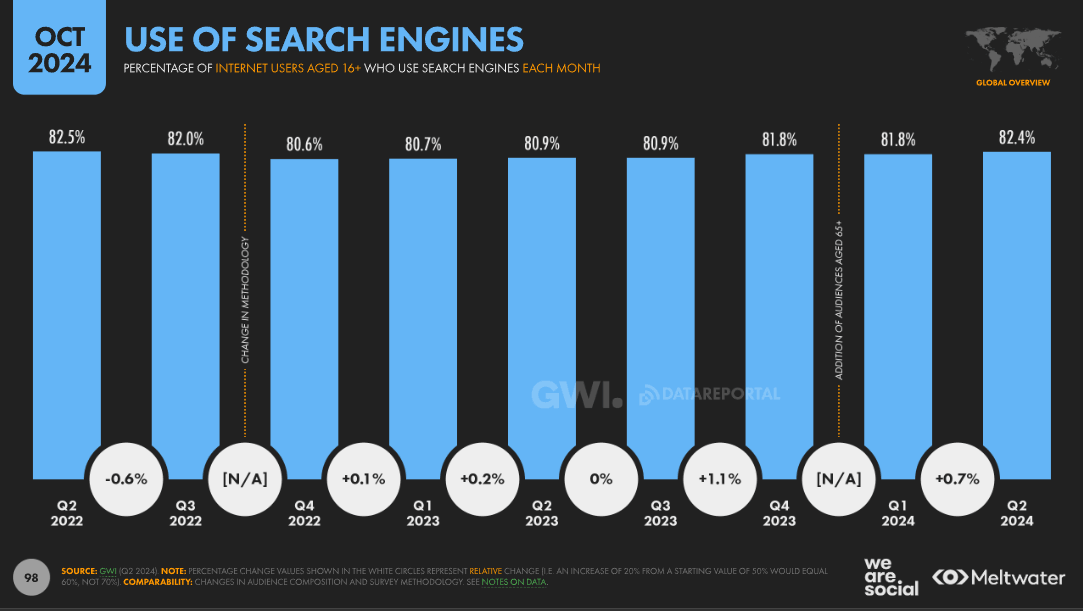
According to DataReportal’s Digital 2024 October Global Statshot Report, more than 80% of the global population uses search engines each month. This makes SEO a prime channel for brand awareness and content distribution.
By creating blog content, comparison pages, solution pages, and landing pages around terms your audience is already searching for, you can get discovered at the right moment and drive qualified traffic to your website. This is where content marketing comes into play.
Content marketing gives that traffic relevant content to engage with. Guides, checklists, newsletters, ebooks, webinars, and case studies help turn passive visits into genuine interest by answering questions that matter to buyers.
Another inbound marketing tactic is organic social media. It can support distribution and brand awareness, especially when used to extend your content’s reach beyond your core target audience. It’s often more effective as a content amplifier than as a standalone acquisition engine.
Email marketing plays a different role inside inbound. Rather than initiating cold contact (like cold calling), email marketing helps nurture people who have already opted in. That includes marketing messages like welcome emails, newsletters, educational sequences, lead-nurturing workflows, and behavior-based automation workflows that keep prospects moving.
Lead magnets are another inbound tactic designed primarily for lead generation. Valuable content like templates, reports, ebooks, and downloadable resources sits at the conversion point between attention and pipeline, giving interested prospects a reason to exchange their contact details for something with immediate value.
Used together, these tactics create a system that continues to generate qualified traffic and conversions beyond a single campaign. That’s one of the main reasons inbound is often treated as a long-term growth channel rather than a short-term acquisition tactic.
What Is Outbound Marketing?
Outbound marketing is a strategy that proactively reaches potential customers through direct or paid channels. Rather than attracting prospects who are already engaging with your brand, it pushes a message outward to generate attention, interest, or response.
In practice, outbound marketing strategies are often among the best marketing techniques when speed matters, when you need to reach a narrow audience, or when organic demand alone is not enough to support pipeline goals. The drawback is that the marketer must earn attention quickly, since the audience may not have requested the interaction.
How it works
Outbound typically starts with audience selection. You define who you want to reach based on demographic, behavioral, or intent signals, then choose the channel, offer, and message most likely to get a response.
From there, the flow is fairly direct: targeting, outreach, response, and conversion. A sales team, for instance, may send cold emails or perform cold calling to a defined account list. A demand generation team may launch paid social campaigns to promote a webinar to prospective customers (ideally within specific audiences). A marketing team may use sponsorships or paid placements to reach qualified leads at scale.
What makes outbound useful is the feedback loop. Results tend to appear faster than with long-term inbound programs, making outbound easier to pressure-test in shorter cycles. You can quickly see whether the targeting is off, the creative is weak, the offer is irrelevant, or the channel is too expensive to sustain.
Common outbound marketing channels and tactics
Cold email remains one of the most common outbound tactics, and B2B email marketing is a great example of that. It gives teams a direct way to reach specific prospects with a tailored message, though results depend heavily on list quality, relevance, and timing. Without those, volume quickly turns into waste.
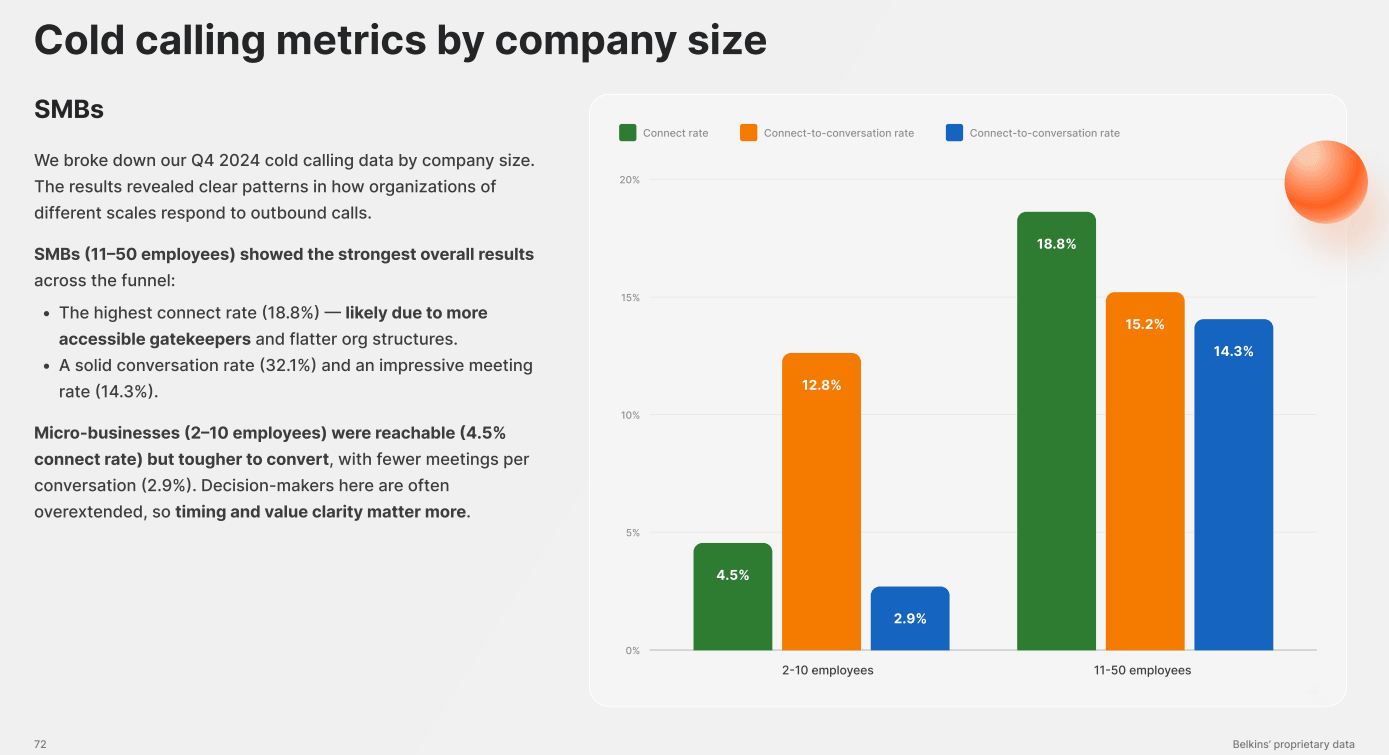
Cold calling plays a similar role. It’s more resource-intensive, but it can still work well in cases where speed, qualification, or direct conversation matters more than scale. Belkins’s B2B Cold Outreach Report shows that cold calling’s conversion rates are high for SMB outreach:
Paid ads are a broader tactic. Search ads help you capture demand with a budget rather than organic rankings, while Facebook lead ads and other paid social and display campaigns let you target audiences based on demographics or account criteria. In that sense, paid media often sits between classic outbound and demand capture, depending on the channel and targeting model.
Sponsorships are another outbound play. Whether it’s a newsletter placement, podcast sponsorship, event presence, or partner promotion, the goal is to borrow attention from an existing audience rather than build it from scratch.
Direct mail is less common, but still relevant for high-value accounts and account-based programs. When the audience is small and the contract value is high, physical outreach and follow-ups can be more memorable than another email in a crowded inbox.
Used well, these tactics create visibility quickly and can support faster pipeline generation than slower-burn inbound efforts. The trade-off is efficiency. Outbound can move fast, but it also becomes expensive quickly when targeting, messaging, or channel choice is weak.
Note: Other traditional marketing channels, such as TV, radio, billboards, print, and trade shows, also fall under outbound marketing efforts, especially when targeting large audiences.
Inbound vs Outbound Marketing: Key Differences
The difference between inbound and outbound marketing comes down to how demand is sourced and the level of control you have over it.
Inbound depends on existing intent, capturing demand when and where it shows up. Outbound lets you define the audience and create activity on your own timeline.
That makes inbound more dependent on visibility and timing, while outbound is more dependent on targeting, budget, and execution quality.
Differences in cost, timing, and ROI
Inbound usually asks for more patience upfront. You invest in crafting SEO content, creating landing pages, nurturing leads through targeted email sequences, and distributing content on social media posts before the return becomes visible.
The payoff is that those assets can continue to generate value after the initial work is done, making this tactic cost-effective. For example, a strong article, a useful lead magnet, or a well-optimized page can continue to attract and convert traffic without requiring the same spend each time.
Outbound behaves differently. It’s easier to launch, but it often needs continuous input to keep producing results. Paid acquisition ends when spend ends. Cold outreach weakens when list quality drops, targeting slips, or email fatigue sets in. In other words, outbound is often more immediate, but also more dependent on constant optimization.
That is why the ROI discussion shouldn’t be reduced to “one is cheaper” or “one works faster.” Inbound tends to improve efficiency over a longer window because the value of the work can accumulate. Outbound tends to be easier to test in the short term because feedback comes faster.
Differences in audience experience
Inbound is usually experienced as helpful when it’s done well. The person reads an article, downloads a resource, joins a newsletter, or visits a page because it answers a question they already had. The interaction feels relevant because it’s tied to existing intent.
Outbound is inherently more disruptive because the marketer starts the interaction. That action raises the standard for targeting and relevance. A cold email, paid ad, or sponsored placement has to justify its presence quickly. If the message is broad, poorly timed, or too generic, it feels like noise. If it’s targeted and solves a real problem, it can still perform.
For marketers, that’s the practical distinction. Inbound is usually better suited to capturing existing demand. Outbound is better suited to creating opportunities where waiting to be found is too slow or too limited. The right choice depends less on preference and more on the marketing metrics you’re trying to improve, as well as your time window.
Inbound vs Outbound Marketing: Pros and Cons
Each marketing tactic comes with its own constraints around timing, control, and cost. Where it gets more interesting is in execution, because that’s where these differences start affecting performance.
Inbound marketing pros and cons
An inbound marketing strategy works best when you can sustain quality and consistency. When it’s done right, it reduces dependency on constant campaign execution. Traffic, leads, and conversions come from content marketing, SEO, email campaigns, lifecycle flows, and assets that work in the background.
The core advantage of inbound marketing is stability, meaning you’re not rebuilding demand from scratch every time you need results.
On the other hand, the main constraint is that inbound is sensitive to momentum. If publishing slows down, rankings drop, or distribution weakens, performance declines. There’s also less control over volume in the short term. Inbound doesn’t scale instantly. If you need more leads this month, you can’t rely on it to deliver them on demand.
Outbound marketing pros and cons
Outbound marketing strategies are easier to activate and adjust. You can launch quickly, test messaging, and scale what works without waiting for visibility to build. That makes it useful when targets are time-bound or when you need to validate positioning fast.
The main advantage is responsiveness. You can react to performance data in near real time.
The constraint is that outbound is sensitive to efficiency. Costs, fatigue, and diminishing returns show up quickly if targeting or messaging is even slightly off.
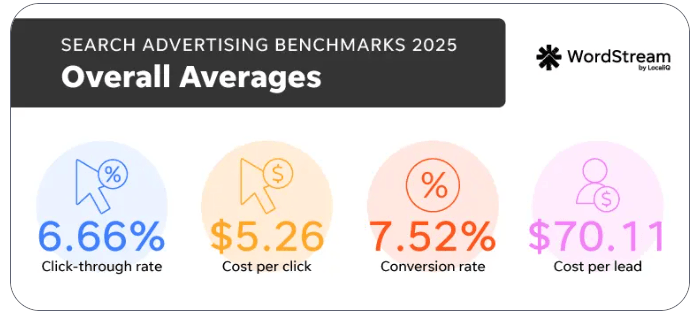
According to WordStream’s 2025 Google Ads Benchmarks Report, average cost per lead across Google and Microsoft Ads reached $70.11, which means inefficiencies scale fast with spend:
Cold outreach shows a similar pattern. Belkins’ 2025 study reveals that average B2B cold email reply rates dropped to 5.8% in 2024, highlighting how dependent outbound is on precision.
Inbound vs Outbound Marketing Examples
The difference between these two approaches becomes easier to spot when you look at how they show up in real campaigns. The examples below focus on the mechanics behind each tactic and the metrics they are most likely to influence.
Inbound marketing examples
A common inbound example comes from content marketing.
A blog post built around a high-intent query such as “email segmentation” doesn’t aim to just rank, but to attract people who are already trying to solve a specific marketing problem. Let’s look at an example:
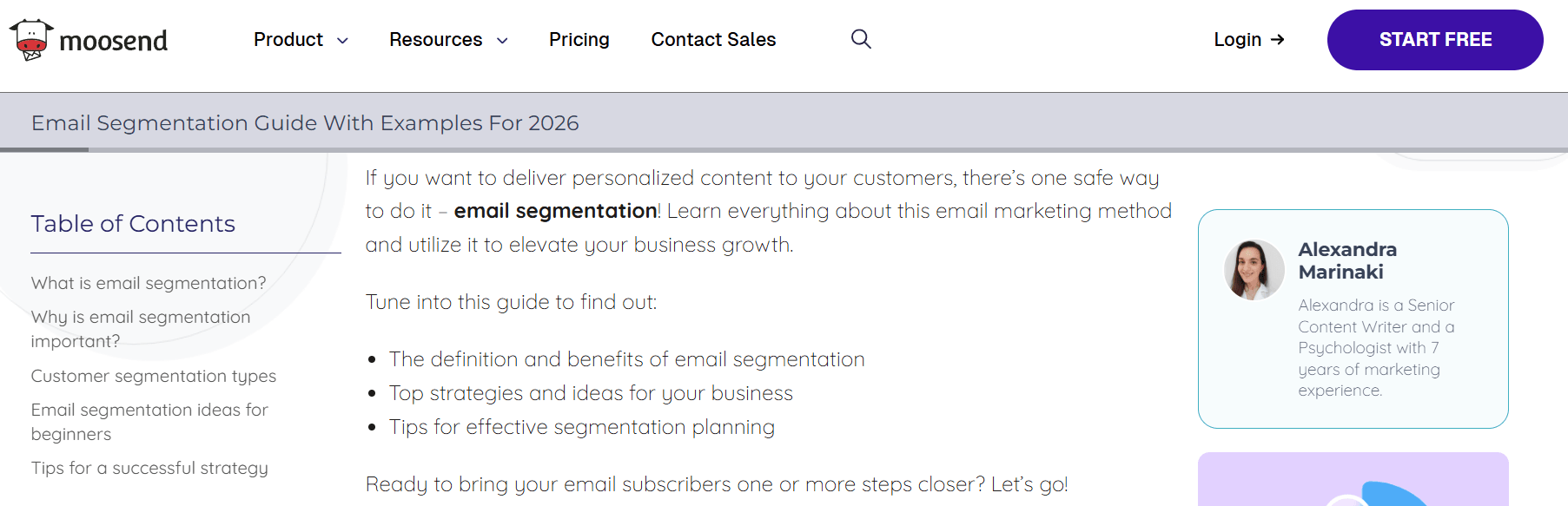
Moosend’s Email Segmentation Guide is a blog post aligned with real search intent. It speaks to marketers looking to improve their email campaigns through targeted content. It can drive qualified organic traffic, build trust in the brand as a topic expert, and introduce new prospects without paid distribution.
Another example is a lead magnet paired with an automated email flow. A marketer offers a template, checklist, case study, or guide in exchange for an email address. Once a new subscriber is added to a list, an automation is triggered:
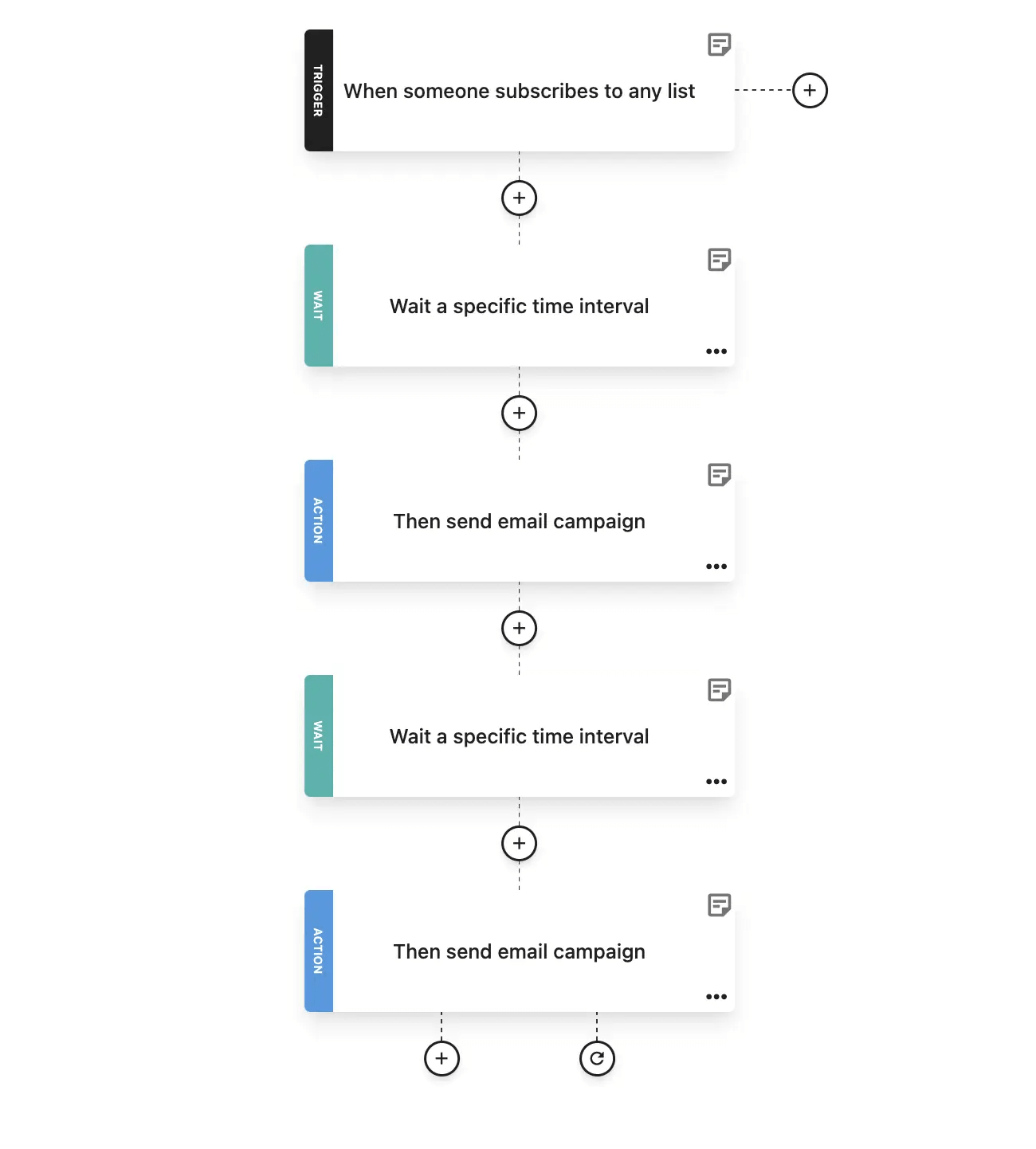
As you can see, Moosend’s email sequence starts with the act of subscribing. After that, the automation follows up with an email campaign. In that setup, the lead magnet captures interest, while the automation helps qualify it. The key metrics here are usually conversion rate, lead quality, and engagement.
A third example is an SEO-driven landing page built around a specific use case or product category. Unlike a broad homepage, this page is designed to match a clear need and convert visitors who already know what they are looking for. When it works, the value shows up in organic traffic, signups, demo requests, or assisted conversions.
Outbound marketing examples
A typical outbound marketing example is a cold email campaign built around a tightly defined Ideal Customer Profile (ICP). The goal is to reach decision-makers directly with messaging tied to a clear pain point, use case, or trigger. Performance depends less on volume and more on list quality, relevance, and timing. Marketers usually evaluate this type of campaign through reply rates, meetings booked, and pipeline created.
Paid LinkedIn ads are another strong example of outbound marketing, especially in B2B. Instead of waiting for organic discovery, the marketer targets specific roles, industries, or company sizes and puts a message in front of them immediately:
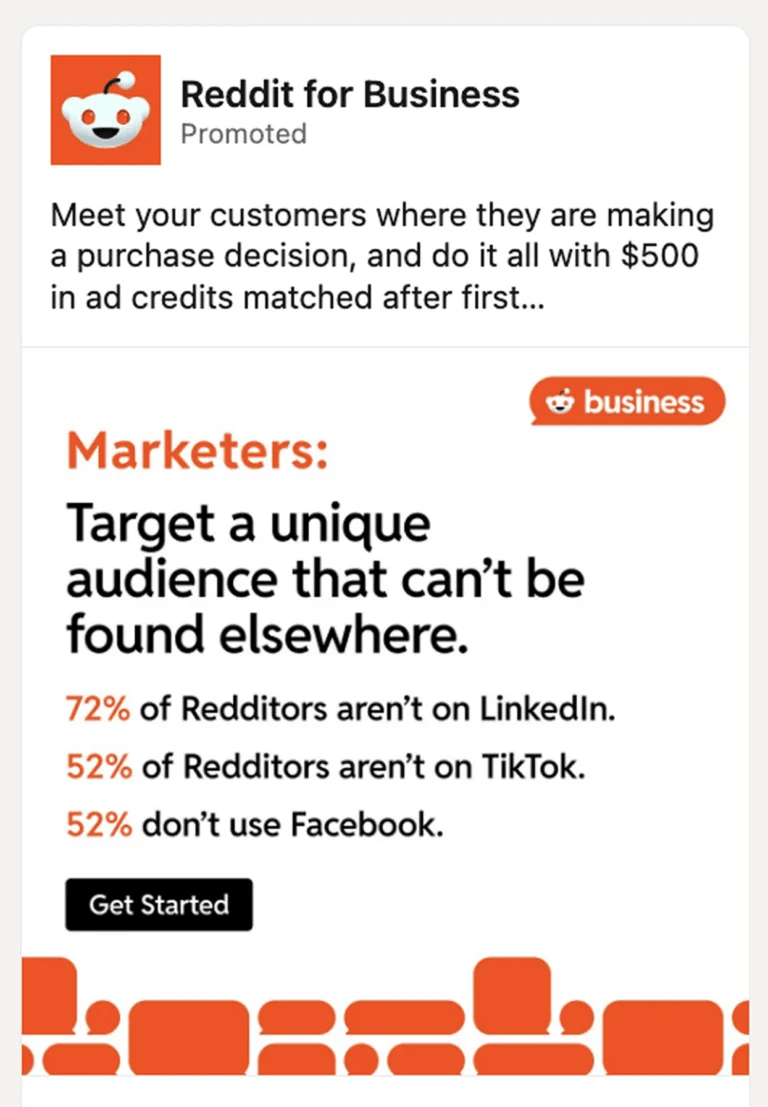
This LinkedIn ad promoting Reddit for Business shows how outbound works when targeting and messaging are aligned.
Here’s what works:
- The ad calls out marketers directly, immediately capturing the ideal audience’s attention, and positions its value around access to users who aren’t active on other platforms.
- It supports that claim with specific data points, reducing skepticism and strengthening the message within seconds. This kind of clarity is essential in outbound marketing, where attention is limited, and relevance determines whether the interaction continues.
Another example is account-based marketing.
Account-based outbound campaigns target a predefined list of high-value companies. Instead of broad targeting, the marketer builds a focused list of accounts that match their ideal customer profile and reaches them through a mix of channels such as personalized emails, LinkedIn outreach, and tailored ad campaigns.
In this case, the goal is precision. Messaging is adapted to the account, sometimes even to the individual stakeholder, and often references specific business challenges, industry context, or recent activity.
This approach works well when the deal value is high and the audience is clearly defined. Performance is typically measured through engagement at the account level, meetings booked, and pipeline generated rather than top-level metrics like clicks or impressions.
How to Combine Inbound and Outbound Marketing Effectively
Despite the differences, most teams don’t choose one marketing tactic over the other. Usually, they run both. The difference between wasted budget and business growth usually comes down to how well these two approaches are connected.
1. Start with inbound signals
Inbound activity gives you real data on what people care about. Page visits, content engagement, ebook downloads, and email marketing responses are clear signals of intent.
Instead of treating outbound as a separate motion, use those signals to guide it. Prioritize audiences who have already interacted with your content and use them alongside your buyer personas.
Adjust your content marketing tactics based on what they’ve seen. A prospect who visited a pricing page should not receive the same outreach as someone who only read a top-of-funnel article.
This approach reduces guesswork, as you’re identifying it based on existing behavior. Outbound becomes more precise because it’s informed by actual interest.
2. Make sure inbound can convert before scaling outbound
Outbound can quickly increase traffic and visibility. But if the destination isn’t built to convert, that traffic won’t translate into pipeline.
Before scaling campaigns or outreach, check the basics:
- Does the landing page clearly match the message that brought the user in?
- Is the value proposition obvious within a few seconds?
- Is there a clear next step in your CTA (demo, signup, download)?
- Is there a follow-up mechanism in place (email sequence, retargeting)?
If these elements are weak, outbound will amplify the problem. You’ll pay more to bring people in, but conversion rates will stay flat. Fixing the inbound layer first improves the return on every outbound effort that follows.
3. Align both around the same funnel and messaging
Inbound and outbound often drift because they are managed by different teams or workflows. Content marketing addresses one set of problems, while ads and outreach address another.
That disconnect shows up in performance. Prospects click, visit, and drop off because the messaging changes from one touchpoint to the next, which doesn’t grab the audience’s attention and could seem spammy.
Alignment solves this, so define:
- A shared ideal customer profile (ICP)
- The core problems you’re solving
- The key messaging angles
Then apply them consistently across:
- Blog content and landing pages
- Paid campaigns
- Sales outreach and follow-ups
When a prospect moves from a blog post to an ad to a sales email, the narrative should feel continuous. That consistency reinforces your positioning across touchpoints, helping you stay relevant to new audiences while building stronger customer relationships with prospects already in your funnel.
4. Use outbound to test what inbound should scale
Inbound takes time to build, so it helps to validate ideas before investing heavily in them. Outbound gives you that speed.
You can test:
- Messaging angles
- Value propositions
- Offers
- Audience segments
If a specific message drives replies, clicks, or conversions in outbound campaigns, it’s a strong candidate for inbound expansion. That same angle can become:
- A blog post
- A landing page
- A lead magnet
This reduces the risk of creating content materials that don’t perform for your buyer personas and target audience. Instead of guessing what will resonate, you base your inbound strategy on real feedback.
5. Let inbound reduce pressure on outbound over time
Outbound is often the fastest way to generate early traction, but it shouldn’t carry the entire acquisition load indefinitely.
As inbound assets grow (content, SEO visibility, email lists), they start capturing demand that would otherwise require paid or outbound effort. Over time, this reduces how much you need to spend to maintain the same level of results.
This doesn’t mean completely replacing outbound. It means shifting the balance:
- Early stage: Outbound marketing drives most activity.
- Growth stage: Inbound and outbound work together to create lasting relationships and attract new customers.
- Mature stage: Inbound carries more of the load, and outbound becomes more targeted.
The goal isn’t to eliminate outbound, but to make it more efficient and less reactive.
6. Measure performance across both
Inbound and outbound rarely work as standalone marketing methods. A user might discover your brand through content marketing, return via an ad, and convert after an email campaign with targeted, relevant content or a cold outreach touchpoint.
By measuring each channel separately, you miss that interaction.
Instead of doing that, focus on:
- Assisted conversions
- Multi-touch journeys
- Time to conversion
- Customer acquisition cost across the full journey
This gives a more accurate view of what’s actually driving results. It also prevents underinvesting in channels that contribute earlier in the process but don’t get the final click.
Choosing the Right Strategy for Your Business
Inbound vs outbound marketing isn’t a binary choice. Rather, it’s a question of timing and priorities.
Inbound is perfect for building long-term demand and improving efficiency. If you need to generate a pipeline quickly or reach a specific audience, use outbound. Most teams need both, just not at the same time or in the same proportion.
What matters is execution. Inbound without consistency stalls. Outbound without precision gets expensive.
The goal is to use each where it adds the most leverage, based on what your growth actually requires.
FAQs
Now, let’s answer the most common questions on inbound vs outbound marketing.
1. What is the main difference between inbound and outbound marketing?
The core difference in inbound vs. outbound marketing lies in how you reach your target audience. An inbound marketing strategy uses valuable content, SEO, and content marketing to attract potential customers, while outbound marketing strategies rely on outreach methods like cold emails, cold calling, and paid marketing campaigns to push marketing messages to a broad audience.
2. How do you choose the right target audience for inbound and outbound marketing?
Choosing the right target audience depends on intent and demographics. For inbound, you focus on search behavior and engagement signals through search engine optimization, social media, and content creation. For outbound, you define specific audiences upfront using firmographic and behavioral data, then reach them through outbound campaigns, email marketing, or sales team outreach.
3. What role does automation play in inbound and outbound marketing?
Automation supports both approaches, but in different ways. In inbound, it powers email marketing, follow-up sequences, and personalized content marketing journeys that nurture qualified leads. In outbound, it helps scale outreach, manage cold emails, and streamline sales team workflows. Used correctly, automation improves optimization without losing relevance in your marketing messages.
4. How does marketing attribution work across inbound and outbound channels?
Attribution tracks how different marketing tactics contribute to conversions across a digital marketing journey. A user might discover your brand through social media posts, return via a paid marketing campaign, and convert after an email marketing follow-up. Looking at metrics like assisted conversions and multi-touch paths helps you understand how inbound and outbound work together to drive business growth.
5. How do you improve messaging across inbound and outbound marketing?
It starts with understanding your target audience and aligning your marketing messages across channels. In inbound, this means creating relevant content through content marketing, case studies, and webinars. In outbound, it means tailoring outreach like cold emails or telemarketing to specific pain points. Consistent messaging helps capture the audience’s attention and improves conversion rates across both approaches.
Similar Posts
 Published by

Create, send and optimize your email marketing campaigns