













Instagram Marketing Guide: From Zero to Kylie [2026]
Published By Maria Fintanidou
February 4, 2019

04/02/19
Instagram used to be about sharing personal moments and photos. Now everyone is looking for branded content there, including your customers. This is why Instagram marketing is perfect for reaching goals like building brand awareness, entertaining your audience, sharing your vision, and driving sales.
But creating a business account, posting, and listening to your followers once in a blue moon isn’t enough. Brands need to design an impactful strategy to stay top of mind for existing and new followers.
Getting started or refining your approach may seem like a lot to take on. So, we created this guide to help you market your brand on Instagram.
Why Instagram Matters to Businesses
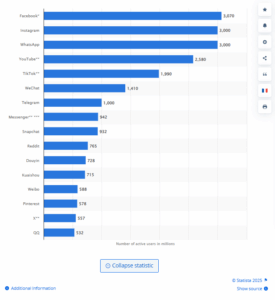
In Statista’s social media research, Instagram ranks as the second most popular channel (after Facebook) with roughly 3B active users.
From them, 29.5% are aged 18-24, while the largest group (31.6%) are users between 25-34. It’s also popular among older adults, though the percentage drops significantly.
Statistics aside, let’s discover why Instagram should be a core component of any digital marketing strategy:
- Broad reach: As the numbers demonstrate, Instagram caters to diverse global audiences. This allows brands to connect with a range of user personas across age groups and backgrounds and engage them with the right message (e.g., tailored ads).
- Visual appeal: Instagram is the ideal platform for creating captivating visual content. With features like Stories and Reels, you, your loyal customers, or famous influencers can showcase your product’s design or the effectiveness of your service in a digestible format.
- Increased engagement: Users on Instagram may like, comment on, and share your content. Plus, tag others to enter a contest or share posts that could interest their friends. All these actions help more people check out your content.
- Content variety: Unlike platforms like LinkedIn, Instagram is ideal for experimentation. For example, 50% of its users visit Instagram for funny content. You can get your creative juices flowing by experimenting with styles or formats until you find what resonates with your audience.
- Paid opportunities: With targeted Instagram ads, you can generate new leads or move existing ones down your sales funnel. The platform also offers shopping features that let users review products on the spot. You also offer paid promotions, where you partner with Instagram influencers and tap into their audiences for visibility.
After covering the main benefits of Instagram marketing, it’s time to explore how it compares to other social media platforms.
Marketing on Instagram vs. Other Social Media Channels
Each social media platform has its own strengths, use cases, and limitations, shaping how businesses should approach them.
Before diving into the nitty-gritty, here’s a quick comparison to help you understand how different social media platforms work:
| Platform | Main strengths | Best for | Limitations |
| Visual storytelling, influencer partnerships, and shopping features | Brand awareness, sales (organic and paid content), lead generation | Algorithm changes, high cost if you use ads or influencer marketing | |
| Largest and diverse user base, versatile content (text, images, videos), powerful advertising | Lead gen, retargeting, community-building through Groups, and brand storytelling | Declining organic reach, ad fatigue, and low engagement for younger users | |
| YouTube | Vast audience reach, long-form and short-form videos, search visibility, paid collaborations | Organic traffic, customer onboarding, lead gen, brand storytelling | Time-consuming content creation, ad skipping, and low engagement |
| B2B focus, thought-leadership opportunities, and powerful networking | High-quality lead generation, relationship-building, organic traffic, and brand awareness | Lack of audience diversity, high ad costs, and strict advertising policies | |
| X (Twitter) | Trending nature, broad reach, customer support-friendly | Real-time engagement, customer support, business updates, and crisis management | Short post lifespan, character limit, fewer engagement options |
| TikTok | Viral power of short-form videos, focus on authentic content, young user base | Brand awareness, sales (e.g., through ads and influencer marketing), and creative storytelling | Short content lifespan, restricted format, limited demographic, rapid changes |
Now let’s analyze what you can do with each platform, which content formats they support, and how to engage your audience.
Instagram emphasizes visual content and storytelling. Brands use their content to build communities, create trends, and leverage influencer partnerships.
Stories, Reels, and Live videos serve as short-lived content to engage your audience on occasions like limited-time promotions. Meme posts are also popular for a more playful brand experience.
As discussed, Instagram can also bring in leads and revenue through its advertising options, while its Shopping feature helps you promote and sell your products (though users will still be directed to your site).
Facebook has the largest user base, with more than three billion people being active on the platform. Marketers use it to reach multiple age groups, but it’s mostly popular with Gen X and millennials.
Unlike Instagram’s visual focus, Facebook is more versatile since users turn to it for videos, images, and long-form text posts. It’s also a great platform for community building, with its Groups enabling companies to connect with their audience.
Facebook also comes with advertising capabilities to craft targeted campaigns based on user demographics, interests, and behavior.
On top of that, Facebook Lead Ads can help you grow your email list. By letting users sign up directly through the ad without leaving the platform, you remove the extra step that could discourage them from taking action.
Like Instagram, Facebook offers shopping functionality to bring traffic to its online store. See how GoPro incorporates a link to their Photo of the Day post, urging users to shop the experience, not just the product.

YouTube
YouTube is both a social media channel and a search engine. In fact, it’s the second most popular search engine after Google. This video-only platform lets brands engage viewers with tutorials, testimonials, interviews, etc.
In 2021, YouTube picked up on the short-form content trend, launching YouTube Shorts to address users’ shorter attention spans. Here’s how Taco Bell repurposed one of its TikTok videos into a YouTube Short:
Taco Bell Soft Taco Supreme! #mexicanfood – YouTube
This is another medium to advertise your brand with detailed analytics to improve your targeting. Plus, businesses may reach out to popular YouTubers to expand their reach.
However, YouTube marketing lacks some of Instagram’s unique opportunities, such as giveaways, while users prefer to comment on or share Instagram content compared to YouTube videos.
LinkedIn is the leading platform for professionals who want to showcase their expertise and build a network within their niche.
LinkedIn allows brands to share insightful content and accomplishments with leads who are usually receptive to their messages.
Add to that its advertising power, with a range of LinkedIn Ads that serve unique goals (e.g., message ads for webinar promotions).
While LinkedIn doesn’t have the visual kick that Instagram does, B2B marketers prefer it because it forges deeper connections through instant messaging or LinkedIn groups.
And it’s not that you’ll just post long-form, thought leadership pieces in text format. Interactive content, such as employee videos or industry-specific polls, could perform equally well.
X (Twitter)
In X (Twitter) marketing, timing and regular updates are everything. That’s because trending topics come and go within minutes, and posts have a short life span.
On Instagram, though, ephemeral content like Stories can remain on your profile as Highlights.
Also, content consumption on X is more passive. This doesn’t mean users won’t comment or share, just that they have fewer engagement options.
There’s a character limit, too, which may set restrictions, at least for X Basic users who only get 280 characters. Premium and Premium + users don’t face the same limitations, though, since they can use up to 25K characters.
Still, X is an excellent space to join conversations and connect with your audience in real-time. This is why many brands use it for customer support purposes, so they can identify and resolve potential issues as soon as they arise.
JetBlue’s answer is an excellent example of quick, responsive, and empathetic customer support on X:

TikTok
TikTok, the youngest child in the room, represents the dominance of short-form videos. It’s also the favorite platform among younger generations, especially Gen Z, though it’s gaining popularity among older demographics.
TikTok is where overly polished videos usually don’t work. Because if Instagram likes authenticity and fun, TikTok is in love with them. Its audiences expect humor and some silliness.
Therefore, marketers and business owners have to think out of the box, prioritizing raw, casual content.
Given their nature, TikTok and Instagram are well-suited to cross-promotion. Where they mainly differ is that content on TikTok dies quickly. Plus, it’s more restricted content-wise since it doesn’t support videos with enough (con)text.
Is Instagram Marketing Relevant to Every Industry?
Short answer: absolutely. It’s usually an easier task for fashion or cosmetic brands that rely on visually rich content.
But while objectives may vary by industry and audience, every brand stands to gain from a solid Instagram marketing strategy.
Let’s take a look at the following use cases to see how it works:
Fashion and cosmetics
We’ll start with the most Instagrammable niche. Visual content is as essential for fashion brands as it is for Instagram. They use it to share product photos, styling suggestions, and behind-the-scenes material.
Do you opt for eco-friendly manufacturing and packaging? Be sure to promote that, too, with relevant hashtags like #sustainableclothing or #sustainablebeauty.
Plus, fashion and eCommerce businesses could leverage Instagram Shopping, which lets users browse products. However, the platform will redirect them to the brand’s website for checkout after recent updates.
Home decor and handmade crafts
Instagram lets you showcase your products in action. Consider using carousel posts to give your followers ideas for transforming a dull-looking space into a work of art.
You can also use Stories, Reels, and Live to share quick decoration tips. Or take it a step further, for instance, by sharing Feng Shui advice for better home vibes.
Another way to boost visibility is through Instagram giveaways, where you ask followers to showcase your products in their homes for a chance to claim a prize.
Here’s how Brooklinen asks users to follow them, share their ideal weekend plans, and tag a friend in return for a bonus entry.

Food and beverage
Another industry whose presence in Instagram feeds feels natural and relies heavily on visual storytelling.
Think mouthwatering photos of dishes, recipe videos, and Stories featuring professionals preparing their creations or just displaying weekly menus.
Authentic content always wins in modern marketing, so don’t forget to share photos of your customers enjoying your products or services.
To stand out, you can also use Instagram Live for mini tutorials on food safety, coffee brewing, wine pairing, or other topics that interest your audience.
Hospitality and travel
Who doesn’t enjoy a mini getaway without leaving their home? That’s precisely what hotels, resorts, and travel agencies may offer their customers through their Instagram accounts.
To engage your audience, let them take room and facility tours or explore nearby activities and experiences through captivating Reels.
Also, Instagram Highlights allow you to save and categorize your Stories, displaying them on your profile below your Bio section.
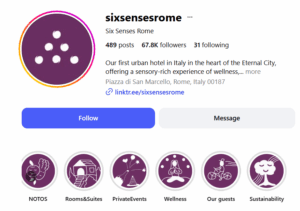
Yes, you can keep them there as long as you need. For example, Six Senses Rome uses Highlights to share guest-generated content and sustainable initiatives.
Education and online learning
Interactive content is an integral part of learning nowadays. So, educational institutions and online learning platforms use Instagram to engage students with quick lessons, fun facts, and course or workshop announcements.
A clever idea is to create Carousel posts or use Live videos to break down complex concepts. At the same time, polls, quizzes, and trivia contests are excellent ways to encourage interaction and keep your audience excited.
Duolingo jumped on a trending topic (seemingly irrelevant to their niche) with a humorous meme post:

B2B
Many B2B companies, like manufacturers, consultants, and service providers, may think their work isn’t exactly Instagram-relevant.
But the power of storytelling and informative content on Instagram is real, even for the most technical fields. Plus, many of your competitors will feel this channel doesn’t suit their brand. So, if you establish an Instagram presence, your business will stand out.
Consider posting photos and videos of your crew in action. People love seeing how things are made or how teams work together to bring projects to life.
You can also use the platform as an additional touchpoint for customer support, where customers reach out and ask questions.
SaaS
Another “non-photogenic” industry that can do so much with Instagram marketing to build a strong community and add a human, fun touch to their communication.
Using Instagram posts, Stories, and Reels, SaaS businesses announce new products or features, onboard users with helpful content, or highlight customer success stories and their culture.
You can also direct them to the latest resources on your blog and share milestones like awards, customer growth achievements, and conference participation.
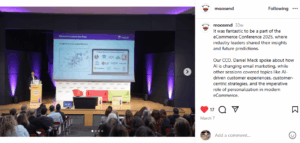
Just like Moosend did in the following post, summarizing the key points of its CCO’s speech in a popular eCommerce conference.
Health and wellness
Health and wellness professionals, such as doctors, clinics, and personal trainers, use Instagram marketing to build connections and trust with their customers.
They do so through posts that educate on healthy habits (e.g., nutrient-rich, savory recipes) or promote supplements and routines for mental and physical well-being (e.g., vitamins and meditation).
Personal trainers, on the other hand, may choose to use Reels to share tips and tricks or bust workout myths.
There’s also the option to showcase customer success stories and before-and-after photos, such as for plastic surgery, a dietary program, or a workout challenge.
Nonprofits
Instagram marketing enhances nonprofit organizations’ efforts to create supportive communities.
They can tell impactful stories about people and regions affected, thank and spotlight volunteers or donors, and share fundraising updates.
What about creating fundraisers? Instagram’s fundraising and donation tools are available in certain regions, and you can incorporate them into a post, Story, Reel, or Live video. Or just add a link to your fundraiser in your bio.
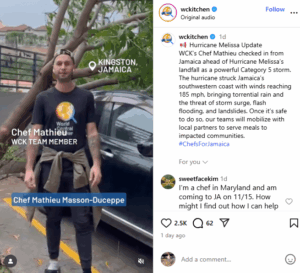
World Central Kitchen used a video post to inform its supporters about its actions during the upcoming natural disaster. In it, they featured an employee reassuring people that they’ll start serving meals to impacted populations as soon as it’s safe.
Best Practices to Get Instagram Marketing Right
Businesses should adopt proven tactics to expand their reach and build an active following. To follow their lead, here are the practices for a winning Instagram marketing strategy.
1. Choose the segments you can reach
Before creating and publishing content, you first need to know which of your customer segments are on the platform.
For example, a financial consulting agency that wants to target retirees with planning suggestions would better use email newsletters or cold calling since this group usually prefers one-on-one communication.
But a hostel business whose guests are usually young adults between 20 and 30 has a better chance of reaching them through Instagram marketing.
Besides Instagram analytics, draw on information from your CRM, email, website reporting, and customer service team to create detailed personas.
Also, you can take a peek at your competitors’ accounts. Is their Instagram strategy geared toward specific groups? Then, perhaps you should target lookalike audiences for your posts.
Once you find your audience, it’s easier to create relevant content. In the hostel case, Reels that display cheap dorm rooms or offer tips on budget-conscious travel will do the trick.
2. Optimize your Instagram profile
Creating an Instagram account is easy, but optimizing your profile is what will get you results. In most cases, that’s the first thing visitors will see, so you have to make it as attractive and effective as possible.
After you’ve set up the basics, add a high-resolution profile picture. Your logo is the best option for credibility and recognition.
Moving to your bio, 150 words is what you get to show the world who you are and what you offer. So, make your description clear, concise, and reflective of your identity. Don’t forget to include your branded hashtag and emojis if they’re relevant.
You should also add a call-to-action to encourage people to visit your website.
You could use more CTAs for other goals, like email lead generation or any action you want followers to take. Just make sure you don’t overdo it because too many links make your bio look cluttered.
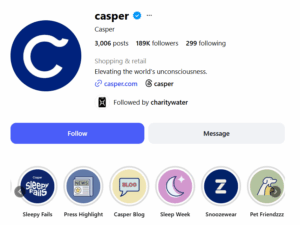
Also, if you have past stories you want to keep around, use Instagram Highlights. This feature allows you to save useful content you’ve posted, neatly categorized so users instantly know what they’ll watch.
Casper cleverly uses this section to share stories inspired by their blog, sleepy fails, our beloved pets, etc. As for the rest of the bio, they only include their logo, a short, catchy phrase that conveys the brand’s mission, and a link to their site.
3. Use hashtags wisely
A reliable way to bring your content in front of the right people is to use the right hashtags. So, when people search for them, they’re likely to come across your content. Besides visibility, you also need hashtags to help users tag your brand.
You can also add tags to your post, reel, and story captions, or your bio. The most common scenario is to have a branded hashtag with your name or variations of it. Then come hashtags that include industry-specific keywords.
More general hashtags may also bring you views, although they tend to be more saturated.
Seasonality is another factor to consider when creating hashtags, as holidays or occasions like the winter time serve as opportunities to promote seasonal offers, special editions, or events.
Again, research competitive businesses to see which hashtags they’re using. Another effective method is to invest in a social listening tool, which will provide insights into the topics and hashtags discussed in your niche.
But while hashtags guide people toward your account, using them excessively may seem salesy. So, prioritize the most relevant ones instead of stuffing in hashtags that distract the user from your content.
In most posts, One Teaspoon uses its branded hashtag and #denim, which is the product category they’re known for. In this case, they added one that relates to the material and evokes a popular song.

4. Create a content calendar
Content creation turns into a pressing task when not handled in time. A content calendar works as a compass, helping you organize your posts and save time from last-minute planning.
Start by brainstorming with your team and deciding on the topics, content types, and formats that serve your overall content strategy.
Be sure to include Instagram posting times, task deadlines, and team members involved in each project. Also, don’t forget about upcoming product launches, seasonal promotions, and events.
But always remember that editorial calendars are more effective when they’re flexible. So, make sure to keep up with rising trends and real-time developments, leaving room for timely content.
Your followers will be searching for it, and if they don’t find it on your account, they might feel that you’re disconnected from current conversations.
5. Experiment with content formats
“So, what kind of posts should I put into my calendar?” Many brands go for promoting their products with simple static posts, but there’s more to it.
Quick tips, how-to videos, motivational quotes, anything goes as long as it matches your tone.
Now, let’s say you find that a format works every time. That’s no reason to stick to a single tactic. Instagram offers several opportunities to engage your audience:
- Static posts: The most straightforward tactic in the book. Unlike Stories or Reels, static content stays on your profile, helping visitors understand your value proposition. So, use them for evergreen content like mission statements, onboarding material, or milestone announcements.
- Stories: This content format disappears after 24 hours. Their time-sensitive nature taps into consumers’ Fear Of Missing Out (FOMO), urging them to act quickly. So, they’re ideal for limited-time deals. But keep in mind that you can keep certain stories on your profile by organizing them into Highlights.
- Reels: Another content format designed to disappear unless you choose to add them to your profile. With Reels, you get a broader reach since they’re also shown to non-followers. Plus, they’re the best-performing format in terms of comments. You can use it for product highlights, day-to-day glimpses, recipes, polls, etc.
- Carousel posts: Carousel albums go more in-depth, encouraging users to swipe through a selection of images. The more they do, the more the algorithm gets the signal that your content is valuable, so it shows it to more people. They’re perfect for sharing step-by-step guides, displaying product lines, or showing before-and-after photos.
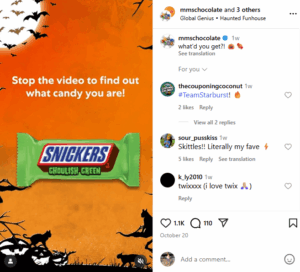
Twix got creative with the following Reel, inviting users to stop the video and find out which Halloween candy they are. A brilliant way to have people comment on and share the post.
6. Show up for your audience
Regardless of algorithm changes, there’s a constant that never goes out of style: engagement. And that’s not just on the user’s side.
Putting your content out in the world is the trigger. What should follow is two-way, real-time communication where you listen, respond, and follow up. So, make sure no DM, comment, or question on your Instagram content is left unanswered.
Participating in conversations and addressing concerns is the most effective way to demonstrate that you value and respect your audience. You should also check for mentions and acknowledge user-generated content by re-posting it.
Besides troubleshooting, there’s also the fun part, like sharing sneak peeks of:
- Production and packaging processes
- Upcoming product lines
- Employees’ day-to-day
- Team brainstorming sessions
- Event preparation
And let’s not forget interactive content like polls and quizzes, where followers can answer questions related to your products and learn more about their preferences.
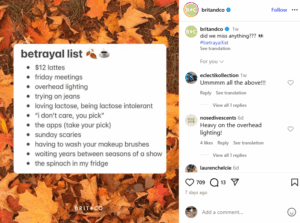
Brit + Co makes sure to respond to every comment as soon as its followers post them. Like here:
7. Make user-generated content a priority
User-generated content is a goldmine for your Instagram marketing strategy because it’s where people seek authenticity and validation.
This type of content lets you showcase your happy customers using your products or services in real-world settings. Back up your claims with testimonials to give consumers more confidence in your brand.
Monitor tagged posts and re-post them, making sure you tag the users who created them in turn. You don’t just get valuable social proof with minimal effort, but you also make followers feel special.
Alternatively, ask loyal customers to share photos and videos, offering a small incentive, such as a coupon code or other perks they’d like.
The UGC collected could also affect consumers’ buying decisions when displayed on product pages, email marketing campaigns, or other social media channels.
Liquid Death uses Highlights to share customer photos and videos of their products in real-life scenarios. Just like here, where Iced Tea is the protagonist and Canyonlands the background.

8. Run relevant giveaways
Instagram giveaways allow you to turn followers into customers while building brand awareness. They bring in engagement opportunities since the entry rules usually require following your account, sharing or commenting on your post, or tagging friends.
An additional benefit is that you don’t eat away your budget since an Instagram giveaway usually costs no more than the chosen price.
Do you want extra value? Then, it’s email list growing time. Ask people to fill in their email address in exchange for an entry.
When they become subscribers, you can keep them informed and excited up until the winner selection date. After that, you can follow up via email.
You can also host a collaboration giveaway, partnering with a brand that offers similar or complementary products to create a prize bundle and reach each other’s audiences.
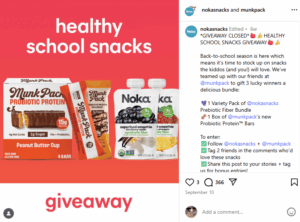
Noka and Munk Pack joined forces, leveraging the back-to-school season to offer consumers a partnership bundle of healthy school snacks. The entry requirements are simple and clear, and there’s a bonus entry option for visitors who share the post in their stories and tag both brands.
9. Monitor performance and adjust
Most of the Instagram marketing tactics discussed call for some trial and error to determine which ones to focus on in future campaigns. To do so, you should track performance and optimize as needed.
Instagram’s Insights provide businesses with a wealth of information on how users engage with your content.
This includes views and interactions, such as likes, comments, and saves, as well as accounts reached, etc. You also get ad insights, like impressions, conversions, and costs.
But you might need more advanced data to refine your approach. A third-party tool goes beyond these native insights, offering in-depth reporting to tell what worked, what didn’t, and where to make tweaks.
Some tools, like Sprout Social, also offer cross-network and competitive analytics to keep all your social media data organized while monitoring your rivals’ performance to identify growth opportunities.
How to Combine Instagram Marketing with Other Channels
If you’ve created converting content on Instagram or another channel, why leave it there? Here’s how to make the most of Instagram marketing by combining it with other channels.
Other social media platforms
The simplest way is to include a call-to-action to other social media profiles, asking users to follow you on Instagram.
The same applies to your Instagram account, where you can add CTAs in your bio or captions to link to other channels.
You can also crosspost or repurpose content from other channels, for instance, by turning a YouTube video into a series of Reels or an X thread into a fun-fact carousel post.
Or, if an Instagram post is performing well, consider reusing it in other social media campaigns.
Email marketing
The debate about email vs social media is finally over.
The best course of action is to connect them by adding a link in your bio to prompt followers to sign up for your newsletter. Just make sure your landing page mentions the benefits of becoming a subscriber, such as early access to new deals.
We already discussed making email signup a requirement for giveaway entries. That’s an excellent way to attract subscribers and engage them with exclusive content and personalized suggestions.
In the opposite scenario, where you want to increase your Instagram following, use social media follow icons in your emails. Some brands create dedicated campaigns to promote their Instagram account.
Fractel’s email campaign is as simple as it comes. It has a straightforward subject line, a few lines of copy explaining why recipients should follow the brand, and two clear CTAs to join its Instagram and Facebook communities.

Influencer marketing
Instagram is a platform where influencer marketing thrives, offering both parties numerous opportunities to work together.
The benefit for businesses is that influencers promote your products or services to their existing followers. On top of that, you get the same authentic touch as with customer testimonials.
Many brands choose sponsored posts, which means they pay influencers to feature the company’s products. In return, influencers have to mention that the content is sponsored. Another common tactic is co-hosting giveaways with influencers.
There’s also the affiliate marketing option. With it, influencers get a unique link and a commission for every sale made through it. That way, businesses pay affiliates only when they make a sale.
Lastly, social media takeovers are also gaining ground. Through them, influencers take over the brand’s account and showcase content like day-to-day operations and live Q&A sessions. This tactic brings a fresh and more genuine perspective to the brand’s content.
Website and blog content
As a part of your content marketing strategy, you could leverage Instagram to promote your website and blog content, for example, by turning long-form content into digestible Reels to guide people through new products or features.
Do you have helpful infographics on your site? Then, have someone from your team present key findings in a story and encourage users to visit your site for more insights.
If you feature customer reviews and testimonials on your product pages, add them to your Instagram posts so your followers can see the value of your offerings from people with similar pain points.
Plus, you can tease upcoming blog content on your Instagram account. For instance, share an insightful stat from your post and invite visitors to stay tuned for the entire piece, which will go public soon.
The SEO Revolution: How Indexed Instagram Content Changes the Rules
All this time, marketers have treated Instagram as a standalone tool that depends on the platform’s algorithm. While that’s still true, search engines are now stepping into the scene.
Since July 10, 2025, Instagram has allowed search engines to display content posted on the platform in their search results. In a nutshell, your posts have become searchable.
This means businesses can drive more organic traffic to their Instagram accounts. Also, their content will live longer on search results than it does in followers’ feeds. So, it will continue to deliver value even after its on-platform kick fades.
Now, how do you keep up? First, make sure your Instagram account is public, and you have enabled the corresponding setting in your Settings and privacy section.
Then come the SEO optimization techniques you’re probably already familiar with:
- Include a branded name and a link that reflects your goal in your Instagram bio.
- Optimize your bio with the right keywords, meaning those that your audience is searching for and are consistent with your SEO strategy.
- Add relevant hashtags that match your content and user intent.
- Customize the alt text in images instead of letting the platform auto-generate it to provide search engines and users with context.
- Use subtitles in videos, stories, and reels for the same reason: adding context while ensuring accessibility.
- Prioritize value-first content that informs, educates, and onboards people, such as tutorials and case studies.
- Use geotags for local SEO discovery if your business has a physical location or you’re posting about services and events tied to specific regions.
Instagram Apps and Tools to Use
To get Instagram marketing right, you need the tools to manage tasks, create and schedule content, and monitor performance and audience engagement.
Social media management software
The Holy Grail of any winning Instagram strategy, they help brands schedule posts, create and monitor custom reports, and get content ideas, all from a single dashboard.
- Buffer, for instance, offers features to create, schedule, and repurpose content, collaborate with your team in real-time, and build a link-in-bio landing page.
- Hootsuite is another platform that you can use to craft and schedule content, access unified social media analytics, execute a social listening strategy, and manage paid ads.
Shoppable content tools
Some brands treat Instagram as a revenue channel. With such a tool, you can tag your products in posts, stories, and reels or track influencer sales.
- With Instagram Shopping enabled, you create a shop on the platform to showcase your products. By clicking the corresponding link, customers can view the tagged products and get directed to your online store to buy them.
- LTK is a platform that connects brands with influencers. From discovering the best creators for the job to tracking their sales, LTK manages everything while offering a dedicated app to facilitate mobile users.
Content editing solutions
Not every business has an in-house designer to create stunning, branded visuals. Here’s where content editing tools come in handy, helping even novice users design polished graphics.
- Canva is a graphic design platform for marketers who want to make visual content. It comes with a drag-and-drop creator, pre-made layouts, and a selection of free and copyrighted images (paid option).
- CapCut’s editing software helps users create and optimize videos in various ways. You can choose between a desktop and mobile version and start removing backgrounds, generating captions, or turning long-form videos into short ones.
Social media contest tools
Social media contest platforms help you set up and manage contests to grow your Instagram following.
- Woorise, for example, offers pre-designed contest templates and drag-and-drop functionality to customize widgets. Also, you gain access to a quiz and survey maker, plus built-in fraud detection tools to identify suspicious entries.
- SweepWidget is a dedicated solution for brands that want to run viral contests. The platform lets you translate your giveaway into 103 languages and use its email API integrations to grow your email list with Instagram contests.
Stay Adaptable and Informed
Instagram marketing is mostly about posting great content. But if creativity is one part of the equation, then adaptability is the other.
The Instagram algorithm relies on user engagement to decide which posts to display, so staying up to date on updates and new features matters.
What works ten out of ten, though, is original content that builds connections. Whatever you create, make it exciting and relevant to your audience.
Also, set a consistent posting schedule so your followers know when to expect new content. Monitor your Instagram content performance and test new tactics and features to keep getting better.
But most importantly, stay on top of every interaction. That’s how you’ll engage followers in real-time conversations where they share their needs, and you’re there with solutions.
Instagram Marketing FAQs
Now, let’s review some frequently asked questions about marketing on Instagram.
1. What is Instagram marketing?
It’s the practice of promoting your business, products, or services on Instagram. You can use a range of tactics, such as organic reach, paid advertising, or influencer marketing, depending on your budget and unique objectives.
2. What kind of posts perform best on Instagram?
Helpful content, such as quick tips and product use cases, sees high engagement on the platform. But fun posts such as challenges, polls, and memes also catch attention. However, when creating more lighthearted posts to match the platform’s tone, ensure they reflect your identity.
3. Do you have to pay to market your brand on Instagram?
Not necessarily. Organic posts, Stories, and Reels can reach your audience and bring in traffic at almost zero cost. However, paid options like ads, sponsored posts, and influencer collaborations get your content in front of new, targeted audiences and increase chances of conversions.
Similar Posts
 Published by
 Published by

Create, send and optimize your email marketing campaigns