















Email Marketing KPIs You Need to Start Tracking [2026]
Published By Will Gordon
September 14, 2026

14/09/26
If you open your marketing dashboard, you’ll likely find a long list of metrics like opens, clicks, bounces, unsubscribes, and more.
Marketers are spoilt for data, but knowing which of those email marketing KPIs to focus on and why makes all the difference. Marketing teams often think that all of the metrics are equally important, but the reality is that only a few of them really deserve your attention.
Figuring out exactly which KPIs you should track before building reports is paramount. The goal is to cut the noise and focus on the core metrics that help you and your team spot opportunities, make better decisions, and increase revenue.
This guide explores essential KPIs, broken into three categories: engagement, deliverability, and revenue and growth. We’ll share the exact formula for each KPI, healthy benchmarks to aim for, and how to avoid common mistakes.
What are KPIs?
A key performance indicator (KPI) is a metric with a target attached that aligns with your business goals and influences business decisions. If a marketing KPI drops or rises significantly, your company’s leadership team will likely assess the impact on your goals and potentially shift the team’s approach accordingly.
Email Marketing KPIs Vs. Vanity Metrics
Vanity metrics are simply the numbers you track that might be of interest to the team, but typically have no real bearing on your overall strategy because there’s no real target associated with them. For example, it may feel good to see your total emails sent and total opens increasing steadily, but they don’t tell you if what you’re doing has a positive impact on your business objectives.
That said, a vanity metric could become a KPI if you tie it to a measurable goal that influences your department or business objectives in some way. For instance, measuring total opens with the aim of achieving a specific target over a given period.
Grouping useful KPIs into categories gives us a clearer view of what they affect and how.
- Engagement KPIs: Show whether your subscribers are engaging with your emails.
- Deliverability KPIs: Help you ensure that your emails reach your audience’s inbox.
- Revenue and growth KPIs: Show how your email marketing efforts impact overall business outcomes.
The goal is to track one or two KPIs from each of the three categories. That way, you know that the numbers you’re looking at regularly will actually give you insight into what to do next.
Engagement KPIs
Engagement KPIs show how subscribers interact with your emails, from opening them to clicking through to your content.
Open rate

Email open rate might not be a reliable success indicator, but it still gives teams a decent idea of whether their subject lines are effective and their sender reputation is intact.
The open rate metric isn’t a great measure of success because of Apple’s Mail Privacy Protection (MPP) feature. Its MPP affects the recorded open rates for recipients who use Apple products by pre-loading tracking pixels and images when the email lands in an Apple Mail inbox. This registers as an open, even if the recipient never opens or reads the email.
Litmus’s 2026 Email Client Market Share report found that more than 50% of tracked email opens happen on devices with Apple’s MPP activated. These findings confirm that for any email marketing team, the email open rate metric will invariably be exaggerated.
But two more reliable metrics you can use alongside open rate are click-through rate and click-to-open rate, both of which we cover next.
Click-through rate vs. click-to-open rate

Click-through rate (CTR) shows how often recipients click the CTAs in your marketing emails, which tells you whether your campaign is working.

The click-to-open rate (CTOR) highlights the percentage of CTA clicks your audience makes versus email opens.
Because the CTOR formula includes inflated email-opens data, CTOR becomes less reliable. In fact, research shows that CTR or conversion rate are better, more dependable metrics for teams to focus on.
So, instead of relying on CTOR alone, measure your subject lines and email marketing content against CTR, and use an A/B testing tool to test alternatives and measure results.
Deliverability KPIs
Deliverability KPIs show whether your emails reach subscribers and help you catch issues that could hurt your sender reputation.
Bounce rate

There are two kinds of email bounces: hard (related to an email address that’s permanently invalid) and soft (when there’s a temporary delivery failure). Tracking your bounce rate helps you spot potential email authentication or mailing list hygiene issues before they do real damage.
Validity’s 2026 Email Deliverability Benchmark report offers some insight into the various reasons emails bounce, as well as guidance on what metrics are considered good or bad and how to optimize email deliverability.
Regular list hygiene practices have been proven to reduce high bounce rates over the long run.
Unsubscribe rate and spam complaint rate

An unsubscribe is when an email marketing audience member chooses to remove themselves from your mailing list. It’s a useful metric in that if there’s a sudden increase in unsubscribes, you know something is off, and it’s typically related to your campaign frequency, content, or targeting.

If you receive a spam complaint, it means a recipient has marked an email you sent them as spam, essentially reporting you to your mailbox provider. Providers like Gmail and Yahoo take spam complaints very seriously, and they could throttle your emails altogether.
While unsubscribe rate and spam complaint rate are very different metrics, they both give you an idea of how recipients feel about your brand and shape your company’s reputation with mailbox providers.
Revenue and Growth KPIs
Revenue and growth KPIs show whether your email campaigns are contributing to meaningful business results, from conversions to revenue and list growth.
Conversion rate

Each email marketing campaign should have a desired outcome, better known as a conversion. That could be a purchase, a document download, a form submission, or another action tied to your campaign goal.
Your conversion rate shows what percentage of delivered emails led to that action, making it one of the clearest ways to judge whether a campaign is driving results beyond opens and clicks.
Teams can measure conversion rate for a single campaign, a specific email type, or a broader period. It’s also useful to compare conversion rates across different audience segments, offers, and campaign types to see what drives the strongest response. Define the conversion clearly before you start tracking, so the metric stays tied to a meaningful business outcome.
Email marketing ROI

This is tricky because, while email marketing ROI reflects real value, it can be hard to measure accurately depending on where your campaign sits in the funnel. Ecommerce businesses may find this a little easier, with engagement metrics and purchases tracked natively. But most businesses will need more than just engagement and deliverability metrics to determine ROI.
Calculating email marketing ROI is much easier with a CRM connected to your email marketing platform. Integrating email marketing with a CRM like Nutshell gives teams deeper insight into how leads move through the sales pipeline and whether they become customers.
Research by Nutshell shows that opens and clicks alone won’t tell you whether the lead you brought in through your campaign became a customer. Your CRM data provides that insight, which is why connecting the two is essential.
List growth rate

Tracking your list growth rate helps you determine whether you’re successfully expanding your reach. You can consider your mailing list healthy if it’s growing faster than it churns and holds up against natural list decay.
In 2026, ZeroBounce put together an Email List Decay report after monitoring more than 11 billion verified email addresses. The study found that at least 23% of businesses’ mailing lists degraded over the past year, typically because of outdated or invalid addresses or reduced engagement over time.
The best way to combat list degradation is to build it through deliberate segmentation and targeted opt-ins to reduce potential drops in engagement.
Building an Email Marketing Dashboard to Track KPIs in One Place
Generating marketing reports in spreadsheets or a separate system can mean teams pick up on roadblocks and issues long after the damage is done.
Setting up a dashboard visible where you work that tracks one to two key KPIs from each category detailed above is the ideal way to stay on top of campaign progress and tackle issues as they arise. Connecting your email marketing platform to your CRM is the best way to set up a dashboard like this.
Nutshell offers an analysis of how to tie CRM and email metrics to business revenue using a three-tier framework, including engagement signals, pipeline metrics, and revenue metrics. With this structure, teams can group KPIs to show what’s happening at different stages of the funnel.
Moosend users have access to email marketing report tools that natively surface the essential engagement metrics, such as opens, clicks, bounces, and unsubscribes.
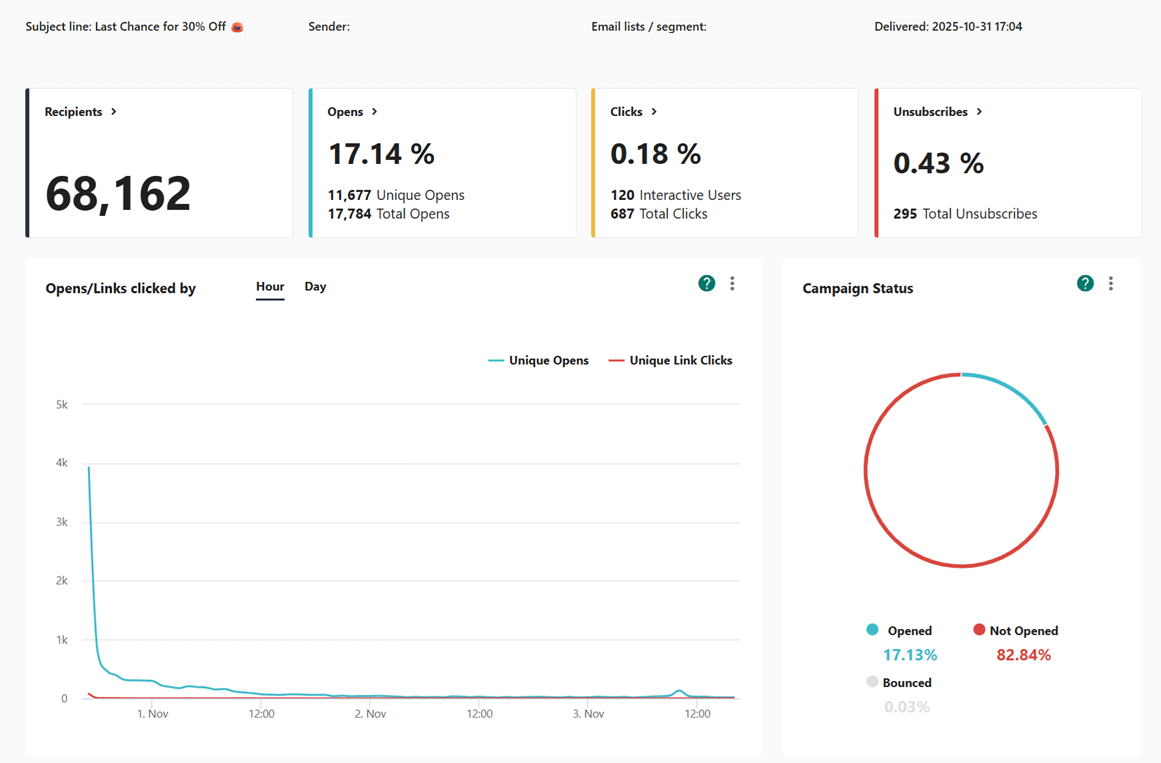
Its ecommerce customers also benefit from behavioral metrics, including purchase details and a revenue summary. Businesses outside ecommerce gain a more holistic view of meaningful KPIs when they pair Moosend with their CRM systems.
Email Marketing KPI Benchmarks to Compare Against
Having the right formula for each KPI helps, but knowing whether your numbers are sufficient in the grand scheme of things is far more valuable. Industry benchmarks give you a clearer perspective on where your numbers stand relative to your competitors and how healthy your results are.
Some key email marketing KPI benchmarks to bear in mind are:
- Open rate: Aim for 18% to 28%.
- Click-through rate: A CTR of 2% to 5% is considered healthy.
- Bounce rate: Try to keep your bounce rate under 2%
- Unsubscribe rate: An acceptable unsubscribe rate is one below 0.2%.
- Conversion rate: Depending on your industry, a conversion rate of between 0.04% and 0.17% is decent.
These benchmark figures are averages across industries and may not exactly apply to your specific business or industry. But they still offer a good starting point for most marketing teams unsure of what they should be aiming for.
Over time, you’ll get a sense of where your baseline for each KPI is and be in a position to set targets relevant to your company’s growth.
Common Mistakes when Tracking Email Marketing KPIs
You’ve chosen the metrics to track, connected your CRM and email marketing tool, and set up a dashboard of core KPIs. Despite doing all the right things, there’s still a chance that this seemingly perfect dashboard could mislead your team if they’ve developed the wrong reporting habits.
Here are a few common bad reporting habits to avoid:
- Optimizing for opens rather than conversions: While your open rate is probably the easiest metric to keep tabs on, it’s also the least trustworthy.
- Comparing your results against generic benchmarks: Generalized benchmarks can help, but you should monitor and adjust for industry- and region-specific variances. A certain open rate may be strong for a business in one region but weak for a business in another.
- Failing to segment your reports: Your mailing list is segmented because you’re targeting different audiences at different stages of the funnel. But pooling together metrics from all these segments into one report gives you an inaccurate picture of each campaign’s performance, because a cold email recipient and an engaged customer will interact with your emails differently.
- Tracking engagement and not ROI: According to Litmus’s research, 45% of brands don’t track email KPIs all the way through to the conversion stage, and only 17% actively measure their email marketing ROI.
- Ignoring subscriber lifetime value: In the same study, Litmus found that only 12% of brands actually measure subscriber lifetime value, which tells you how much a subscriber is worth throughout their association with the brand.
These common mistakes highlight just a few of many email marketing metrics your team could consider tracking, depending on your campaign goals.
Turning KPI Data into Better Campaigns
Once you know the metrics you need to track to determine the impact of your email marketing efforts on your business revenue and goals, remember to avoid trying to track everything at once. Tracking too many KPIs can be overwhelming and often leads teams to track nothing at all.
Instead, choose one to two key KPIs from each of the engagement, deliverability, and revenue and growth categories, and keep those front and center via your CRM dashboard. This way, the most relevant metrics stay in plain sight, so you can act quickly if things change. It also produces a more effective marketing report that shows whether your campaigns drive real revenue and growth.
Reviewing those top-level dashboard KPIs every quarter helps keep the metrics relevant as campaign and business goals change. Maintaining the framework and instilling the right reporting habits ensures you always have your eye on the metrics that matter most to your business.
Similar Posts

 Published by


 Published by

Create, send and optimize your email marketing campaigns