













Why Your Re-engagement Emails Fail & How to Fix Them [2026]
Published By Marilia Dimitriou
May 6, 2026

06/05/26
When subscribers stop opening emails, or customers stop buying, the usual response is to send a reminder, a discount, or a “still interested?” message.
Sometimes these emails bring a few people back. More often, though, they sit in the inbox, ignored, deleted, or even marked as spam. So why does this happen? Aren’t re-engagement emails supposed to solve disengagement?
The reason is simple. Re-engagement campaigns try to repair a relationship that has already started to fade. By the time a contact enters a win-back flow, the problem is usually weeks or even months old.
That’s why re-engagement emails fail. They rarely address the real issue. Instead, they tend to reveal that something in the customer experience has already gone wrong.
Re-engage before they drift away
Improve your re-engagement strategy with smarter targeting and timely emails.
Try MoosendWhy Re-engagement Campaigns Miss the Mark
Re-engagement emails aren’t inherently bad. In fact, they can be a powerful tool for recovery. However, issues such as late outreach and generic messaging often make it harder to truly win back lapsed customers or address the underlying problem that caused inactivity.
So why shouldn’t you solely rely on re-engagement campaigns?
1. Most win-back emails arrive too late
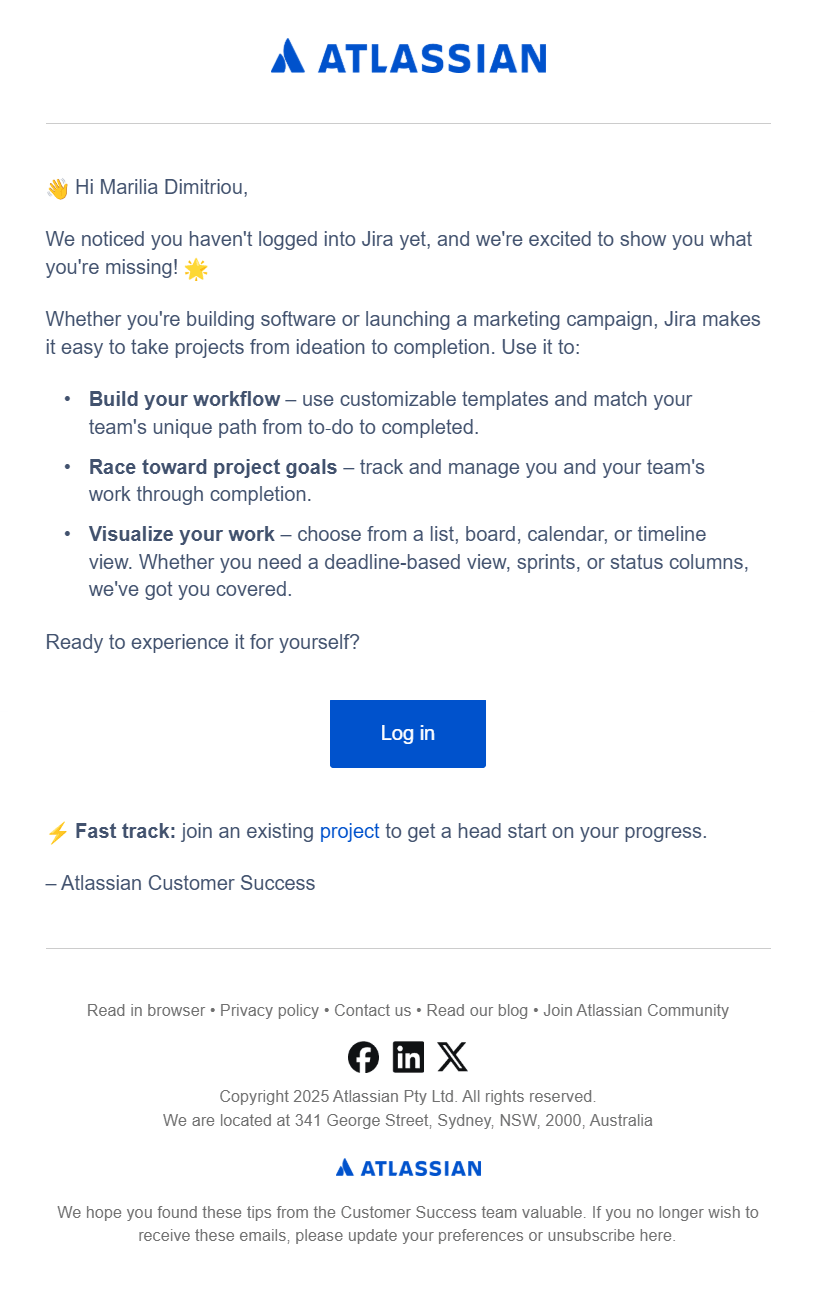
Usually, re-engagement messages start after a fixed period of inactivity. For instance, a SaaS company may trigger a workflow after 60 days without a login.
Here’s an example from Atlassian:
An eCommerce brand, on the other hand, might offer a discount to customers who haven’t purchased in the past 6 months.
On paper, this approach sounds reasonable. In practice, though, it often comes too late. By the time the email arrives, the subscriber may have already stopped seeing value in the product and moved on.
At that stage, a quick “just checking in” email or a last-minute discount, which are two of the most common re-engagement tactics, rarely change the outcome. Once disengagement has already settled in, even a well-timed incentive struggles to bring customers back.
2. Re-engagement emails assume the wrong problem
If you take a look at your inbox, you’ll see that most win-back emails follow the same formula. They open with a message like “We miss you,” offer a discount or special promotion, and end with an invitation to come back and shop again.
The assumption behind these emails is that their inactivity is a motivation problem. If customers receive a reminder or a discount, they’ll naturally return.
But disengagement rarely happens for a single reason. Beyond losing sight of the value, people may stop interacting with a brand because:
- The product didn’t solve their problem
- Emails became too frequent
- The content stopped being relevant
- Their needs or priorities changed
- They completed their goal
When the real issue isn’t motivation, a discount or reminder doesn’t really change anything. If someone was dissatisfied from the start and left, they aren’t going to come back because you gave them 20% off.
Let’s take a look at this example from American Giant.
Subject line: We Miss You—Here’s 25% Off
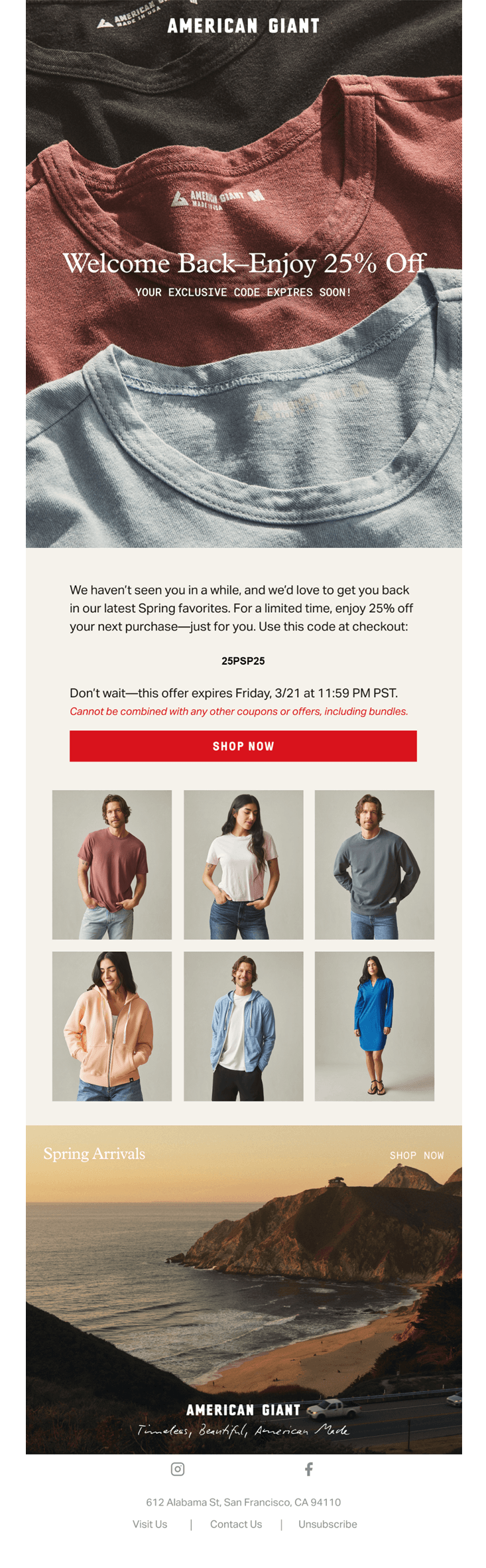
This re-engagement email offers a discount and invites the recipient to “come back,” showcasing a selection of products and seasonal items.
But imagine receiving this message after months of inactivity. The email assumes that a discount alone will bring the customer back, even though the original reason for disengagement may still exist.
In my case, I received this email without having purchased a product, taken any action, or shown interest in specific products, which made the message feel disconnected from my experience.
A more effective approach would’ve been to nurture the relationship first. For example, the brand could have added value by sharing styling tips, highlighting popular items, introducing new collections, or explaining what sets its products apart from competitors.
3. Your win-back email looks like everyone else’s
By now, you must have noticed that when re-engagement campaigns run out of ideas, they often resort to “We miss you, here’s a discount” messaging.
If you check your own inbox, you’ll find a few familiar subject lines like these:
- We’ve been missing you 🩷 Here’s 20% off
- Hey, we miss you. Here’s 20% off.
- Marilia, we miss you | 25% off
- We’ve missed you so…here’s your 20% OFF
Brands like Skechers, Fenty Beauty, and Cox & Cox all use the same approach, and they’re not the only ones.
As a result, it becomes difficult to tell which brand sent the email. In some cases, subscribers may click expecting one brand, only to realize it was another with a nearly identical subject line. Instead of standing out, the email becomes just another promotion competing for attention.
Of course, a strong incentive may still convince someone to make a purchase. But over time, this uniform messaging also changes behavior. Customers start recognizing the pattern and learn that waiting often leads to a better offer later.
In other words, re-engagement emails not only get lost in the clutter but also train customers to engage only when the price drops. And when discounts become the primary reason to return, loyalty and brand advocacy rarely follow.
If you want to stand out, keep the win-back intent, but avoid the predictable “We miss you — X% off” pattern. You can opt for something like this:
- Something new since your last visit
- Still interested? Take a look
- We picked these for you
- Come see what’s changed
4. Your re-engagement strategy often ignores context
For many brands, every subscriber and customer who stops opening emails or making purchases ends up in the same “inactive” segment.
Take a SaaS trial user who never activated the account. This person may simply need help getting started. In that case, a reminder email or discount does little to solve the problem. A short walkthrough, onboarding checklist, or product demo would likely be far more useful.
The same issue appears in eCommerce. Some customers only shop during specific seasons, such as holidays or summer sales. They may appear inactive for months, even though their buying cycle hasn’t changed.
When brands group all of these contacts into a single inactive segment, they end up sending the same message to people with very different situations. As a result, the re-engagement email often misses the mark, not because the idea is wrong, but because the segmentation behind it is too broad.
5. You try to win everyone back
Remember the saying, “If you love something, let it go”? The same idea applies to your email list. Not every subscriber will stay engaged forever, and that’s perfectly normal. In many cases, unsubscribes can even be a win.
When brands continue sending re-engagement emails to contacts who have already lost interest, the consequences become clear. And it’s no longer just about being ignored in the inbox.
Beyond the drop in open rates and clicks, inbox providers may begin moving these messages to the spam or promotions folders. Over time, this can reduce your ability to reach the inbox and ultimately affect your revenue.
In that sense, trying to win everyone back can do more harm than good. Re-engagement campaigns often fail when they focus solely on recovering subscribers rather than recognizing when a contact has already disengaged for good.
As these contacts keep receiving emails, engagement signals weaken, and the campaign ends up reinforcing inactivity rather than reversing it.
What Works Better than a Generic Re-engagement Email
Instead of relying on a last-minute win-back message, you should focus on engagement earlier in the customer lifecycle. Re-engagement works best when it’s part of an ongoing strategy rather than a reaction to months of inactivity.
With behavioral data, predictive models, and AI-driven analytics, marketers can identify signals that show when a customer’s interest is starting to drop. This allows teams to intervene before the relationship fades completely.
But technology alone isn’t the answer. The real goal is to address disengagement at its root. Customers should stay because they find value in your product or love the brand experience, not because they are waiting for the next discount.
Here are a few approaches to consider.
Detect disengagement as early as possible
Instead of waiting for fixed inactivity windows like 60 or 90 days, monitor your metrics (opens, clicks, etc.) continuously and act when engagement begins to drop.
For example, a SaaS company could trigger an onboarding reminder or a short product guide when usage declines. An eCommerce brand might highlight new arrivals or categories related to a customer’s previous browsing or purchases when clicks start to slow down.
By responding to these early signals, brands can reconnect with customers while the relationship is still warm, rather than trying to recover it months later with a generic win-back email.
Personalize the “come back” experience
Your re-engagement strategy should focus on giving customers a strong reason to come back.
Behavioral data can reveal what they previously interacted with, what they ignored, and where their interest started to decline. With this information, you can tailor re-engagement messages around something relevant to the recipient.
For example, your email might highlight:
- a new feature that solves a known pain point
- improvements in the product experience
- new content aligned with past interests
- products related to previous purchases or browsing behavior
Sometimes, relevance can also come from offering useful content.
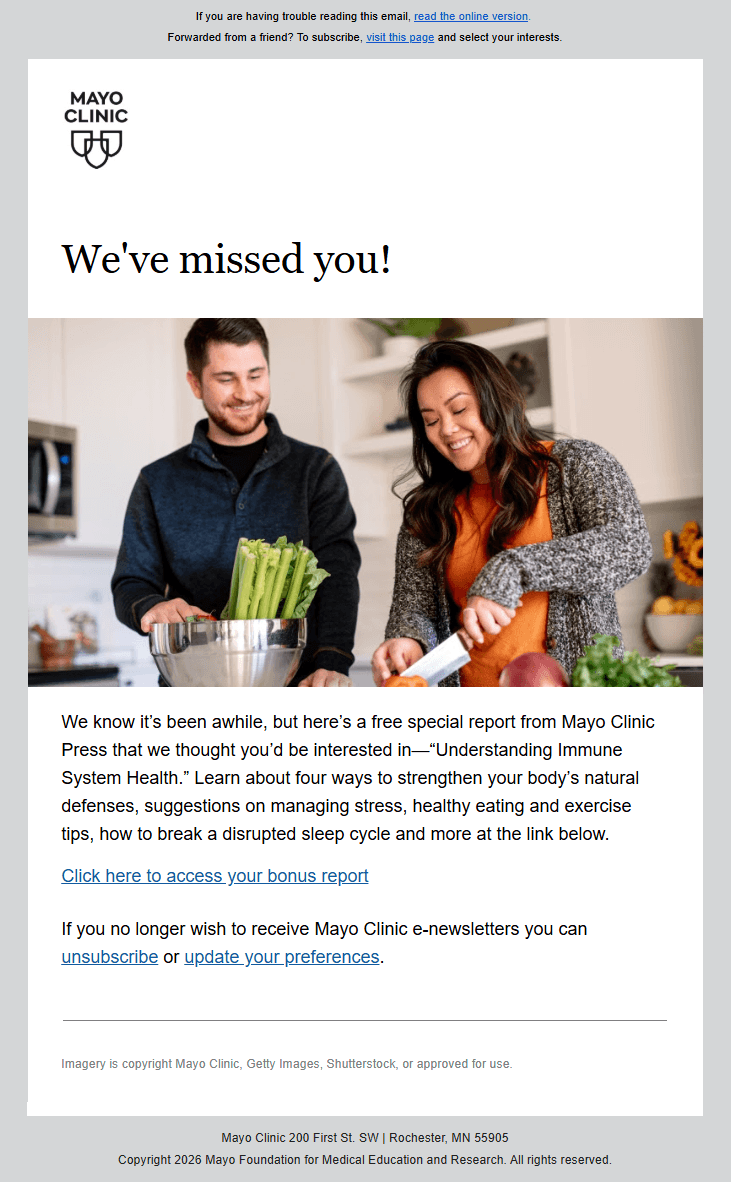
The example below from Mayo Clinic takes this approach. Instead of relying on a discount, the email offers a free report on immune system health, providing practical information about managing stress, improving sleep, and strengthening natural defenses.
Predictive models can further support this strategy by identifying which customers are most likely to return and which types of messages resonate with them. This allows brands to focus their efforts where re-engagement is most likely to succeed.
Plus, you can use a similar email to identify who’s still interested in your brand and segment your audience based on their response.
For example, subscribers who clicked may show renewed interest and can move into a reactivated segment. Those who opened but didn’t click may need additional nurturing, while contacts who ignored the message completely may be closer to full disengagement.
Let subscribers choose their engagement preferences
Another way to prevent disengagement is to give subscribers more control over their interactions with your brand.
Instead of forcing customers to choose between receiving all emails or unsubscribing completely, you can offer preference options such as:
- Reducing email frequency
- Choosing specific topics or categories
- Pausing communications for a period of time
These small adjustments help maintain the relationship without overwhelming the subscriber.
Over time, this approach protects engagement and prevents contacts from becoming inactive in the first place.
Additional Reading
If you’d like to explore these ideas further, the following resources provide practical examples and strategies for improving engagement and deliverability:
- Case Study: How Max Stores Rebuilt Email Engagement
- Email Spam Filters: How to Use Their Rules to Craft Better Emails
- Email Retargeting 101: Benefits, Strategy & Examples
Re-engagement Emails Are Half the Solution
Despite their limitations, re-engagement emails still play an important role in email marketing. They give brands an opportunity to reconnect with subscribers who may have simply become distracted or temporarily inactive.
They also help marketers understand which contacts are still interested and which ones have moved on, allowing teams to maintain healthier lists and stronger engagement signals.
However, re-engagement emails work best as part of a broader, more “proactive” engagement strategy. On their own, they may recover a portion of inactive subscribers, but they rarely solve the reasons customers disengage in the first place.
The brands that succeed focus on engagement long before a win-back email becomes necessary. And that’s exactly where your focus should be as well.
FAQs
Below are some common questions about re-engagement emails.
1. When should you send a re-engagement email?
You should send a re-engagement email when you notice early signs of declining engagement, not after long periods of inactivity. For example, if open rates drop, clicks slow down, or product usage decreases, it’s a good time to intervene. Waiting 60 or 90 days often means the relationship has already weakened.
2. How many re-engagement emails should you send?
Most brands use a short sequence of 2–4 emails. This allows you to test different approaches, such as helpful content, product updates, or a final confirmation. Sending too many messages can further hurt engagement, especially if the subscriber has already lost interest.
3. What should you do with subscribers who don’t respond?
If subscribers don’t respond after a re-engagement sequence, consider suppressing or removing them from your list. Continuing to email disengaged contacts can lower engagement signals and affect inbox placement. In many cases, removing inactive subscribers helps improve overall performance.
4. How do you identify disengaged subscribers?
Common signs include declining open rates, reduced clicks, lower product usage, or long periods without interaction. Instead of relying only on time-based rules, monitor behavioral trends and act when engagement begins to drop.
5. Are re-engagement emails still worth sending?
Yes, but they work best as part of a broader strategy. Re-engagement emails can recover some subscribers and help identify who is still interested. However, they rarely solve disengagement on their own. Preventing disengagement earlier in the lifecycle is usually more effective.
Similar Posts
 Published by
 Published by
Create, send and optimize your email marketing campaigns