









Promotions vs Pleasure: The Lipstick Effect in Email Marketing [2026]
Published By Alexandra Marinaki
March 9, 2026

09/03/26
We’ve all seen those emails with countdown timers, “LAST CALL” subject lines, and cues that trigger the fear of missing out. Sometimes we bite, but mostly we scroll past, especially when it isn’t a major event like Black Friday, where discounts actually live up to our expectations.
Urgency in emails doesn’t always lead to higher conversion rates. In fact, if you lean on it too hard, your audience just develops “urgency fatigue” and stops believing the timer.
Moreover, during economic downturns, people aren’t just hunting for the lowest price; they’re looking for the biggest emotional reward. We tend to replace big-ticket luxuries, like vacation or a new car, with smaller, “affordable” indulgences that offer an immediate mood boost.
Economists call that the “lipstick effect.”
Turn limited-time deals into affordable treats
Create rewarding email experiences from $9/month.
TRY MOOSENDWhat the Lipstick Effect Really Is
The lipstick effect is a psychological and economic theory suggesting that during uncertain economic times, people resort to more affordable luxury items, like high-end beauty products or premium coffee, instead of major luxury goods.
The concept was first pinpointed by Leonard Lauder, Chairman of Estée Lauder, who noticed a huge spike in lipstick sales during the early 2000s economic recession. But the trend wasn’t new. It had been documented as far back as the Great Depression and was explored in Juliet Schor’s book, The Overspent American.
So, what does the “Lipstick Index” actually tell us? It suggests that when times are tough, we don’t stop treating ourselves; we just change how we do it. Why? Because small luxuries provide a sense of control and comfort in a world that feels chaotic.
Understanding this economic indicator should shift how we handle promotions, especially on personal, one-on-one channels like email. Subscribers didn’t just sign up for “cheap.” They need an emotional reason to choose your brand that goes beyond a discount.
Promotions vs. Pleasure: Two Different Motives
Now, I’m not saying your discount and flash sale emails are bad. There’s a time and a place for them. It’s more about knowing which motive will actually build trust and turn a subscriber into a happy, long-term customer.
Think of it as a choice between two different biological responses:
- The stress response (urgency & scarcity): These tactics are designed to trigger the sympathetic nervous system, our “fight or flight” mode. While this can drive a quick sale if someone is already looking to buy, constant stress is paralyzing. If you’re always shouting “LAST CHANCE,” your audience starts to see you as a source of “inbox fatigue” or a “bargain brand.” Eventually, they don’t just stop buying, but hit unsubscribe or move you to spam.
- The reward response (pleasure & indulgence): This is driven by the emotional high of a self-reward. Unlike the instant effect of a flash sale, the excitement of a small indulgence creates a positive, long-lasting connection to your brand. When a product delivers on that “treat yourself” promise, it reinforces the habit of coming back to your brand for an uplift.
So, the lipstick effect is what glues customers to your brand, the bridge between value and true desire. When you switch your narrative from “Buy now before it’s gone” to “You deserve this!” you’re honoring your customer’s intelligence and their emotional state. And in the end, you’ll win customers who are loyal to your brand, not just your latest coupon code.
Why Email Is the Perfect Channel for “Affordable Indulgence”
Unlike social media, paid ads, or search, email is a private, curated space. It’s where people receive messages from brands they’ve actually opted into. This level of familiarity gives you a great advantage: your audience has already dropped its guard, making it much more emotionally receptive to your story.
From the subject line to the email footer, you have the room to move beyond “hurry up” and embrace storytelling. Modern email marketing software, like Moosend or Constant Contact make it easier than ever to prioritize the sense of reward:
- Smart automation: Following “if/then” logic, you can use timing to your benefit. Imagine a weather-based trigger that suggests a “cozy night in” bundle when it’s raining; zero urgency, just pure comfort.
- Milestone moments: Sending a birthday or anniversary email with a free sample of a premium product or early access to a new collection makes the customer feel seen, not just sold to.
- Creative AI & templates: These features let you test different “moods” and wordplays through A/B testing to see exactly which emotional rewards resonate most with your list.
Whatever you decide, make sure your copy emphasizes well-being, self-care, or the “treat yourself” factor.
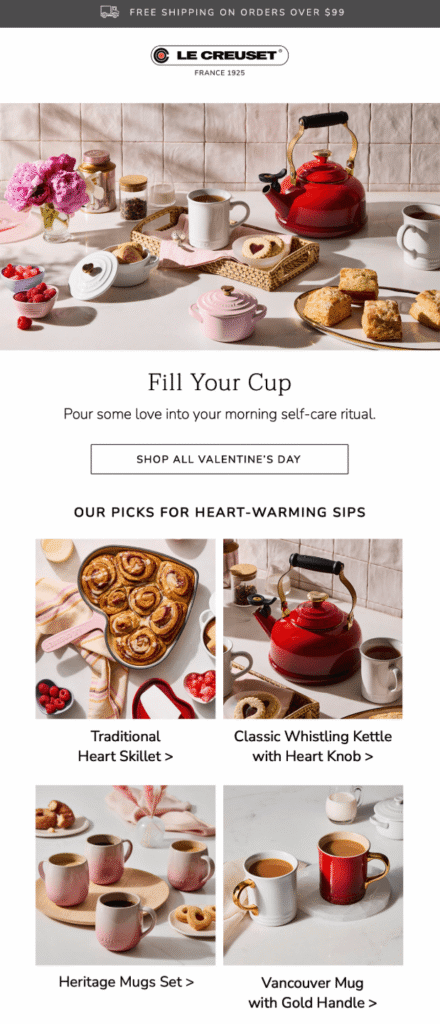
Take the cookware brand Le Creuset, for example. Instead of shouting about a 10% discount, their seasonal campaigns use soft, brief copy and imagery that sells an experience. Now that’s not a sales pitch, but an invitation to a better morning.
Subject line: Pour Some Love Into Your Mornings
How the Lipstick Effect Should Shape Your Email Offers
The lipstick effect isn’t just for beauty brands, but a mindset that applies to various types of products. The goal is to identify how your offering provides that “affordable luxury” feeling and ensure your email reflects it.
Start by reframing your offers. Instead of common phrases like “Save 20%,” try something like “You’ve earned this.” This simple affirmation can be the secret to higher open rates and conversions, provided the offer actually feels like a reward.
Instead of focusing on the price tag, focus on the emotional value. Position your products as “small wins,” “stress relievers,” “productivity boosters,” or “confidence gains.” When you frame a purchase as a tool for well-being rather than just another expense, the “need” for a discount starts to disappear.
This strategy works just as well for digital services as it does for physical goods. If you’re in SaaS, don’t just sell “tools.” Promote your premium features as a way to reclaim time and reduce daily friction. If you’re a blogger, share early access to your new ebook as an exclusive treat. It’s all about finding the right perspective and communicating it with a focus on the user’s emotional state.
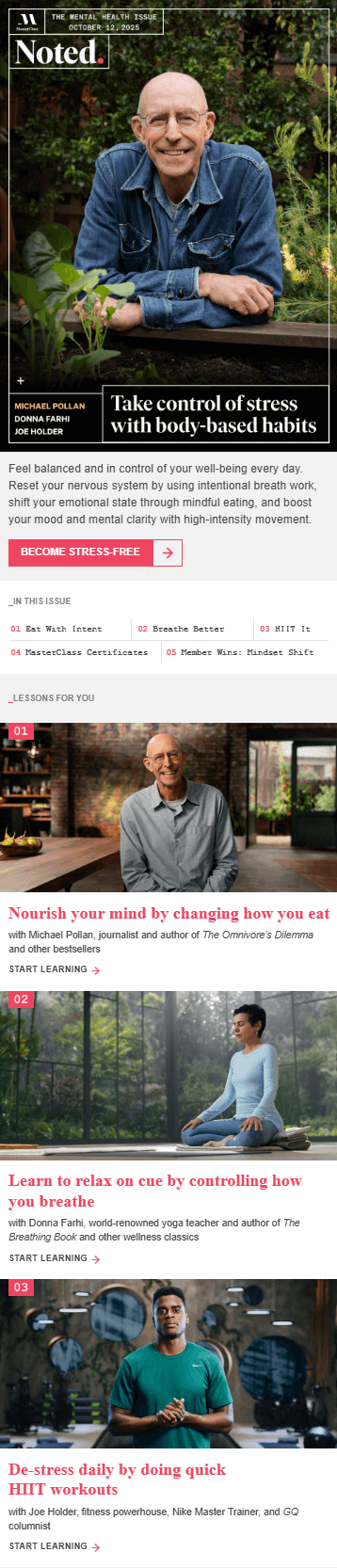
A perfect example of this comes from the learning platform MasterClass. Here, the subject line focuses on well-being and comfort. It’s inviting with a promising reward, and it offers the subscriber something precious.
Subject line: Outsmart stress—try habits that reset your mind
How to Apply the Lipstick Effect on Your Email Campaigns
Let’s take a look at some easy tactical steps you can follow to reframe your campaigns, starting with the most important email elements.
Email subject lines
Great first impressions happen the moment you hit the inbox, and with the right email subject line, you can trigger the “lipstick effect” before the email is even opened.
If urgency has always been an important part of your strategy, try pivoting to see how your audience responds. Instead of price-hooked subject lines, choose variations driven by emotion. Curiosity, comfort, and self-reward are powerful cues that, when delivered in balance, feel like a breath of fresh air compared to a countdown timer.
Take a look at how these notable brands use the “lipstick effect” to spark interest:
- Do your lunches need an upgrade?
- How hot do you like it?
- A little love for your skin 🤍✨
- Love the way you rest
- Sunday self-care club 🛁🫧
- Your lips need winter relief ❄️
- A home refresh would heal us, tbh
If you aren’t sure this tactic fits your brand, use A/B testing to compare an “emotional” subject line with a traditional “urgent” one. This tactic identifies the high-performing variant using a small segment of your list, then automatically sends it to the rest of your subscribers.
You can also use an AI writer to help you experiment with different tones and wordplay to find that perfect balance of comfort and curiosity.
Email copy
The same mindset should continue through to your copywriting, by opting for language that puts emotions first. Emphasize the experience someone will have when they indulge in your offering and the outcome of that experience.
For example, if you’re promoting a premium lipstick, don’t just talk about the price. Highlight its unique ingredients or how long-lasting the finish is. Then, back it up with social proof. Customer testimonials confirming the product feels as good as it looks can make a massive difference in converting a reluctant subscriber.
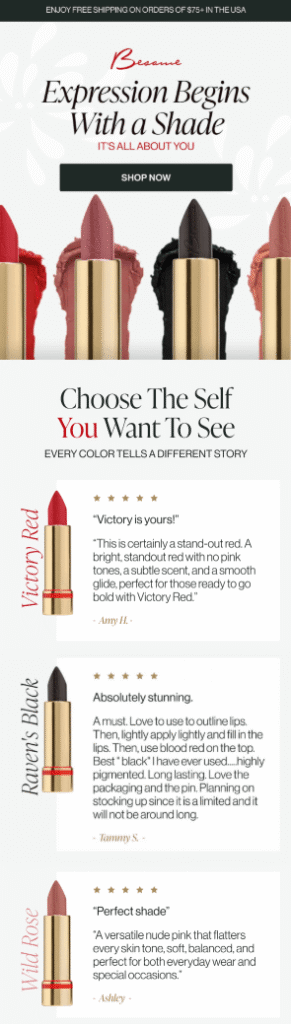
Check out this brilliant example from Bésame Cosmetics. They invite customers to choose a lipstick that best describes their own identity, placing reviews right next to each product to validate the results.
Subject line: Which Story Will You Wear Today? 💄
Overall, by removing the pressure to “move fast,” you replace anxiety with subtle reassurance. This motivates the customer to choose your brand because they want to, not because they’re afraid they’ll miss a deal.
Call-to-action
“Buy Now” CTA buttons are everywhere, so if you want to stand out, you need to offer a different pathway. An aggressive invitation rarely convinces a hesitant shopper. Instead, you need to give them a rewarding reason to move forward.
Think back to the Bésame Cosmetics example. Instead of the standard “Shop Now,” they invite the reader to “Explore Your Identity.” The first feels like a transaction, and the second feels like a journey of self-discovery. Depending on your goals, you might try phrases that emphasize growth and ease, such as “Unlock your potential,” “Simplify your workflow,” or “See how it works for you.”
This philosophy even applies to your design choices, specifically your button colors. Unless it’s a core part of your brand palette, try to avoid red. It’s the color of “stop” and “warning,” which can trigger the stress response we’re trying to avoid.
Instead, opt for a softer alternative that stands out against your background while staying on-brand. By making the button feel like an inviting “entry” rather than a “demand,” you prompt them to click.
Email design
To visually trigger the lipstick effect, replace clutter with vibrance. High-pressure emails often use bold colors, large fonts, and countdown timers to grab attention. But if you want to offer an emotional reward, you should opt for inspirational aesthetics instead.
Here are a few design tweaks that will make your emails look like a treat:
- Swap products shot against dull backgrounds for lifestyle images that resemble moments of peace and joy.
- Add enough white space to give your content room to breathe and establish a sense of calm authority in a crowded inbox.
- Try incorporating premium-looking colors like deep forest greens, soft creams, or muted metallics.
- Use elegant, readable fonts that feel editorial to make your email look like a page from a high-end magazine.
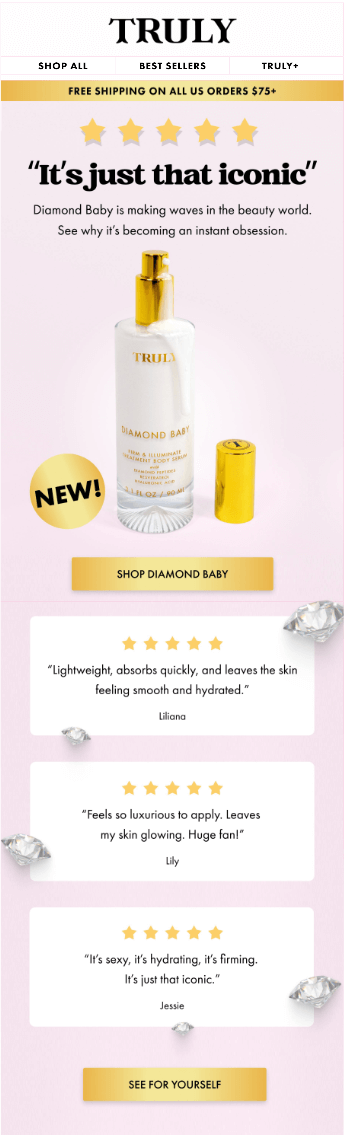
By following these tips, the concept applies across the entire email experience, not just the “words.” Just like in this example from Truly:
Subject line: “It’s just that iconic” 🤩
When Promotions Still Matter (And How to Blend Both)
Of course, the lipstick effect doesn’t define every consumer spending habit. There are times, like major holidays or seasonal events, when urgency remains a powerful tool to boost your sales. But you don’t have to choose between being a “premium brand” and a “profitable” one. You can combine both tactics to maximize interest rates without hurting your brand.
For instance, instead of labeling your promotion as a “deal” or a “discount,” try using the word “treat.” It’s a subtle shift, but it has a much larger emotional impact. It allows you to offer a price break without “cheapening” your products or coming across as a bargain brand.
You can also plan limited-time offers that feel curated rather than desperate. Instead of year-round discounting, save your sales for peak holiday seasons or important milestones in the customer journey. By diving into your data, you can identify which sales periods actually convert and stick to those, without hurting your bottom line.
Imagine a boutique fragrance brand that avoids discounting to protect its high-end image. Instead of a generic “Winter Clearance” with 30% off banners, they launch a “Winter Glow Treat.” They use their data to identify the exact 48-hour window when their audience is most active and offer an exclusive bundle in a limited-edition gift box.
Stop Choosing, Start Balancing
Long story short: it’s not about choosing between promotions and pleasure, but knowing when to lead with each, and when to blend them. Prioritizing both ensures you aren’t just hitting monthly targets, but actually securing your company’s future in a competitive landscape.
So remember, especially in tough times, emails that feel human will always outperform those that feel transactional. Sometimes, the best way to grow your business is simply to lead with emotion.
Similar Posts
 Published by
Create, send and optimize your email marketing campaigns