















8 Market Research Best Practices to Boost Your Email Marketing
Published By Britney Steele
February 26, 2026

26/02/26
While it’s tempting to want to show up in your audience’s inboxes every day, prioritizing sending tons of emails over conducting market research isn’t the healthiest marketing approach.
Strong email marketing starts before you hit send. Market research helps you uncover real audience insights, track changing demands, and shape campaigns that actually convert.
In this guide, we’ll walk through the most effective market research best practices for email marketing and show you why understanding your audience matters more than increasing send volume.
What is Market Research?
Market research is the process of gathering and analyzing information about your audience, competitors, and industry to make informed decisions.
In email marketing, it helps you understand who your subscribers are, what they care about, and how they behave, so you can send relevant messages that drive engagement and conversions.
Why Conduct Market Research Before an Email Campaign
Fast-growing companies invest heavily in research and development (R&D) from the start, and that mindset goes beyond product development. Marketing needs it just as much.
In fact, 80% of companies that use market segmentation report increased sales. Across industries, the majority rely on research to guide their strategy: 77% of B2B, 82% of B2C, and 83% of B2B2C businesses use it to shape marketing decisions.
Before you launch your next email, here’s why market research should come first.
Helps you uncover gaps in the market
Too busy sending emails? Then you might miss opportunities to fill gaps in the market.
But if you conduct market research, you can spot insights that reflect crucial gaps in the market, so you can swoop in and fill them.
For instance, after conducting research, you might feel inspired to innovate your product to serve an unmet customer need. Or, you may notice your target audience’s messaging preferences are shifting, and their brand loyalty is following suit.
Let’s say you run a SaaS content marketing agency, and for a while, SaaS brands preferred content centered around snarky product comparison lists and high-performing keywords. However, after conducting research, you may discover that SaaS brands now prefer objective knowledge base articles and thought leadership blog content.
Had you not taken the time to perform updated research, you may have missed out on serving new SaaS clients that are on the hunt for agencies that specialize in these two types of content assets.
Reveals insights into your target market’s needs, preferences, and pain points
Market research provides important insights into your target market that aren’t available elsewhere.
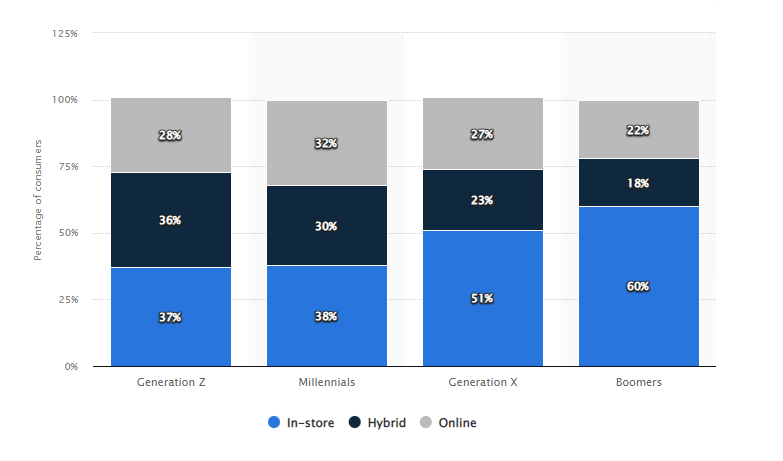
Sending too many emails without taking the time to keep up with consumer demands (which are always changing) can hinder you from understanding your target market’s most current needs, preferences, and pain points.
But do you know what happens when you’re up to date on these details?
You can craft email campaigns that are hyper-tailored to your target audience’s needs and preferences. This leads to better engagement and, ultimately, more conversions.
Lets you in on warnings and important industry updates
Putting minimal effort into market research is like watching the news once a month; you’ll miss crucial warnings and updates.
Whether it’s learning about a supply chain crisis that can directly affect your organization or discovering viral marketing trends, research is pivotal to staying ahead of the game.
For instance, if you’re a career coach, you might learn that jobs in Houston are drastically increasing. This is important to know so you can update your job-search clients and supply them with appropriate resources.
Or, if you’re in the fashion industry, you might learn that analysts are projecting a relatively slow sales growth next year.
Whatever the case, market research can help clarify key issues, enabling you to design contingency plans and proactive solutions as needed.
Helps you discover the latest buying and marketing trends
From discovering viral TikTok videos and Reels ideas to learning that Gen Zers are increasing how much they spend on digital experiences, market research lets you in on the latest buying and marketing trends.
While your business should never get in the habit of constantly following others, staying educated on buying and marketing trends can help you make sure you’re:
- Not missing out on golden marketing opportunities that can help you widen your reach.
- Updating and adjusting your products and services to match your audience’s needs.
- Structuring your prices and packages appropriately.
- Planning your promo windows in line with the latest industry best practices.
Provides a strong ROI
According to statistics, 95% of businesses have seen a positive return on investment (ROI) from their market research efforts. Even more impressive, 86% of companies report an ROI of more than 4x their original market research investment.
This means that for every dollar spent on understanding their market and customers, businesses are earning back four dollars or more.
Market research yields such strong returns because it helps you avoid costly missteps, such as targeting the wrong audience, launching ineffective campaigns, or investing in products and services that don’t generate interest.
This means your messages are hitting the right inboxes with the right offers at the right time. And this dramatically increases the chances of opens, clicks, and conversions.
Market Research Best Practices to Boost Your Email Marketing
Now that we’ve got the importance of market research over email marketing out of the way, let’s talk about the best strategies for executing said research.
1. Understand your target audience
Every campaign starts with the people you want to reach. Skip that step, and you risk writing emails that resonate with no one. Audience research helps you define who belongs on your list and how to communicate with them clearly.
One of the biggest mistakes is sending the same message to everyone. For example, are you promoting a premium skincare serum to your entire list, or only to subscribers who have shown interest in beauty products or anti-aging content?
Market research helps you uncover these patterns and segment your audience accordingly, so your emails feel relevant instead of random.
Tip: Create audience personas based on age, behavior, product interest, and past email engagement. Use your CRM software to tag and segment these groups.
2. Analyze recent customer data
If you’re already collecting data, you should be using it. Your customer behavior provides clear direction on which messaging will matter to them. Insights into financial behavior can also inform more relevant campaigns.
For example, credit score monitoring data highlights audience financial readiness, which can influence segmentation and personalized messaging for finance-related email campaigns. Using such data must be done ethically and in compliance with privacy regulations (such as GDPR, CCPA, and FCRA in the U.S.), especially when handling sensitive financial data.
Analyze purchase patterns, email open, click data, and time since last engagement. Break down your list by lifecycle stage (e.g., new lead, active buyer, lapsed customer) and send emails tailored to each stage.
3. Research your competitors
Competitor research shows you what your audience is already seeing. It reveals how others in your space are communicating, what gaps they’ve left, and where you can stand out.
Look closely at their emails. Review their tone, offers, structure, and frequency. Find out what’s missing or inconsistent, and use those insights to sharpen your own approach.
A good tactic is to sign up for competitor email lists. Track their subject lines, frequency, and tone. Use a spreadsheet to log their offers and timing. Compare their strategy with your own and identify any gaps or overused messaging in your industry.
Let’s look at an example. Say, your competitor is a wellness brand like The Fullest. They sell saffron-based products, and this email leans into the season:

What works:
- Starts with a warm, lifestyle-driven headline (“A Golden Summer Starts Here”)
- Follows with product education that’s easy to scan (“5 Reasons…”)
- Uses calming visuals and testimonials to reinforce mood and energy benefits
- Ends with bundles and flexible payment options
This gives you a clear read on how they’re framing their products, the emotions they’re appealing to, and the way they’re guiding the reader through the page.
By looking at a few competitor emails like this side by side, you’ll start to see common overused tactics, gaps in their messaging, and ways your brand can bring something new to the table.
In this case, you might notice that The Fullest emphasizes lifestyle and education with soothing visuals. However, they don’t highlight user-generated content or interactive elements in their emails. This gives your brand an opportunity to engage customers more personally and build a stronger sense of community.
4. Gather market insights
Market research shows you what your customers aren’t saying directly. This includes industry trends, shifts in buyer behavior, and unmet needs across your audience segments.
Take CoSchedule’s recent marketing industry survey email as an example:
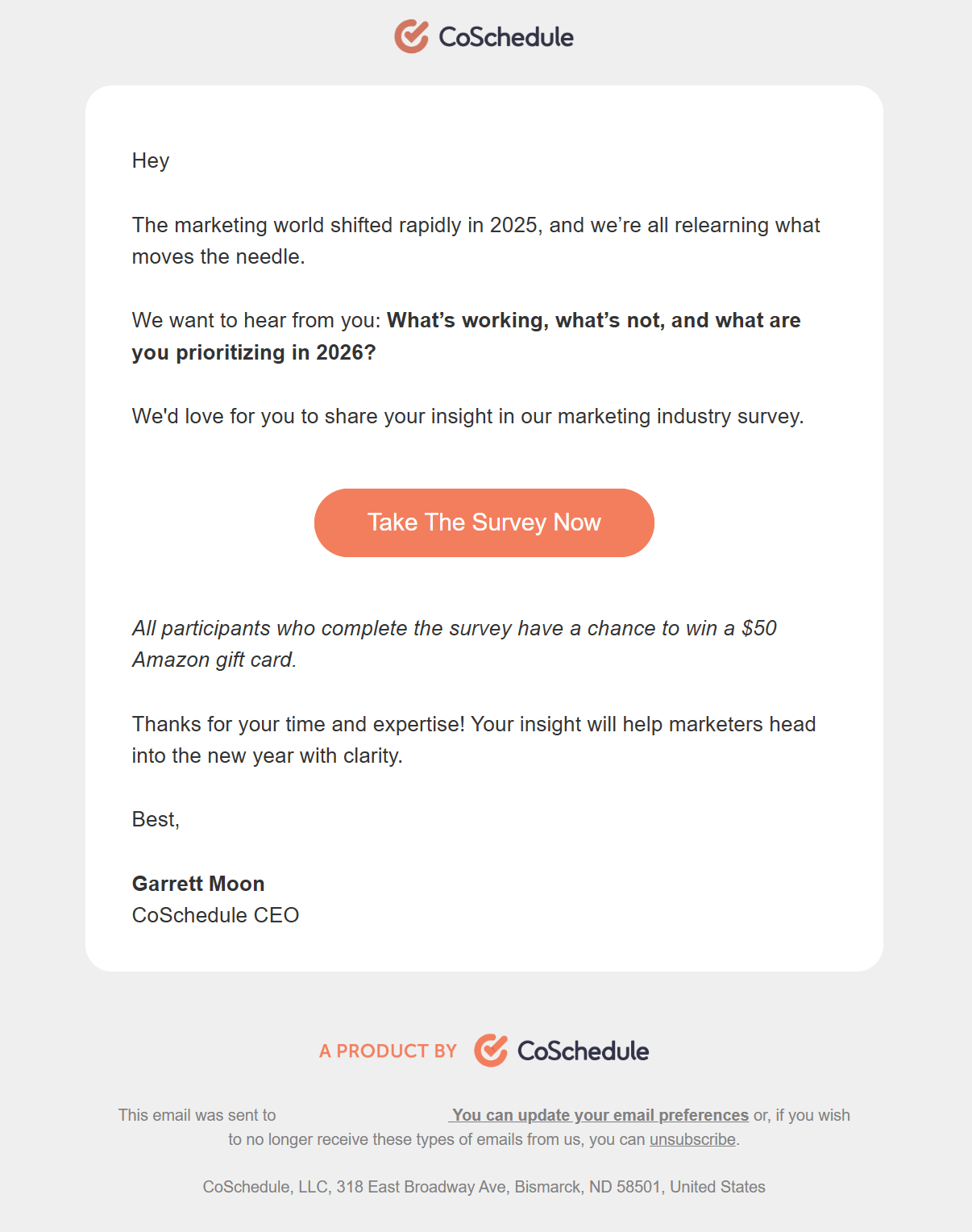
Instead of guessing what marketers care about in 2026, they directly ask their audience what’s working, what’s not, and what they’re prioritizing next year. That’s market research in action. They gather insights straight from their subscribers and use them to shape future content, features, and messaging.
This approach improves outreach efficiency and builds trust by demonstrating that you understand specific needs rather than pushing a broad message to everyone.
Tip: Subscribe to industry newsletters, review analyst reports, or run a short survey as CoSchedule did. Ask about content preferences, communication frequency, and evolving priorities to keep your email strategy aligned with real audience expectations.
5. Use social listening tools
If your audience is talking about your brand or category online, you should be listening. Social platforms, forums, and reviews offer immediate insight into what people care about and how they describe their needs.
These insights can inform email content that feels timely, familiar, and relevant to what your audience is already thinking about.
Here, you can use tools like Mention, Brand24, or Sprout Social to monitor keywords related to your brand, product category, and competitors. Track common questions, complaints, and suggestions. Use that language in your subject lines and email copy.
6. Test and experiment
Testing is how you turn research into results. When you experiment with different elements of your emails, you learn what your audience responds to instead of assuming.
Start with small changes. Try different subject lines, formats, and offers across segments. Use the data to make confident decisions about how to improve your performance.
Test one variable at a time (e.g., subject lines, CTA placement, header image). Run A/B tests with a statistically significant sample size. Lastly, use your email platform’s reporting tools to analyze performance and apply what works in future sends.
7. Integrate market research into email design
Design plays a role in how your message is received. Your research should guide choices around structure, language, tone, and content hierarchy.
Using an online grammar checker like Grammarly or Wordvice can help clean up your writing and make your emails sound more polished. But that’s only part of the equation.
If you’re sending emails without really understanding who your audience is, even perfect grammar won’t save your outreach. Instead of blasting inboxes, take time to understand who you’re talking to and what they care about.
Match your design to your target audience’s preferences. For example, if you’re emailing busy professionals, use concise copy, mobile-optimized layouts, and clear CTA buttons. If your audience prefers storytelling, lead with imagery and longer-form narratives.
8. Measure the impact of market research
Before launching a new research-informed campaign, benchmark your current metrics like open rate, click-through rate, conversion rate, unsubscribe rate, and revenue per email. Then, compare post-campaign data to track changes. Look at both overall performance and how individual segments responded.
If you’re segmenting by behavior or preferences, analyze which groups are most engaged. Are certain product-focused emails performing better with repeat buyers? Are informational emails getting more clicks from new leads?
Add optional feedback links or quick polls in your emails to collect qualitative responses. Even a one-question prompt like “Was this email helpful?” can reveal valuable trends.
Research should lead to measurable improvement. If it doesn’t, refine the process. Look for any weak points. For example, poor results often stem from a mismatch in targeting, tone, or timing. From there, examine your targeting, messaging, and timing to find where the disconnect happened. Then, adjust.
Market Research for Better Email Campaigns
Market research may feel time-consuming, but it’s what turns random campaigns into strategic ones. It helps you replace assumptions with clarity, sharpen your targeting, and send messages that actually resonate.
When you understand your audience, every email has a purpose, your offers feel relevant, your timing makes sense, and your conversions increase.
Yes, research takes effort. But so does recovering from campaigns that miss the mark.
Once you have the insights, tools like Moosend help you act on them with smart segmentation, automation, and data-driven optimization. You can try it for free and see how easy it is to turn your research into emails that connect and convert.
FAQs
Here’s some additional information on market research for email marketing.
1. How often should you conduct market research for email marketing?
Market research should be an ongoing process. At a minimum, review audience data and performance metrics quarterly. However, industries that change quickly may require monthly check-ins. Continuous research helps you adapt to shifts in customer behavior, preferences, and market conditions before your campaigns lose relevance.
2. What tools can help with market research for email marketing?
You can use various tools, including CRM platforms, email analytics dashboards, customer surveys, social listening tools, and industry reports. Website analytics and heatmaps also reveal how users interact with your content. Combining quantitative data with direct customer feedback gives you a clearer picture of what to improve in your email campaigns.
3. What happens if you skip market research in email marketing?
Skipping market research increases the risk of targeting the wrong audience, sending irrelevant content, and lowering engagement rates. Over time, this can lead to higher unsubscribe rates, poor deliverability, and reduced ROI. Without research, your email strategy becomes reactive instead of data-driven, making consistent growth harder to achieve.
Similar Posts

 Published by

 Published by


Create, send and optimize your email marketing campaigns